Tesla Cybercab Accelerates Expansion: Gold Two-Seat Robotaxi to Launch in More U.S. Cities This Year

Tesla accelerates Cybercab expansion across cities while staying silent on paid ride data, with commercialization still unproven.
Tesla plans to roll out its gold two-seat Cybercab robotaxi to more U.S. cities this year but has not disclosed deployment scale, city list, or paid ride volume. This "high-profile expansion, low-profile data" posture preserves market imagination while avoiding doubts from unconvincing early data. The two-seat design balances cost and efficiency but may limit high-value scenarios. Expansion is constrained by city-by-city regulatory approvals and competition from Waymo. Tesla's vertical integration and FSD data flywheel are strengths, but operational experience and localized services remain weaknesses, and real progress requires verifiable metrics.
Tesla is pressing the accelerator on its robotaxi business. According to the latest reports, the company plans to roll out its gold two-seat Cybercab robotaxi to more U.S. cities this year, but it remains silent on the number of paid rides. This posture of "high-profile expansion, low-profile data" reflects Tesla's ambition and caution coexisting on the autonomous driving commercialization track.
From Concept to Street: Cybercab's City Expansion Route
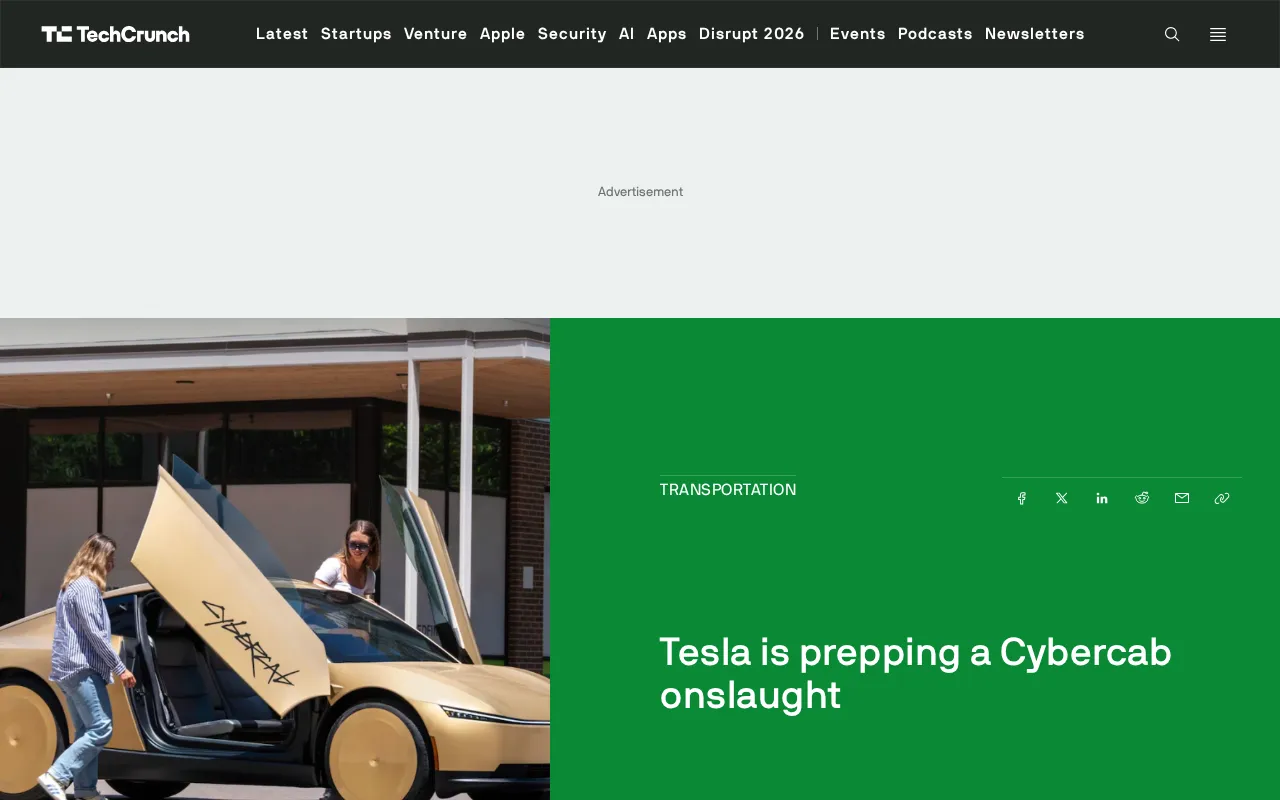
The Cybercab is a two-seat vehicle designed by Tesla specifically for the robotaxi use case, with no steering wheel or pedals, finished in gold, and positioned as a low-cost, high-turnover mobility tool. The vehicle had previously been piloted in some cities, and the latest reports indicate that Tesla is preparing to expand this service to more U.S. cities.
Unlike traditional ride-hailing platforms, Tesla has chosen to advance its robotaxi business by building its own fleet and operating the service itself. The advantage of this asset-heavy model is complete control over service quality and the data loop, but the disadvantage is equally obvious—expansion speed is constrained by vehicle production capacity, regulatory approvals, and localized operational capabilities.
According to source information, Tesla's expansion plan this year covers multiple U.S. cities, but it has not disclosed the specific deployment scale or the list of cities. This vague wording both preserves market imagination and avoids the fulfillment pressure that comes with premature commitments.
Robotaxi (autonomous taxi) refers to paid passenger services provided by L4/L5 autonomous driving systems in specific areas without a human safety driver present. Its commercialization typically goes through three stages: road testing permits, driverless testing, and commercial operation licenses. Unlike assisted driving, the robotaxi operator bears legal responsibility for trip safety, so regulators in various jurisdictions generally require companies to submit materials such as operating areas, remote monitoring plans, and accident response mechanisms. Tesla's choice to build its own fleet rather than connect to third-party platforms means it simultaneously plays the roles of manufacturer, operator, and data controller. This vertical integration has potential for cost control, but it also makes its expansion speed directly subject to vehicle production capacity and city-by-city approval progress.
Why Paid Ride Data Has Become a "Secret That Can't Be Told"
More intriguing than the expansion plan is Tesla's continued silence on the number of paid Cybercab rides. In the autonomous driving industry, paid ride volume is one of the core indicators for measuring commercialization progress, and competitors such as Waymo regularly disclose such data. Tesla's unusual silence may stem from several considerations.
First, early operational data may not yet be convincing. In the initial phase of pilot programs in new cities, the number of vehicles is limited and the operating area is restricted, so public data could instead invite outside doubts about commercialization progress. Second, Tesla has always been adept at managing market expectations with vision rather than short-term data; the long-term narrative of the Cybercab is more valuable than monthly orders.
This information strategy has two sides. For investors, the lack of verifiable operational data increases valuation difficulty; for industry observers, it means it is hard to objectively assess the true maturity of Tesla's robotaxi business.
Waymo is an autonomous driving company under Alphabet and currently the largest operator of commercial robotaxi services in the United States. It already provides paid passenger services without safety drivers in cities such as Phoenix, San Francisco, and Los Angeles, and regularly publishes weekly order volumes, operating areas, and mileage data. Waymo uses a multi-sensor fusion approach (LiDAR + cameras + millimeter-wave radar). The reason its operational data is valuable for reference is that it discloses both order scale and safety records, allowing outsiders to cross-validate commercialization maturity. If Tesla does not disclose comparable data for a long time, the market will find it difficult to measure its progress on the same scale as Waymo's, which is one reason analysts are calling for greater operational transparency.
The Business Logic and Controversy of the Two-Seat Design
The Cybercab sticks with a two-seat layout, which is not the mainstream choice in the robotaxi industry. Most competitors' autonomous taxis use four-seat or larger space designs to cover family travel and multi-passenger ride-sharing scenarios. Tesla's two-seat solution has clearly been through a trade-off between cost and efficiency.
From an operational perspective, a two-seat vehicle has a smaller body and lower manufacturing cost, making it suitable for short-distance, high-frequency urban travel. Tesla's logic may be: most robotaxi orders are for one or two passengers, so reducing seats can lower per-vehicle cost and improve turnover efficiency. But whether this assumption holds depends on verification of the real order structure.
The controversy is that the two-seat design may limit the coverage of service scenarios. High-frequency, high-value scenarios such as airport transfers and family travel often require more space, and the two-seat Cybercab may only be able to enter a niche market for urban commuting. Whether Tesla will launch a multi-seat version later remains unclear.
The Dual Test of Regulation and Competition
The pace of Tesla's Cybercab expansion depends largely on each state's regulatory attitude toward commercial autonomous driving operations. U.S. states differ significantly in their rules for autonomous driving road testing and commercialization permits, and Tesla needs to complete the approval process one by one in each target city.
That said, competition in the robotaxi track is heating up. Waymo has achieved large-scale commercial operations in multiple cities and continues to expand its service areas; traditional ride-hailing platforms are also laying out autonomous driving partnerships. Tesla's advantages lie in its vertical integration capability and brand effect, but it also has a first-mover disadvantage—it is still a catch-up player in operational experience and localized services.
It is worth noting that Tesla's expansion news echoes the pace of previous FSD (Full Self-Driving) software iterations. Improvements in software capability are a prerequisite for robotaxi scale-up, and the data generated by fleet operations can in turn feed model training, creating a flywheel effect. Whether this cycle can truly start turning will determine the real value of the Cybercab expansion plan.
FSD (Full Self-Driving) is Tesla's advanced driver-assistance software suite. It is currently delivered to owners in the United States in a supervised form (requiring the driver to take over at any time) and is not truly driverless. The key premise of Tesla's robotaxi narrative is that FSD capability evolves from supervised assisted driving to a driverless operation level that allows hands-off and eyes-off driving. Its technical route relies on a pure vision approach and end-to-end neural networks, continuously training models through massive driving data collected by the fleet. This "data flywheel" logic—more vehicles, more data, stronger models, better experience—is the core selling point that distinguishes Tesla from Waymo's multi-sensor route, but whether it can reach the safety threshold for driverless operations remains the focus of regulatory approval and market skepticism.
Implications for the Industry
Tesla's Cybercab city expansion marks the robotaxi competition moving from the technology validation stage to the operational scale contest stage. Whoever can complete fleet deployment at lower cost and higher efficiency will be able to seize the initiative in the next stage of competition.
But Tesla's reticence about paid ride data also reminds the market to remain rational. The real progress of autonomous driving commercialization must ultimately be judged by verifiable operational metrics, not by the vision painted at launch events. For observers following this track, the city rollout situation and regulatory approval progress in the coming quarters will be more informative than any slogan.
One-line Summary
Tesla accelerates Cybercab expansion across multiple cities while staying silent on paid ride data, leaving the true extent of commercialization to be verified.
Paragraph Summary
Tesla plans to roll out its gold two-seat Cybercab robotaxi to more U.S. cities this year but has not disclosed the specific deployment scale, city list, or number of paid rides. The article analyzes that this "high-profile expansion, low-profile data" posture both preserves market imagination and avoids doubts raised by unconvincing early operational data. The two-seat design is a trade-off between cost and efficiency but may limit high-value scenarios such as airport transfers and family travel. The pace of expansion is also constrained by city-by-city approval of commercial autonomous driving operations in each state and faces competitive pressure from first movers such as Waymo. Tesla's vertical integration capability and FSD data flywheel are advantages, but operational experience and localized services remain weaknesses, and real progress must be judged by verifiable metrics.
Related articles

Mistral Large 4 Open-Sources a Trillion Parameters, Microsoft Offers Voluntary Severance to 60,000 Employees
Mistral Large 4 open-sources a trillion-parameter multimodal model with a coding agent score of 48; SanDisk earnings show AI inference reshaping NAND demand; Google Gemini adds in-app file editing, OpenAI raises Codex quotas, and Microsoft offers voluntary severance to 60,000 employees.
Mistral Large 4 Opens Its Weights: AI Morning Brief Roundup of Models and Ecosystem Trends
Mistral Large 4 opens its weights, a 1-trillion-parameter MoE architecture that can run locally on MacStudio; Meta's test-generation technology enters production; top tax benchmark pass rate only 10.8%; Canadian government takes a stake in Cohere; Doubao Work opens third-party model calls. This AI Morning Brief rounds up model, ecosystem, capital, and policy developments.

Mistral Large 4 Goes Open Source: A 1T-Parameter European Qwen Challenging DeepSeek
Mistral Large 4 is now open source: 1T total parameters, 52B activated, focused on coding and cybersecurity, with ~610G NVFP4 weights. We analyze its comparison with DeepSeek V4 Flash, API pricing, demo realism, and local deployment value.