Tesla Roadster Takes Flight, Drives Upside Down, and Hits 0-60 in Under a Second

Tesla publicly demonstrated its next-gen Roadster with a flight hop, upside-down driving, and sub-one-second 0-60, but production remains distant.
Tesla publicly unveiled its next-generation Roadster prototype for the first time in Waco, Texas, performing three demonstrations: a sub-one-second 0-60 sprint, upside-down driving, and a short-distance flight hop. The core bottleneck for sub-one-second acceleration lies in tire grip and aerodynamic downforce rather than motor power alone; upside-down driving validated the body structure's rigidity and chassis system reliability under extreme orientations; and the flight demo confirmed the existence of SpaceX cold gas thrusters, though it is closer to a short hop than sustained flight. The article notes that the Roadster has been delayed multiple times since its 2017 concept debut, a significant gap remains between demo and production, and regulatory hurdles for flight and upside-down features may be greater than the technical ones. This demonstration at least proves Tesla is still advancing the car's development.
Tesla publicly unveiled its next-generation Roadster prototype for the first time at an event in Waco, Texas. The all-electric supercar performed three visually striking demonstrations on the spot: a short-distance flight, driving upside down, and a 0-60 mph sprint in under one second. The "flying car" concept Elon Musk promised years ago has, at least in part, become reality.
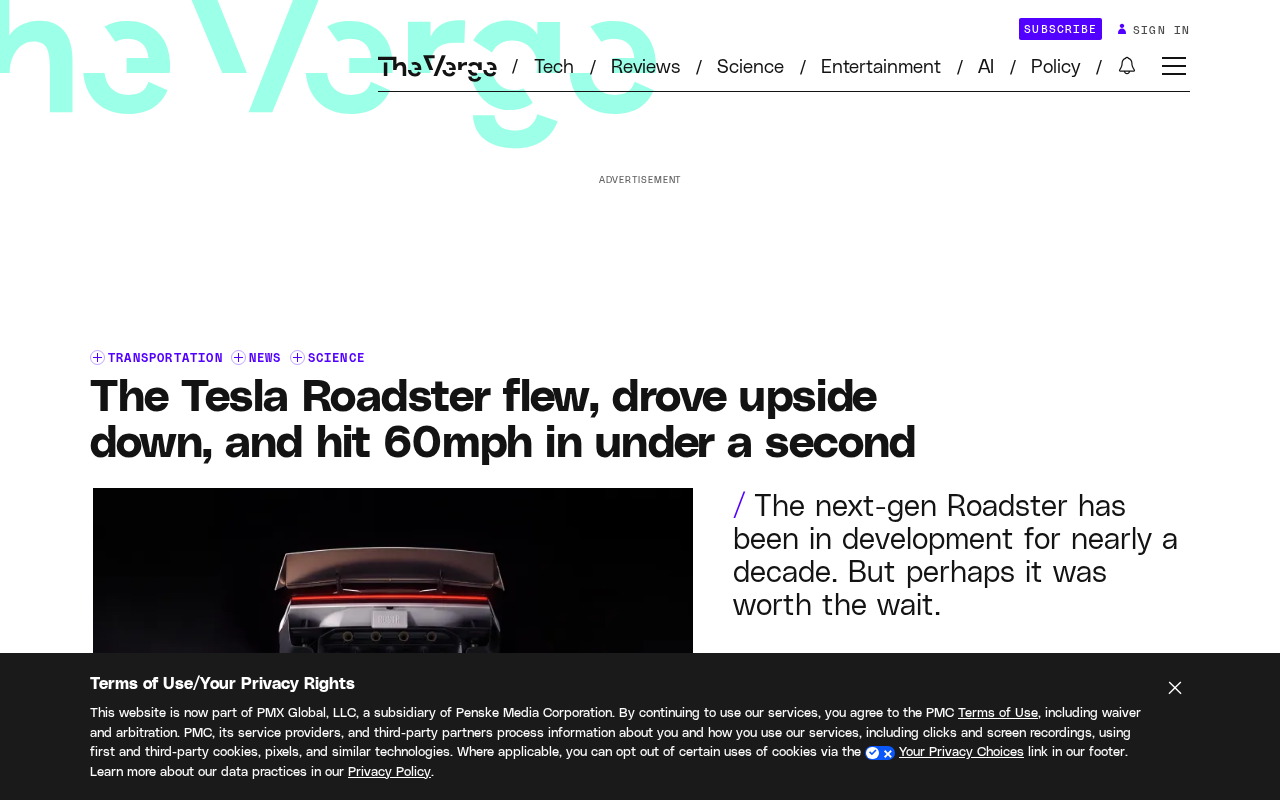
Three Demonstrations, Each Defying Physical Intuition
0-60 in Under a Second: What Does It Actually Mean
Today's production EV acceleration benchmark sits around 2 seconds, and hitting 1.9 seconds already places a car among the top-tier performance machines. Roadster pushes that number below one second, and the engineering challenge behind it goes far beyond simply "cranking up motor power."
Tire grip is the core bottleneck. Even if the motors can deliver peak torque instantaneously, the coefficient of friction between tire and road has a physical ceiling. Achieving sub-one-second 0-60 requires extremely aggressive aerodynamic downforce design, specially formulated tires, and likely entirely new control strategies for suspension and torque distribution. If this figure can be replicated on a production car, it will redefine the performance ceiling for supercars.
The Physical Limits of Tire Grip
The maximum static friction between tire and road is determined by the product of the friction coefficient μ and the normal force N, i.e., F = μN. High-performance tires on ideal surfaces achieve μ values of roughly 1.0–1.3. To achieve sub-one-second 0-60, the vehicle needs average acceleration exceeding 1g (about 9.8 m/s²), meaning the normal force from the car's own weight alone is far from sufficient — aerodynamic downforce must press the car into the road. F1 cars generate downforce exceeding their own weight at high speeds, but their low-speed downforce is limited. So if the Roadster is to achieve sufficient grip from the moment of launch, it likely requires aggressive design in chassis layout, active rear wings, and ground effects.
Torque Vectoring and Motor Response
The advantage of EVs is that motors can deliver peak torque from zero RPM, but torque to all four wheels must be precisely distributed to avoid slipping. High-performance EVs typically use dual-motor or even tri-motor layouts, adjusting torque hundreds of times per second to approach the traction limit. This control strategy relies on high-precision wheel speed sensors and inertial measurement units, and its algorithmic complexity is no less demanding than increasing motor power itself.
Driving Upside Down: Not Acrobatics, but Engineering Validation
A car driving upside down sounds like a stunt, but it actually tests the vehicle's structural rigidity and chassis sealing under extreme orientations. In an inverted state, the forces acting on the vehicle are completely reversed from normal driving — the suspension system, battery pack mounting structure, and even the flow of fluids inside the car must withstand reverse gravity.
Tesla's choice to publicly demonstrate this capability is more about sending a signal: the Roadster's body structure and the integration of its powertrain, battery, and electronics are already capable of maintaining normal function under non-standard physical orientations.
Flight Demonstration: How Much of Musk's Promise Was Delivered
When Musk first mentioned the Roadster years ago, he hinted at a "SpaceX option package" featuring cold gas thrusters to enhance acceleration, braking, and handling. Though brief, this flight demonstration confirmed that the thruster concept is not pure marketing talk.
It's important to view this rationally: this "flight" is closer to a short hop or attitude adjustment, fundamentally different from the sustained flying car in the public imagination. It relies on high-pressure gas propulsion, not a sustained lift system. What form this feature will take in the actual delivery version remains unknown.
How SpaceX Cold Gas Thrusters Work
A so-called "cold gas thruster" is a propulsion device that doesn't rely on combustion: high-pressure gas (such as compressed air or nitrogen) is expelled at high speed through a nozzle, generating thrust according to Newton's third law. Its specific impulse is far lower than a rocket engine, but it is structurally simple, responds extremely quickly, and can precisely control pulse duration, making it suitable for attitude fine-tuning and short-duration acceleration assistance. SpaceX's Dragon spacecraft uses a similar cold gas propulsion system for on-orbit attitude control.
Regulatory and Safety Challenges
Using cold gas thrusters on road vehicles faces unique regulatory hurdles. High-pressure gas tanks are pressure vessels that must pass crash safety certification; thruster operation may produce noise, airflow impact, and even visual interference; and road certification for "non-standard propulsion devices" is virtually nonexistent in most countries. Additionally, the gas carried by thrusters is limited and consumed with each use, so the real-world experience may be far less effortless than the demonstration suggests.
How Far Is This Car from Production
The original report left a key hint at the end: "This car will likely bring some..." — the sentence unfinished, but given Tesla's consistent product cadence, the Roadster's final delivery timeline, price, and specific configuration remain full of variables.
Since the concept car's debut in 2017, the Roadster's launch has been repeatedly delayed. This demonstration did show substantial engineering progress, but the gap between a demo car and a production car has never been small in the auto industry. Features like flight and upside-down driving may face greater obstacles in regulatory certification than in the technology itself.
For those who follow the limits of EV performance, this demonstration at least proves one thing: Tesla is still advancing the development of this car rather than shelving it entirely. As for when consumers can actually buy a Roadster that can "fly," the answer remains unclear.
The "Engineering Gap" Between Concept and Production Cars
The auto industry commonly uses "concept cars" to showcase design directions and technological visions, but their engineering state is fundamentally different from production vehicles. Concept cars often don't meet crash regulations, durability, NVH (noise, vibration, and harshness), or cost control requirements. Going from concept to production typically requires redesigning the body structure, validating the supply chain, completing tens of thousands of hours of bench and road testing, and establishing an after-sales system. The Tesla Roadster has been delayed multiple times since its 2017 announcement, partly because the regulatory and engineering feasibility of these features has not been fully resolved.
The Lag in Regulatory Certification
Features like flight hops and upside-down driving have no corresponding classification in existing road traffic regulations. Even if the technology matures, the vehicle must pass type approval in its target market, including active safety, electromagnetic compatibility, pedestrian protection, and numerous other tests. New hardware such as thrusters and active suspension could trigger additional safety assessments, further lengthening the time to market.
One-line Summary
Tesla publicly demonstrated its next-gen Roadster with a flight hop, upside-down driving, and sub-one-second 0-60, but production remains distant.
Paragraph Summary
Tesla publicly unveiled its next-generation Roadster prototype for the first time in Waco, Texas, performing three demonstrations: a sub-one-second 0-60 sprint, upside-down driving, and a short-distance flight hop. The core bottleneck for sub-one-second acceleration lies in tire grip and aerodynamic downforce rather than motor power alone; upside-down driving validated the body structure's rigidity and chassis system reliability under extreme orientations; and the flight demo confirmed the existence of SpaceX cold gas thrusters, though it is closer to a short hop than sustained flight. The article notes that the Roadster has been delayed multiple times since its 2017 concept debut, a significant gap remains between demo and production, and regulatory hurdles for flight and upside-down features may be greater than the technical ones. This demonstration at least proves Tesla is still advancing the car's development.
Related articles

Amphibious Transforming Drone: Beyond 100x Power Savings, What Are the Real Needs?
Is the amphibious transforming drone just a gimmick? Starting from the 100x power difference of the M4 Morphobot, explore real application scenarios and thesis topic ideas, analyzing boundary conditions where pure drones and pure ground robots both fail.

Warhound Raises $200 Million: Genetically Engineered "War Dogs" Paired with Anduril Gear
Warhound raises $200M, backed by Ben Lamm and Palmer Luckey, to genetically engineer dogs for military and law enforcement use and equip them with Anduril gear. This article analyzes its technology direction, funding logic, and ethical controversy.

Claude API Comes to Google Cloud: IAM Integration and SDK Access Guide
Anthropic hosts the full Claude API on Google Cloud with IAM-controlled permissions and unified billing. This guide covers the Vertex AI and Anthropic-hosted entry points, IAM role configuration, and SDK access.