Tesla Unveils SpaceX-Powered Flying Roadster, Pushing the Limits of Physics

Tesla's second-gen Roadster with SpaceX cold gas thrusters leaps over its entire vehicle lineup, bringing aerospace tech to consumer sports cars.
Tesla unveiled its second-generation Roadster in Texas, applying SpaceX cold gas thruster technology to a consumer vehicle for the first time. In the demo, the car leaped over the Cybercab, Cybertruck, Tesla Semi, Model Y, and Model 3. The propulsion system works like spacecraft attitude thrusters, using high-pressure gas release for vertical thrust with millisecond response and fine adjustability, while landing posture is controlled by real-time software algorithms. Positioned as an extreme performance mode, it likely won't be used in everyday driving. The move blurs the line between ground vehicles and low-altitude aircraft, and poses new challenges to automotive safety regulations—NHTSA and EU certification systems don't cover airborne vehicle scenarios, potentially affecting delivery timelines.
Tesla officially pulled back the curtain on the long-rumored second-generation Roadster during a demonstration in Texas. Unlike any electric vehicle before it, this sports car is equipped with cold gas thruster technology from SpaceX, and at the demo it completed a leap into the air, soaring over a lineup of the company's own vehicles including the Cybercab, Cybertruck, Tesla Semi, Model Y, and Model 3.
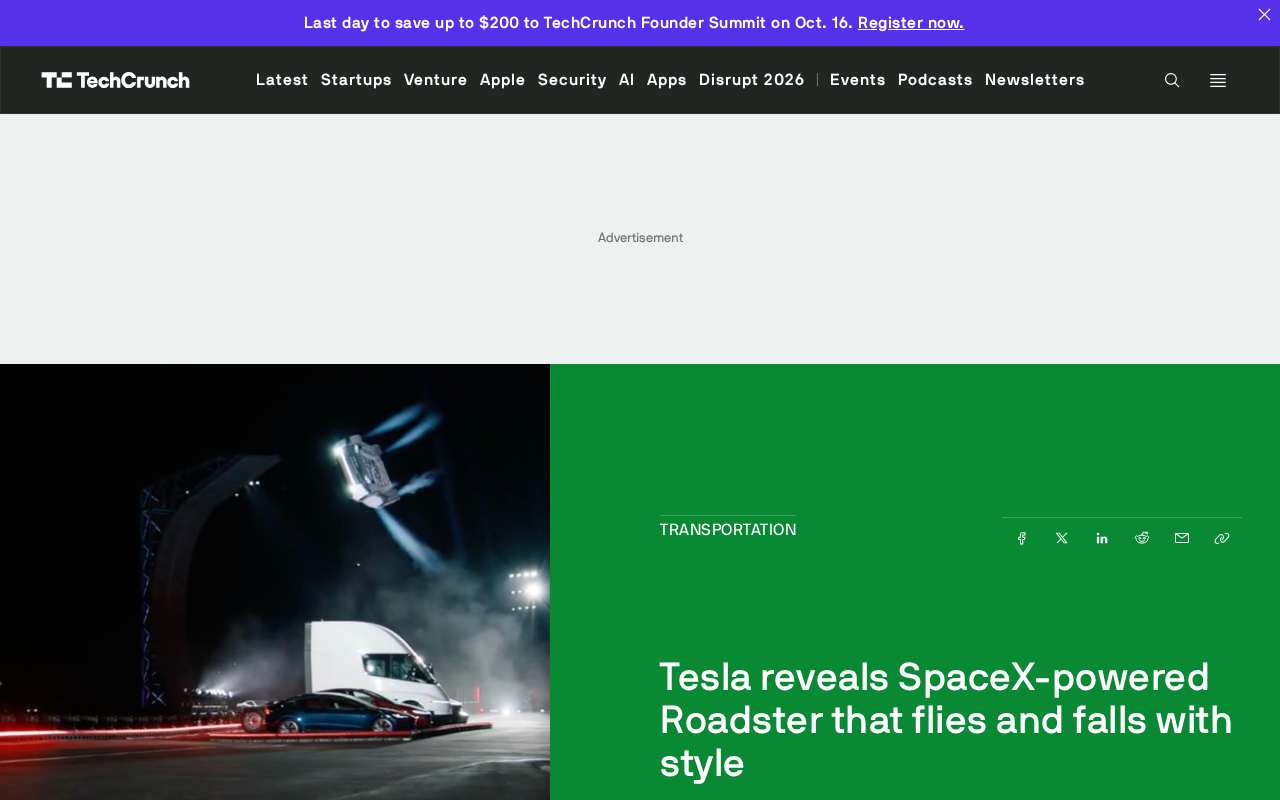
This demonstration was less a product launch than a technological manifesto. It marks the first time Tesla has injected aerospace engineering thinking into a consumer vehicle product at scale, and it pushes the EV industry's performance race into a dimension that previously existed only in science fiction.
When an EV Learns to "Jump"
From the demo footage, this Roadster didn't rely on traditional suspension systems or aerodynamic kits to achieve its leap. At its core is a cold gas propulsion system developed with SpaceX's help, similar in principle to the thrusters spacecraft use for attitude adjustment. By instantly releasing high-pressure gas to generate thrust, the vehicle can achieve vertical acceleration in an extremely short time, allowing it to leap over obstacles ahead.
The elegance of this design lies in its "controllability." Cold gas thrusters differ from rocket engines in that they don't rely on combustion reactions—they respond extremely quickly and their thrust can be finely adjusted. This means the vehicle's mid-air attitude adjustments and landing cushioning can all be intervened in real time through software algorithms. Based on the results, the Roadster in the demo not only successfully cleared multiple vehicle models but also maintained a relatively stable landing posture without losing control or flipping.
Tesla officially described the maneuver as "flies and falls with style," which highlights both the flying aspect and hints at the technical sophistication of the landing phase.
A cold gas thruster works by storing inert gases such as nitrogen or helium at high pressure in a container, then releasing them through solenoid-controlled nozzles, where the gas expansion generates reaction thrust. Its specific impulse (impulse per unit of propellant) is far lower than that of chemical rocket engines, but its advantages lie in simple structure, response times as short as milliseconds, and the ability to start and stop repeatedly and precisely—which is why it's widely used for satellite attitude control and spacecraft docking adjustments. When transplanted to a car, the thrust requirement jumps from the millinewton level of spacecraft to the kilonewton level needed to lift a nearly two-ton vehicle body, requiring gas storage pressure, nozzle flow rates, and structural strength to increase by several orders of magnitude, while the weight of the entire system must be controlled—otherwise it would severely erode the already tight range of an electric sports car.
Why SpaceX Technology?
Cold gas thrusters are nothing new in the aerospace field. SpaceX's Dragon spacecraft and Starlink satellites all rely on similar principles for orbital adjustments. Transplanting this technology to a car requires solving several key problems: propellant storage and replenishment, system miniaturization and weight reduction, and most fundamentally—safety redundancy design.
Considering the Roadster needs to be legally road-worthy, this propulsion system most likely won't be activated during normal driving. Its positioning is closer to an extreme performance mode, similar to a supercar's "track mode," but the experience dimension it brings is genuinely different.
From a brand synergy perspective, technology sharing between Musk's two companies has always been an open secret. SpaceX's materials science, propulsion technology, and thermal management expertise have previously been indirectly reflected in Tesla's battery cooling and body structure design. But this time it's an explicit technology branding—its symbolic significance far outweighs the engineering details themselves.
The core obstacle to adapting aerospace-grade technology for automotive use lies in the mismatch of certification standards. Spacecraft components follow NASA or ESA reliability specifications, which allow for single-mission customization and limited lifespans, whereas automotive components must pass AEC-Q series, ISO 26262 functional safety, and other standards, requiring million-unit production consistency and service life of over a decade. High-pressure gas storage systems also involve pressure vessel certification—compressed natural gas (CNG) cylinder standards for vehicles can serve as a reference, but their pressure ratings and cyclic charge-discharge requirements differ significantly from thruster tanks. Additionally, propellant refueling requires dedicated infrastructure—currently neither gas stations nor charging stations have cold gas replenishment capability, meaning that if the production Roadster retains this feature, Tesla would need to build its own refueling network, and its cost and coverage would directly affect the feature's practical usability.
Flying Over Competitors: A Carefully Designed Visual Narrative
The choice of objects to fly over in the demo was quite deliberate. The Cybercab represents the future form of autonomous ride-hailing, the Cybertruck is the most talked-about electric pickup, the Tesla Semi carries the vision of electrifying commercial transport, and the Model Y and Model 3 are today's sales pillars. Having the Roadster leap over all of them sends a clear message: this isn't just the flagship of Tesla's product line—it's the jewel in the technology crown.
However, this kind of performance-oriented demonstration also easily invites skepticism. Can a single successful jump represent the reliability of a production car? The maintenance costs of the propulsion system, the convenience of propellant replenishment, and its practicality in real-world driving scenarios are all unanswered questions.
Where Is the Boundary of Flying Cars
Strictly speaking, the Roadster hasn't achieved sustained flight. What it completed was a short-distance, low-altitude bouncing obstacle clearance. This is fundamentally different from a true flying car—such as an eVTOL (electric vertical takeoff and landing aircraft). But its emergence blurs the line between ground transportation and low-altitude aircraft.
On the regulatory front, vehicles with brief airborne capabilities will face entirely new certification challenges. Existing automotive safety regulations completely fail to cover the scenario of "a vehicle leaping and then landing." The National Highway Traffic Safety Administration's (NHTSA) crash test standards and the EU's whole-vehicle type approval both need supplementary provisions for such features. This could delay the Roadster's delivery timeline in some markets.
From a broader perspective, Tesla is also testing public acceptance of a "new form of automobile." When a car can jump over another car, traditional traffic rules, driver training, and insurance systems will all face cascading effects.
After the Show, Before Mass Production
Tesla has always excelled at generating buzz with impressive demonstrations, but what ultimately determines a product's success is still production capability and daily user experience. The performance degradation curve of the Roadster's propulsion system after repeated use, the construction of a cold gas tank refueling network, and the system's actual impact on vehicle range and weight all deserve continued attention.
This demonstration at least proves one thing: in the performance race after electrification, Tesla has chosen a technology path completely different from other automakers. While competitors are still chasing lap times at the Nürburgring Nordschleife, Tesla has sent its car into the sky—even if only for a brief few seconds.
One-line Summary
Tesla's second-generation Roadster, equipped with SpaceX cold gas thrusters, leaps over its entire vehicle lineup in a demonstration, bringing aerospace technology to a consumer sports car.
Paragraph Summary
Tesla unveiled its second-generation Roadster in Texas, applying SpaceX's cold gas thruster technology to a consumer vehicle for the first time. In the demo, the car leaped over the Cybercab, Cybertruck, Tesla Semi, Model Y, and Model 3. The propulsion system works similarly to spacecraft attitude adjustment thrusters, generating vertical thrust through instantaneous release of high-pressure gas, with millisecond-level response and fine adjustability, while landing posture is intervened in real time by software algorithms. This feature is positioned as an extreme performance mode and will most likely not be enabled during everyday road driving. The move not only blurs the boundary between ground transportation and low-altitude aircraft but also poses entirely new challenges to existing automotive safety regulations—neither NHTSA nor EU certification systems cover vehicle airborne scenarios, potentially affecting delivery timelines.
Related articles

OpenAI Codex CLI Practical Guide: The Open-Source AI Coding Agent in Your Terminal
OpenAI Codex CLI is an open-source AI coding agent that runs in your terminal. This guide covers its 2025 launch, 2026 desktop app, ChatGPT merger, and a three-step setup and workflow.

AI for Beginners Course Review: ChatGPT, Gemini, and AI Agents in Practice
A hands-on review of a complete beginner AI course covering ChatGPT, Gemini, Notebook LM, Manus, and DeepSeq, with 18,000-record dataset analysis, AI agent website building, and LLM principles and limits.

How Do AI Agents Autonomously Complete Complex Tasks? The ReAct Framework Explained
What's the core difference between an AI Agent and a chatbot? Using competitive research as an example, this article breaks down the ReAct framework's three-step loop of reasoning, acting, and observing, explaining how Agents autonomously decompose tasks, call tools, spot data gaps, and dynamically adjust plans to ultimately deliver complete results.