TextKit: Send and Receive US/Canada SMS with a Simple API at 50% Lower Cost Than Twilio

TextKit enters the developer market with a simplified US/Canada SMS API, half the price of Twilio, and AI integration.
TextKit is an SMS sending and receiving API service for the US and Canadian markets, with 68 upvotes on Product Hunt. It focuses on being "out-of-the-box," attempting to simplify carrier integration and compliance registration, and offers AI-assisted SMS campaign registration. It claims to be 50% cheaper than Twilio, though the specific billing structure is not detailed. TextKit also claims integration with 100+ services including Claude and ChatGPT, entering AI workflow and Agent scenarios, and provides human support. Its limitations are that the market is limited to the US and Canada, and feature depth and reliability still need practical verification.
SMS functionality seems simple, but making it truly "plug-and-play" for developers involves carrier integration, compliance registration, and cost control that are far from easy. After launching on Product Hunt, TextKit received 68 upvotes and ranked 17th for the day. Its US/Canada SMS API service targets the pain points of established vendors like Twilio.
An "Out-of-the-Box" SMS API
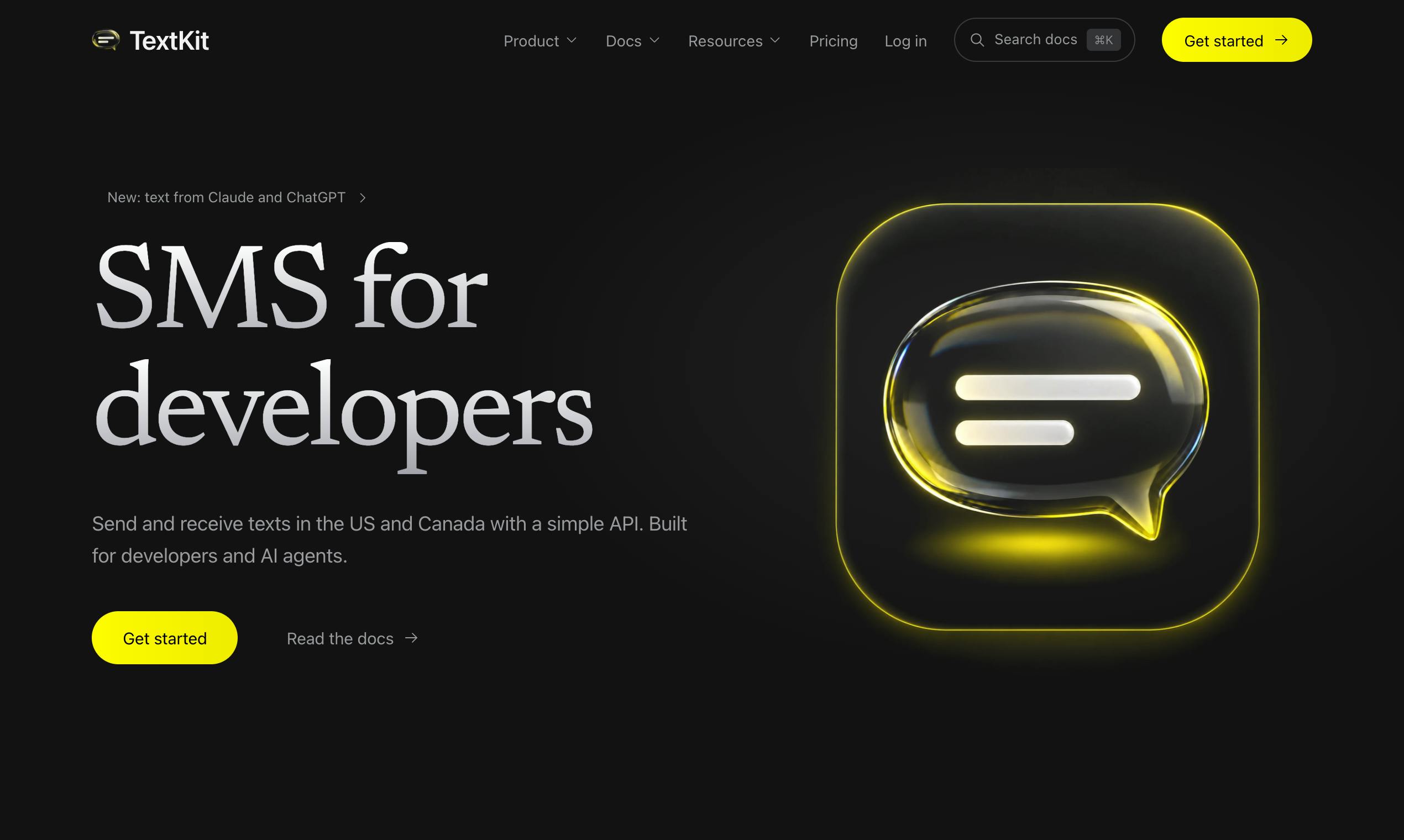
TextKit's positioning is very clear: providing an API for sending and receiving SMS in the US and Canadian markets. The official description emphasizes "a simple SMS api that just works," meaning developers don't need to struggle with complex carrier protocols and documentation—just call the interface to complete integration.
Unlike many SMS platforms that require enterprises to complete carrier registration and compliance reviews themselves, TextKit simplifies this step. Its promotional mention of "AI-assisted campaign registrations" is worth noting: SMS marketing campaigns often require submitting purpose, templates, and other information to carriers, and TextKit attempts to use AI to assist with these processes, reducing the cost of repeated manual communication.
A2P 10DLC and SMS Campaign Registration
Sending application-to-person (A2P) SMS to mobile users in the US requires compliance with the carrier-led A2P 10DLC (10-Digit Long Code) registration system. Enterprises need to submit brand information, campaign purpose, SMS templates, and opt-out mechanisms, and only after approval can they obtain higher sending rates and delivery rates. Unregistered or non-compliant traffic will be filtered by carriers or even face hefty penalties. This process involves third-party organizations such as The Campaign Registry, takes a long time, and requires repeated communication. TextKit's advertised "AI-assisted campaign registration" targets this pain point, attempting to use automation to reduce manual filling and review back-and-forth, but the final approval rate still depends on carrier policies and the compliance of submitted content.
Cost Advantage: 50% Cheaper Than Twilio
TextKit's most direct selling point is price. The official claim is that its cost is "50% cheaper than Twilio," i.e., half the price of the industry benchmark Twilio. For teams that need to send large volumes of verification codes, notifications, or marketing SMS, this is a considerable saving.
However, whether the cost advantage holds depends on the actual use case. Twilio's pricing includes number rental, per-message billing, and some advanced feature fees, while TextKit's specific billing structure is not detailed in the original information. When choosing a solution, developers still need to calculate based on their own sending volume, target market (US/Canada only), and feature requirements.
Twilio's Pricing Composition and Comparison Baseline
Twilio's SMS costs typically consist of several parts: monthly number rental (e.g., about $1/month for a US local number), per-message sending fees (about $0.0079/message in the US, slightly higher in Canada), carrier surcharges, and one-time or recurring fees such as 10DLC registration. The claim of "50% cheaper than Twilio" needs to clarify which part is being compared: if only the per-message unit price is compared, the savings are limited; if it includes a bundled price for numbers and compliance services, it may be more attractive. In addition, low prices may come with trade-offs in delivery rates, support response, or feature completeness. When calculating, developers should include monthly rental, registration fees, tiered overage pricing, and actual sending volume, rather than just looking at the per-message quote.
Integration and Ecosystem: 100+ Services, Covering Claude and ChatGPT
TextKit claims to integrate with over 100 services and specifically names support for Claude and ChatGPT. This means it is not just an API for backend developers but is also trying to enter AI workflow scenarios.
For example, users might want to use natural language instructions to have an AI assistant send SMS reminders, or hand received SMS content to a large model for processing. TextKit positions itself as the SMS channel for such scenarios, lowering the barrier for AI applications to access SMS capabilities. For developers building AI Agents or automated workflows, this integration capability may be more attractive than a simple API.
AI Agent SMS Tool Invocation
Large models such as Claude and ChatGPT can connect to external APIs through tool use / function calling: the model generates structured parameters based on conversational intent, the host program calls the SMS interface to complete sending, and then returns the result to the model. If TextKit provides a standard REST API and a clear parameter schema, it can be wrapped as such a tool for scenarios like verification code delivery, appointment reminders, and alert notifications. It should be noted that SMS sending involves costs and compliance, so AI workflows usually need to include confirmation steps, rate limits, and opt-out handling to prevent the model from mistakenly triggering bulk sends. On the receiving side, SMS content can be sent to a large model via webhook for classification or automatic replies.
Human Support and Differentiation
In the developer tools space, documentation and self-service are standard, but TextKit specifically mentions "Human support." Troubleshooting SMS services often involves carrier-side issues that are difficult to solve with documentation alone, making human support a practical plus for small and medium-sized teams.
Overall, TextKit's differentiation comes from three points: a simplified US/Canada SMS API, a price advantage, and proactive adaptation to the AI ecosystem. Its limitations are also obvious: the market is limited to the US and Canada, and feature depth and reliability still need to be verified through actual use.
For developers who need to quickly launch SMS functionality and whose business is concentrated in the US and Canada, TextKit offers a lightweight option worth evaluating. Whether it is more suitable than Twilio depends on the team's trade-offs regarding cost, integration complexity, and support response speed.
One-line Summary
TextKit enters the developer market with a simplified US/Canada SMS API, half the price of Twilio, and AI integration as its selling points.
Paragraph Summary
TextKit is an SMS sending and receiving API service for the US and Canadian markets, with 68 upvotes on Product Hunt. It focuses on being "out-of-the-box," attempting to simplify carrier integration and compliance registration processes, and offers AI-assisted SMS campaign registration to lower the barrier. On price, the official claim is 50% cheaper than Twilio, but the specific billing structure is not detailed; actual savings depend on the combination of numbers, per-message fees, and compliance costs. TextKit also claims integration with over 100 services and specifically names support for Claude and ChatGPT, entering AI workflow and Agent scenarios. It also provides human support to help troubleshoot carrier-side issues. Its limitations are that the market is limited to the US and Canada, and feature depth and reliability still need practical verification. Whether it is better than Twilio depends on the team's trade-offs regarding cost, integration complexity, and support response.
Related articles
 Tech Frontiers
Google Omni 1.2 Flash: 15-Second AI Video at Just $0.07 per Second
Google DeepMind releases Gemini Omni 1.2 Flash: 15-second video, 720p at $0.07/sec (30% cheaper), multi-turn editing without regeneration, draft upscaling to 4K.
 Tech Frontiers
No AI Ghostwriting: Writer's Quarter Reinvents Novel Writing with a Visual Workbench
The Writer's Quarter is an AI-free novel writing and planning tool that unifies character building, story planning, and manuscript writing in one visual workbench. This article analyzes its positioning, target users, and differentiated value amid the rise of AI writing tools.
 Tech Frontiers
Fleeep: A Unified Inspiration Collection Notes App for Creatives
Fleeep is a notes app for creatives that unifies screenshots, bookmarks, saved posts, and inspiration into one calm, cross-device, offline-capable space. This article analyzes its positioning, differentiation, and target users.