Thaw: Free and Open-Source Mac Menu Bar Manager with One-Click Hide and Search
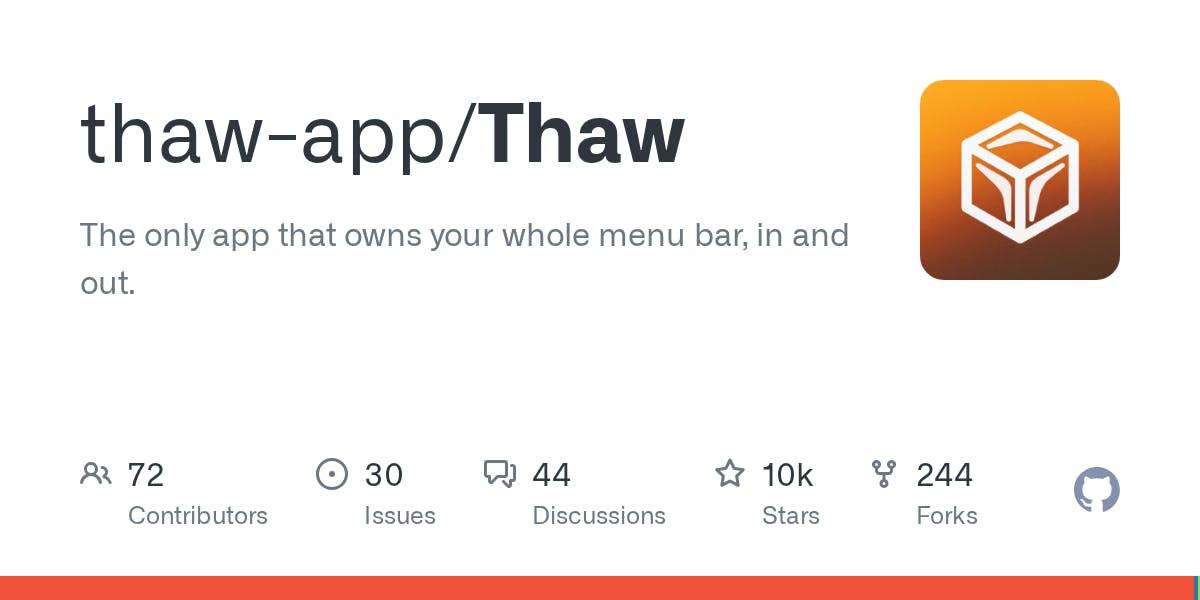
Open-source Mac menu bar manager with hide, search, and customization—free and privacy-first
Thaw is a new open-source Mac menu bar management tool that tackles icon clutter through hiding, quick search, and appearance customization. It's completely free, privacy-first with no tracking, and keeps all data local—offering a compelling alternative to commercial tools like Bartender.
Why Mac Menu Bar Management Matters
For every Mac user, the menu bar is the most frequently accessed yet often overlooked area of the screen. As more applications get installed, icons continuously encroach leftward, eventually forming a cluttered, barely distinguishable icon cluster. This crowding becomes particularly severe on limited-resolution screens or newer MacBooks with the notch—icons may even be swallowed entirely by the notch.
Technical evolution of the macOS menu bar: The macOS Menu Bar has been a core interface element since the first Macintosh system launched in 1984, permanently positioned at the top of the screen. Early menu bars primarily displayed system status icons (clock, volume, Wi-Fi) and active application menus. As third-party applications proliferated, more developers utilized the NSStatusItem API to place persistent icons in the menu bar for quick user access. This design initially boosted efficiency, but once installed applications exceed a certain threshold, the limited horizontal space (typically 15-25 icons on 13-16 inch screens) becomes a bottleneck. After Apple introduced the notch design in 2021, available space shrank by approximately 20%, making icon overlap and obstruction a widespread issue that created urgent demand for menu bar management tools.
Recently launched on Product Hunt, the open-source tool Thaw addresses precisely this long-standing pain point. Promoted as "the only one that gives you full control over your entire menu bar," it landed at #8 on the daily rankings with 92 upvotes, tagged under Mac, Open Source, GitHub, and menu bar applications.
About Product Hunt's validation mechanism: Product Hunt is the world's largest product discovery community, where hundreds of new products launch daily with rankings determined by user upvotes. Breaking into the daily top ten means standing out among hundreds of products that day, typically requiring 80-150 votes. For open-source tools, Product Hunt serves not only as a channel for early user acquisition but also as a litmus test for Product-Market Fit. While 92 votes isn't top-tier performance, it demonstrates meaningful user resonance for a new tool in the vertical niche of menu bar management. Notably, open-source projects' Product Hunt performance often strongly correlates with GitHub Star growth—quality products can gain hundreds to thousands of Stars within a week of launch.
Thaw's Three Core Features
According to the official description, Thaw centers on "reclaiming control of your menu bar" with three primary capabilities.
Hide Unnecessary Menu Bar Icons
Thaw allows users to hide infrequently used menu bar icons, keeping only truly high-frequency applications visible. This maintains a minimalist, clean visual state and prevents icon overflow into the notch area that causes display chaos. This "collapse/organize" functionality is a classic feature of similar tools (like Bartender and Hidden Bar) and a fundamental requirement for menu bar management software.
Technical implementation of menu bar management: Menu bar management tools require macOS Accessibility and Screen Recording permissions to identify, hide, or rearrange menu bar icons. These permissions represent the system's highest authorization levels: Accessibility allows apps to simulate user actions and access other applications' interface elements; Screen Recording captures screen content. Apple significantly tightened such permission management starting with macOS Mojave (10.14), requiring manual user authorization in "System Preferences > Security & Privacy." Because such elevated permissions are required, privacy policies and code transparency of menu bar management tools become critically important. Open-source software's advantage lies in allowing users or security researchers to audit source code and confirm it operates only locally without sending data to external servers.
One-Click Search for Any Icon
Beyond hiding, Thaw emphasizes "find anything in one keystroke." This means that even when icons are collapsed, users don't need to manually expand and search one by one—instead, they invoke search via hotkey to quickly locate and trigger the target application. This keyboard-first interaction design particularly appeals to efficiency-focused power Mac users.
Customize Menu Bar Appearance
Thaw also provides personalized menu bar appearance adjustments, letting users "make your menu bar look exactly how you want." While the official description doesn't detail specific customization dimensions, this direction indicates Thaw cares not only about functional organization but also visual presentation consistency and aesthetics.
Free, Open-Source, and Privacy-First: Thaw's Core Advantages
Thaw's most compelling differentiator lies in simultaneously satisfying the triple attributes of free, open-source, and privacy protection.
In the menu bar management niche, the long-dominant commercial software Bartender sparked user concerns about privacy and security following an ownership change event, prompting more users to seek open-source Bartender alternatives. Thaw's emergence comes at an opportune moment.
Detailed explanation of the Bartender trust crisis: Bartender has been the benchmark product in Mac menu bar management since its 2012 launch, long dominating the market. In early 2024, Bartender was acquired by an undisclosed company. The new version requested broader system permissions, and software updates weren't signed by the original developer, triggering strong user concerns about privacy and security. Numerous discussion threads appeared on Reddit and Hacker News, with users questioning whether the new owner would collect menu bar application data (potentially exposing all software users have installed). This incident directly drove users toward open-source alternatives like Ice, Hidden Bar, and Thaw mentioned in this article. It also highlights the special nature of system-level tools—they possess extremely high access privileges, and if exploited maliciously, consequences far exceed ordinary applications.
The official statement is clear: Thaw is "privacy-first by design"—no tracking, no account registration required, and all data stays on your Mac. For a tool that reads and manages system menu bar content, this "data never leaves your device" promise is crucial. The open-source attribute further means anyone can review its source code to verify it's truly as clean and transparent as advertised.
Audit value of open-source software: The core value of open-source software isn't just free usage, but "verifiable trust." When source code is public on platforms like GitHub, anyone can check whether it contains tracking code, network requests, or data upload logic. For menu bar management tools, key audit points include: whether it calls network APIs, writes external logs, or includes third-party analytics SDKs (like Google Analytics or Mixpanel). Thaw's claim that "data doesn't leave your device" means its code shouldn't contain calls to networking libraries like URLSession or Alamofire (except perhaps for update checks). Additionally, open-source enables community code contributions and bug fixes, forming a decentralized maintenance ecosystem. However, note that open-source doesn't equal absolute security—supply chain risks in dependency libraries still require attention.
Why Mac Menu Bar Management Tools Deserve Attention
Menu bar management may seem like a minor need, but it reflects a persistent trend in the Mac ecosystem: users' dual demands for system-level control and privacy.
On one hand, as application numbers balloon, native macOS menu bar management capabilities remain limited, leaving third-party tools to fill the gap; on the other hand, with heightened data privacy awareness today, users increasingly favor transparent, auditable, offline local tools over entrusting closed-source commercial software.
Thaw positions "full menu bar control" as its core proposition, combined with free, open-source, and zero-tracking promises that precisely hit both demands. For users who want to organize cluttered menu bars, are privacy-sensitive, and don't want to pay for tools like Bartender, it offers a quite attractive option.
Conclusion: Is Thaw Worth Trying?
As a new tool just launched on Product Hunt, Thaw currently has few reviews, and community reputation requires time for validation. Its specific stability, compatibility, and actual performance on notched models all need user evaluation through hands-on testing. But from a product positioning perspective, it combines the three major functions of "hide, search, beautify" with the three major principles of "free, open-source, privacy-first"—clear thinking and distinct selling points.
If your Mac menu bar is already overwhelmed and you don't want to be bound by commercial software subscription fees and data policies, try this open-source Thaw—it might just help you truly "reclaim" that small piece of screen real estate that belongs to you.
Related articles
AI Agent Cost Optimization in Practice: Engineering Wisdom That Saved $1 Million in One Hour
Databricks eliminated $1M/year in wasted AI Agent spend in just one hour. Learn the root causes of Agent cost overruns and key strategies like model tiering, context pruning, and caching.
How the FDA Is Building an AI-Ready Data Foundation on Databricks
Explore how the FDA leverages Databricks for Government to build a unified Lakehouse architecture and AI-ready data foundation while meeting federal security and compliance standards.
The Power of Security Collaboration: Why Vulnerability Discovery Cannot Do Without Human Intelligence
Explore how security collaboration outperforms tool dependency, the value of vulnerability stories, cross-team knowledge sharing practices, and building stronger defenses by investing in people and collaboration.