The 83K-Star LLM Intro Course: A Full Breakdown of mlabonne/llm-course

mlabonne/llm-course, with 83K stars, is the most-watched LLM intro course, lowering the learning barrier with roadmaps and Colab notebooks.
This article introduces mlabonne/llm-course, a widely followed LLM intro course repository on GitHub. With over 83,000 stars and nearly 10,000 forks, its core assets are structured learning roadmaps and directly runnable Colab notebooks, addressing "what to learn" and "can't get it running" respectively. The roadmap typically covers LLM fundamentals, fine-tuning and alignment, and application development and deployment, while Colab notebooks lower the entry barrier from "configuring an environment" to "clicking Run" via a zero-config cloud environment. The article notes the repository is clearly positioned as an intro course, suitable for developers with programming basics, though deep learning still requires papers and practice; users should watch its update status to avoid notebooks failing due to dependency version changes.
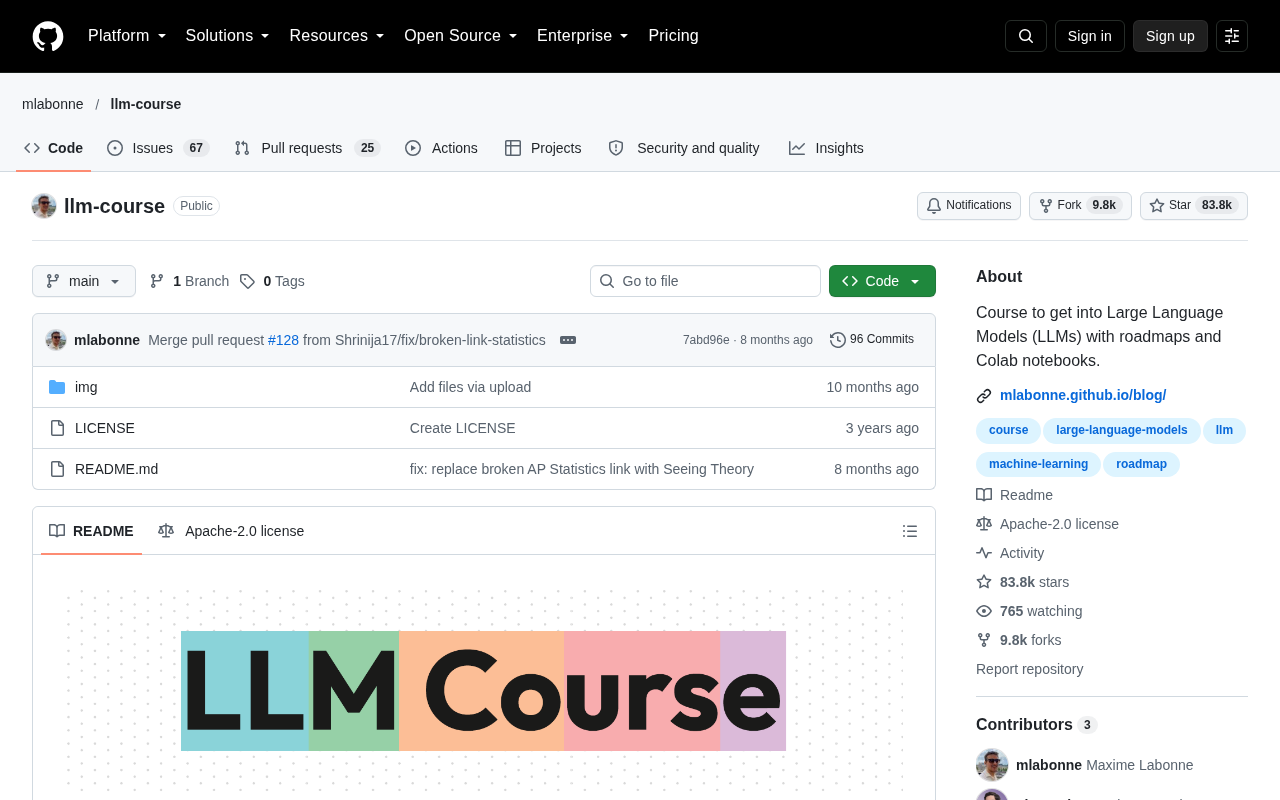
In an era flooded with AI learning resources, the fact that a single GitHub repository has earned over 83,000 stars says something in itself. That repository is mlabonne/llm-course—a project that doesn't sell courses or impose barriers, but instead breaks the path to learning large language models into executable steps using roadmaps and Colab notebooks.
Why This Repository Deserves Attention
83,761 stars, 9,770 forks, and 81 new stars in a single day—behind these numbers is a clear fact: a large number of developers and learners are using this repository as their entry point into the LLM field. Unlike the typical "master it in X days" courses on the market, the core assets of llm-course are structured learning roadmaps and directly runnable Colab notebooks. The former solves the question of "what to learn and in what order," while the latter addresses the pain point of "I understand it but can't get it running."
The repository title is refreshingly direct: Course to get into Large Language Models (LLMs) with roadmaps and Colab notebooks. No marketing spin—its positioning is simply an introductory course.
What Stars and Forks Mean: On GitHub, a star is similar to a "bookmark" or "like," indicating that a user recognizes the repository's value; a fork copies the repository to one's own account, usually meaning the user wants to modify it, contribute to it, or build on it independently. 83,000 stars and nearly 10,000 forks show that the repository is not only widely bookmarked but also that a large number of users are willing to use it as the starting point for their own work—indicating high community engagement.
Roadmap Design: Three Main Tracks Covering the Full LLM Learning Landscape
Although the original material doesn't break down the specific branches of the roadmap, based on the repository's positioning and common LLM course design logic, it typically organizes content around three main tracks: LLM fundamentals, model fine-tuning and alignment, and application development and deployment. The value of this division is that it lets learners choose a path based on their goals—those interested in research can focus on fundamentals, while those interested in building products can focus on applications.
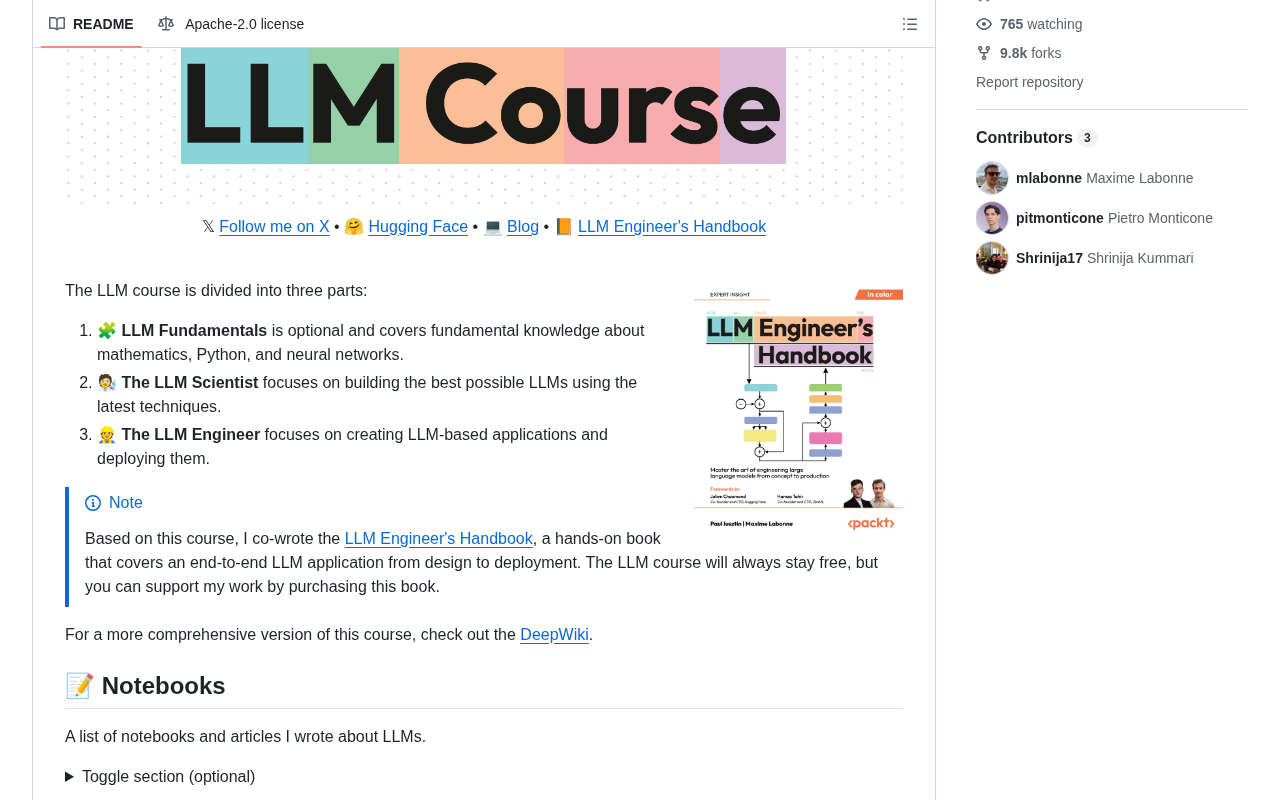
The presence of Colab notebooks is what sets this course apart from purely theoretical tutorials. The LLM field is dense with concepts—terms like attention mechanisms, LoRA, quantization, and RLHF can easily remain at the "I've heard of it" level if you only read text. Notebooks, however, put code, output, and explanation in the same interface, allowing learners to run cells one by one, modify parameters, and observe how results change. This feedback loop is something pure documentation cannot replace.
LoRA (Low-Rank Adaptation) is a parameter-efficient fine-tuning technique. Rather than directly modifying all the weights of a large model, it freezes the original model and inserts low-rank matrices alongside specific layers, training only these newly added small parameters. This significantly reduces memory and compute requirements while adapting the model to downstream tasks. LoRA is often combined with quantization (e.g., QLoRA) and is one of the mainstream methods for individual developers fine-tuning large models under limited resources—and a key topic in llm-course's fine-tuning module.
RLHF (Reinforcement Learning from Human Feedback) is an alignment technique that makes large model outputs better match human preferences. A typical pipeline involves: collecting human ranking data on model outputs, training a reward model to simulate human preferences, and then using reinforcement learning algorithms (such as PPO) to optimize the language model to maximize the reward. RLHF is a key step behind dialogue models like ChatGPT, and understanding it helps grasp the modern LLM training paradigm of "pre-training—fine-tuning—alignment."
Colab Notebooks: Turning "Understanding" into "Running"
From a learning-efficiency perspective, Colab notebooks solve a practical problem: environment setup. LLM-related experiments often involve CUDA, PyTorch versions, and dependency conflicts, and the proportion of beginners who get stuck at this step is quite high. By providing directly runnable notebooks, the repository effectively lowers the entry barrier from "knowing how to configure an environment" to "knowing how to click Run."
This also explains why the repository has accumulated such a high star count. Here, stars aren't just bookmarks—they're more like votes, with learners using them to mark "this is a resource I've actually used." The 81 new stars in a single day show that it continues to attract new users rather than resting on historical accumulation.
Google Colab is a free cloud-based Jupyter Notebook environment provided by Google. Users can run Python code in the browser without local configuration and can access free or paid GPU/TPU resources. For LLM learning, Colab notebooks integrate code, explanatory text, and results in a single document, supporting cell-by-cell execution and parameter modification, which greatly lowers the barrier to experimentation. However, the free tier has runtime limits and resource quotas, and complex experiments may require Colab Pro or a local environment.
Who It's For, and Who It Isn't
The repository's positioning is very clear: introductory. It suits developers with some programming background who want a systematic understanding of LLMs, as well as product people or researchers who need to quickly build a knowledge framework. But if your goal is to go deep into a specific subfield—say, specializing in inference optimization or distributed training—a roadmap-style course can only provide an index; depth still requires papers and specialized practice.
Another thing to watch is the update cadence. The LLM field changes extremely fast, and if course content goes without updates for a long time, some notebooks may fail to run directly due to changes in dependency library versions. Before use, it's advisable to check the repository's recent commit history and Issues section to confirm its current state.
How to Use This Repository Efficiently
A practical strategy: first read through the roadmap to determine where you currently stand, then start with the corresponding Colab notebook, filling in theory as you run code. Don't try to learn everything linearly from start to finish—LLM knowledge is networked rather than linear, and running code with specific questions in mind will make your understanding far more efficient.
For learners who already have some background, you can use the repository as a checklist to fill gaps against the roadmap, rather than as a from-scratch tutorial. The community validation of 83,000 stars reduces the cost of choosing, but which learning path to take still depends on your personal goals.
Related articles

Workbuddy for Absolute Beginners: How a Desktop AI Agent Fits Into Real Workflows
A beginner's guide to the Workbuddy desktop AI agent: installation, claiming credits, file management, and building automated workflows—compared with CodeX for fit and cost, helping professionals shift from AI question-askers to AI managers.

OpenAI's New Agent Stack: Computer Use, Decisions API, and Ultra-Fast Workflows
OpenAI Dev Day unveiled a new agent stack: Computer Use outperforms humans, Decisions API delivers ultra-low-latency classification via Luna, Agents API opens the same Computer Use capabilities, and GPT-6.1 Sol costs only one-seventh of Astra. Core updates, benchmark data, and developer insights.

Liang Wenfeng Open-Sources DeepInfo Inference Framework, Takes On U.S. Ban
DeepSeek open-sources its DeepInfo inference framework after its models, featuring GPU/CPU cross-pipelining, small-model prediction with large-model verification, and full Huawei Ascend and NVIDIA chip support—facing the U.S. federal ban head-on. This article analyzes its significance for AI deployment and open-source strategy.