The Abandoned Popcorn Time: Why Millions of Zombie Apps Must Be Disabled

Popcorn Time is no longer updated, yet millions of devices still have it installed, potentially hijacked into a botnet.
Popcorn Time, once called "pirate Netflix," has been out of development for years, but millions of devices worldwide still have old versions installed. Because the app relies on the BitTorrent protocol for P2P streaming, each client is a network node, and since it no longer receives security updates, known vulnerabilities could be exploited by attackers to hijack these unpatched clients and incorporate them into a botnet for DDoS attacks or malware distribution. The article points out that remotely disabling old versions is a necessary measure to prevent the formation of a zombie army, while also highlighting the security risks of abandoned software and the importance of software lifecycle management.
From "Pirate Netflix" to a Botnet Risk
Remember Popcorn Time? Once dubbed the "pirate Netflix," this app made it easy for users to stream pirated movies and TV shows through a clean interface, and it became a major target for the MPAA (Motion Picture Association of America). According to foreign media reports, development of the app has been stalled for years, but millions of devices worldwide still have it installed, quietly waiting to be awakened to form a zombie army.
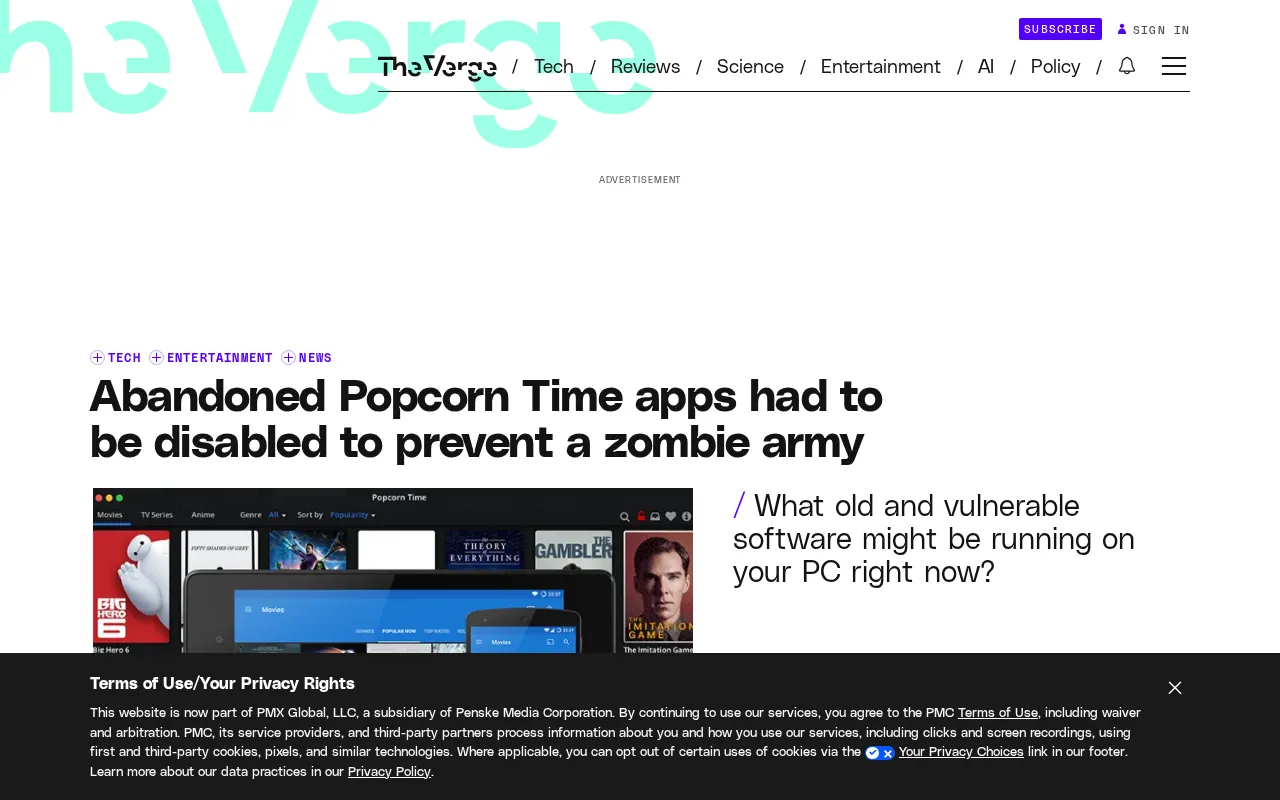
This brief message from RSS reveals a neglected security risk: how abandoned software becomes a breeding ground for attackers. The Popcorn Time case is not unique, but its massive user base and P2P architecture make the risk particularly prominent.
MPAA (Motion Picture Association of America) is an industry organization representing major Hollywood studios, long dedicated to copyright protection and anti-piracy efforts. It has taken legal and technical measures against pirated streaming apps such as Popcorn Time, including pushing for domain blocking and pressuring hosting providers, making it one of the main opponents of such apps.
How Is a Botnet Formed?
Popcorn Time's core mechanism relies on the BitTorrent protocol for streaming, meaning every client is also a node in the network. When official development stopped, the app no longer received security updates, and any known vulnerability could be maliciously exploited. Attackers could hijack these unpatched clients and incorporate them into a botnet to launch DDoS attacks, spread malware, or conduct other illegal activities.
According to the original description, these apps "had to be disabled" to prevent them from joining the zombie army. This implies that some central control mechanism—possibly a tracking server or update channel—was used to remotely disable old versions. While this "kill switch" approach is effective, it also raises questions about control over users' devices.
The BitTorrent protocol is a peer-to-peer (P2P) file-sharing protocol in which users download file pieces simultaneously from multiple other users (peers) rather than relying on a single server. Popcorn Time uses this protocol to enable streaming while downloading, with each client acting as both downloader and uploader. This architecture is efficient, but it also means clients must continuously communicate with numerous unknown nodes, expanding the attack surface.
DDoS attack (Distributed Denial of Service) refers to an attacker controlling a large number of infected devices (i.e., a botnet) to simultaneously send massive requests to a target server, overwhelming it and causing it to crash. The larger the botnet, the more powerful the attack, which makes Popcorn Time, with millions of potential clients, highly attractive to attackers.
The Security Debt of Abandoned Software
Popcorn Time's predicament is a typical cautionary tale of software lifecycle management. When a project stops being maintained, users often do not proactively uninstall it, but instead let the app continue running. For applications that rely on network communication, this is equivalent to leaving an unguarded backdoor in the system.
Security experts often emphasize the importance of "timely updates," but the Popcorn Time example shows that updating alone is not enough—when the software itself is abandoned, users need to migrate or completely remove it. For users still using old versions of Popcorn Time, a disable notification may serve as a mandatory security reminder.
Software lifecycle management refers to the management of the entire process from planning, development, deployment, maintenance, to retirement. The "retirement" phase is often overlooked but crucial: if users continue to use software after maintenance stops, known vulnerabilities cannot be patched, creating long-term exposure risk. Good lifecycle management requires providing migration plans, security notices, or remote disable mechanisms at retirement to reduce residual risk.
Implications for Users and Developers
For users, installing software from unknown sources or that is no longer maintained carries extremely high risk. Even once-popular tools can turn from convenient utilities into security risks once they lose support. For developers, providing a clear migration path or self-destruct mechanism when a project ends may help reduce residual risk.
The Popcorn Time story is not over. The zombie apps on millions of devices remind us that in the digital world, abandoned code does not simply disappear—it may be waiting for the next command.
Related articles

LLM Application Development: A High-Paying Career Guide for Ordinary People
LLM application development offers fresh graduates up to 35K/month, with SP offers reaching 600K. This article explains the core skills, how to break in, and how ordinary people can seize AI opportunities through learning by doing.

Say Goodbye to AI Influencer Faces: A Complete Guide to Creating Visual Assets for AI Comic Dramas from Scratch
Bilibili creator shares a full workflow for zero-basics AI comic drama visual assets: use Doubao Work skills with script-first, visual references, and real-person texture to escape AI influencer faces, then lock character and scene consistency with asset sheet layouts, weapon detail images, scene nine-grids, and cinematic color palettes.

The AI Production Pipeline Behind Great Videos: From Research to Agent Validation
AI video production isn't just a model race. This article breaks down a transferable four-step pipeline: researching professional workflows, organizing a skill checklist, configuring agents, and experimental validation—and explains how general-purpose LLMs like DeepSeek can replace paid tools to run the entire process.