The Accidental Birth of OpenClaw 2.0: Lessons from an Open-Source Reverse-Engineered Game Engine
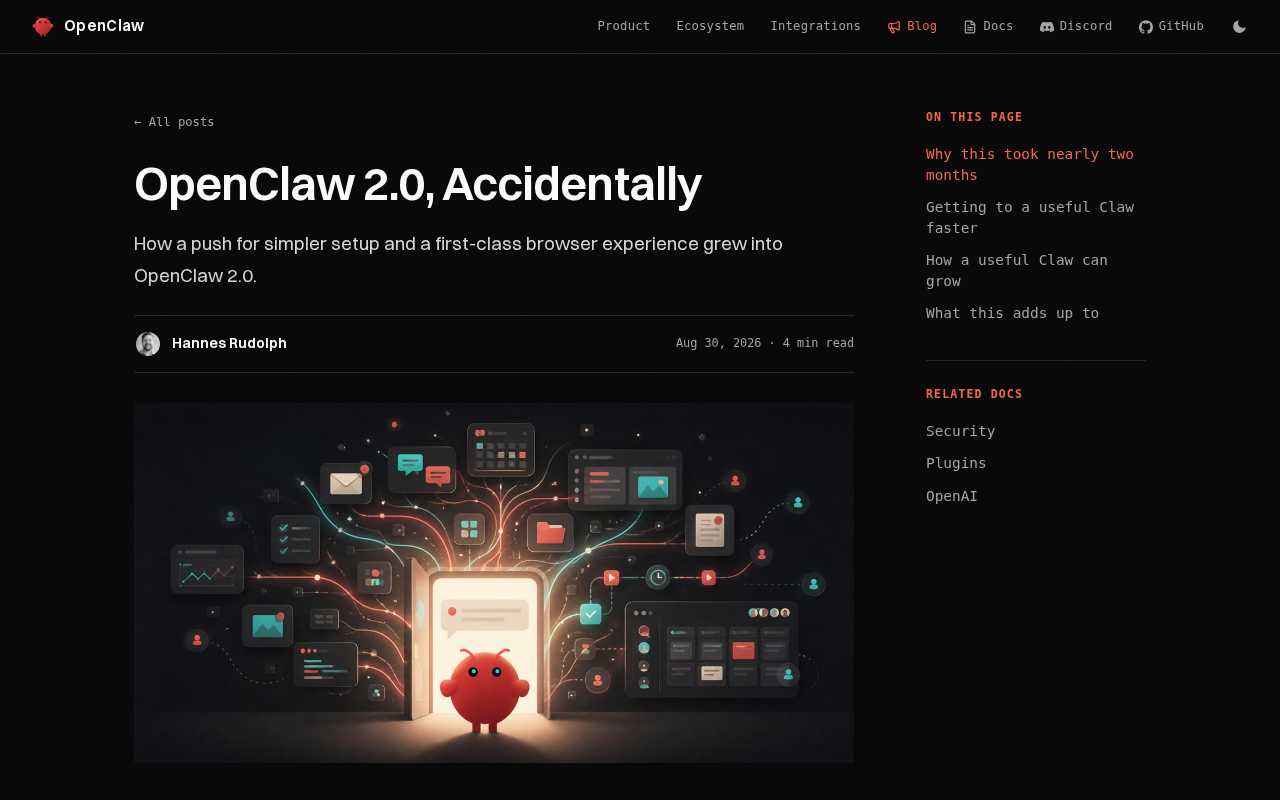
How an accidental rewrite of an open-source game engine reimplementation reveals universal software engineering truths.
A Hacker News post about the accidental creation of OpenClaw 2.0—an open-source reimplementation of the classic game Captain Claw—sparks discussion about reverse engineering techniques, the legal gray areas of engine reimplementation, independent developer motivation, and the unexpected architectural breakthroughs that emerge from refactoring. The case offers practical lessons for software engineers about embracing rewrites, documenting evolutionary changes, and the enduring value of human creativity in an AI-augmented world.
An "Accident" That Sparked an Open-Source Discussion
Recently, a post titled "OpenClaw 2.0, Accidentally" caught the attention of the developer community on Hacker News. Hacker News is a tech news aggregation and discussion platform created in 2007 by Y Combinator, Silicon Valley's renowned startup accelerator. Unlike general-purpose communities such as Reddit, HN is known for its high-quality technical discussions, strict community norms, and elite user base. The platform uses an algorithmic ranking system that factors in upvotes, comment activity, and time decay to determine post visibility. While this particular post didn't go viral (28 upvotes, 15 comments), it reached moderate traction on HN—and content that makes the front page typically has genuine technical depth or a unique perspective. The slightly tongue-in-cheek title—"Accidentally built OpenClaw 2.0"—touches on a thought-provoking topic in open-source software development: when we try to replicate, reverse-engineer, or rebuild an existing project, we often end up creating something entirely new without even intending to.
OpenClaw itself is a well-known open-source project—an engine reimplementation of the classic 2D platformer Captain Claw (published by Monolith Productions in 1997). The original OpenClaw project reverse-engineered the game's resource files and reimplemented the game logic using modern C++ and cross-platform frameworks, allowing this nostalgic title to run on contemporary operating systems. The so-called "accidental 2.0 version" implies that the developer inadvertently achieved a major upgrade or rewrite of the original project during some process. In the Semantic Versioning specification, a major version bump signifies incompatible API changes or architectural restructuring—which is precisely the technical implication of this "accidental" upgrade.
The Technical Lineage of Reverse Engineering and Open-Source Game Engine Reimplementation
From Game Archaeology to Engine Reconstruction
Projects like OpenClaw fall under the umbrella of Game Preservation and Engine Reimplementation. The core challenge is that the original game's source code is typically unavailable. Developers can only analyze the game's resource file formats, disassemble the executable, and observe runtime behavior to piece together the internal logic bit by bit.
This process is essentially "technical archaeology." Developers need to:
-
Parse proprietary resource formats: Commercial games typically use proprietary packaging formats to store images, audio, level data, and other assets—formats that are often undocumented. Reverse engineers must use hex editors to analyze file structures, identify magic numbers and field boundaries, then write parsers to extract the data. In the case of Captain Claw, its .REZ and .WAV file formats required analyzing file headers, compression algorithms, and index table structures. Modern tools like 010 Editor's template language and Python's
structlibrary have greatly simplified this process. After successfully parsing resource formats, the data must also be converted into standard formats usable by modern engines (such as PNG, OGG). -
Reconstruct game logic: When reverse-engineering a game engine, disassembly is the core technique. Tools like IDA Pro and Ghidra (NSA's open-source disassembler) can convert executables into assembly code or pseudo-C code, helping developers understand program logic. But static analysis has its limits: packing, code obfuscation, and dynamically generated code all increase the difficulty. Dynamic analysis is therefore needed as well: using debuggers (such as x64dbg, OllyDbg) to set breakpoints at runtime, observe memory changes, and trace function call stacks. Through these techniques, developers must reconstruct the physics engine, collision detection, AI behavior, state machines, and other core logic. 2D platformers typically use tile-based collision systems: the map is divided into fixed-size tiles, each marked as passable, solid, or a special type. When a character moves, the engine detects intersections between the character's bounding box and surrounding tiles, calculates collision normals, and adjusts the position accordingly.
-
Rebuild the rendering pipeline: Re-implement the visuals—originally dependent on specific hardware or APIs (such as DirectX 5, common in the '90s)—using modern graphics libraries. SDL (Simple DirectMedia Layer) is a cross-platform multimedia development library that has been a standard tool for indie game development and engine porting since its initial release in 1998. SDL provides a unified API for handling video, audio, input devices, and thread management, abstracting away the underlying differences between Windows, Linux, macOS, and other operating systems. In engine reimplementation projects like OpenClaw, SDL plays a critical role: it converts originally platform-specific code into standard calls that run across modern platforms. SDL 2.0 (released in 2013) further enhanced hardware acceleration support and mobile platform compatibility.
It's precisely during this iterative process of trial, error, and refactoring that "accidents" tend to happen—a developer might discover a more elegant architecture while fixing a bug, or unintentionally transform the entire project while rewriting a single module.
The Software Engineering Philosophy Behind the "Accident"
The word "Accidentally" in the title actually reveals a universal principle of software evolution. Many major architectural upgrades don't originate from grand top-down designs but rather emerge naturally through continuous iteration and localized optimization. This echoes the growth trajectories of classic open-source projects like the Linux kernel and Git—none of them planned a "2.0" from the start. Instead, they evolved gradually through the process of solving real problems.
Community Discussion Reflects the State of the Open-Source Ecosystem
Although this post didn't generate a large number of comments, on a community like Hacker News—known for technical depth—topics like these often spark in-depth discussions about open-source sustainability, the legality of reverse engineering, and the motivations of independent developers.
The Legal and Ethical Boundaries of Reverse Engineering
Reverse-engineering game engines exists in a legal gray area in most jurisdictions. Projects like OpenClaw typically only reimplement the engine code, requiring users to supply the original game's resource files themselves to avoid copyright risks. This model of "open-source engine, retained content" has become standard industry practice.
Similar landmark cases include OpenMW and devilutionX. OpenMW is the open-source engine reimplementation of The Elder Scrolls III: Morrowind, started in 2008, and has now fully replicated the original functionality while adding modern features like multiplayer and 64-bit support. devilutionX is an engine rewrite that emerged from the successful reverse engineering of Diablo in 2018, fully reconstructing the game logic through disassembly. Both projects adopted a "clean room" design methodology: developers never viewed the original source code (even if leaked), reimplementing everything solely by observing game behavior—thus sidestepping copyright disputes. Their success proves both the technical feasibility and legal safety of engine reimplementation, while also providing referenceable development models and community operations experience for projects like OpenClaw.
The Intrinsic Motivation of Independent Developers
These open-source reimplementation projects are almost entirely maintained by hobbyists in their spare time, driven by pure technical passion and nostalgia for classic works. "Accidentally" building 2.0 perfectly illustrates how, under non-utilitarian motivation, developers are more willing to pursue excellence in code quality and architectural design—ultimately producing results that surpass the original goals.
However, the sustainability of open-source projects remains a key concern in the industry. Research shows that over 70% of open-source projects are sustained by fewer than 5 core maintainers, most of whom contribute their time voluntarily. Maintainer burnout is widespread: handling issues without compensation, reviewing PRs, and managing community disputes can lead to project stagnation or abandonment over time. In recent years, platforms like GitHub Sponsors and Open Collective have emerged, attempting to improve the situation through financial incentives. But for niche projects like OpenClaw, the audience size can hardly support full-time development. Therefore, an "accidental" upgrade to version 2.0 often means the maintainer broke through a burnout period driven by personal interest, reinvesting energy into large-scale refactoring.
The Unique Value of Long-Tail Open-Source Projects
Compared to popular frameworks with tens of thousands of stars, projects like OpenClaw have a limited audience. Yet they form a vital part of a healthy open-source ecosystem—preserving digital cultural heritage, providing real-world reverse engineering case studies for learners, and validating the technical feasibility of cross-platform porting. The cumulative contributions of these long-tail projects build the depth and diversity of the entire open-source community.
Practical Takeaways for Software Developers
Unexpected Gains from Refactoring
For engineers engaged in day-to-day software development, the OpenClaw 2.0 case offers several practical insights:
- Don't be afraid to rewrite. When existing code becomes hard to maintain, planned refactoring—or even partial rewrites—can lead to unexpected architectural improvements.
- Document your "accidents." When a project undergoes a qualitative shift during its evolution, promptly recording the changes and clarifying version semantics helps future contributors understand the codebase's trajectory. In open-source projects, major version bumps often accompany significant milestones. The challenge of such an "accidental" upgrade lies in thoroughly cleaning up technical debt while maintaining backward compatibility (or providing a migration path). CHANGELOG files, migration guides, and deprecation warnings are essential documentation—they help users and contributors understand the differences between old and new versions, lowering the barrier to upgrading.
- Keep an open mind. The best technical solutions are sometimes not designed in advance but "discovered" through hands-on practice.
Reverse Engineering as an Effective Learning Path
For developers who want to gain a deeper understanding of low-level systems, participating in or studying open-source reverse engineering projects like OpenClaw is an excellent learning approach. It covers file format parsing, game loop design, cross-platform abstraction layers, memory management, and a range of other hardcore skills—far closer to the complexity and challenges of real-world engineering than reading tutorials. By using memory scanning tools like Cheat Engine to locate key variables and then tracing back to the code that modifies them, developers can gain deep insight into how programs operate. This process requires in-depth understanding of x86/x64 assembly language, calling conventions, and executable file formats (PE/ELF)—a comprehensive test of one's overall skill set.
Conclusion
The seemingly understated title "OpenClaw 2.0, Accidentally" is a microcosm of the open-source community's quiet, dedicated work. It reminds us that great software projects don't always begin with grand blueprints. More often, they're born from a developer's relentless pursuit of a problem—and the unexpected "accidents" encountered along the way.
In an era where AI-assisted programming is becoming increasingly prevalent, projects like these—which rely on deep engineering expertise and reverse-engineering ingenuity—actually highlight the irreplaceable value of human developers. The creativity to impose order on chaotic code and to conceive entirely new architectures while solving concrete problems is something current technology still cannot fully replicate.
Related articles

Knockin': AI Business Cards That Make Your Personal Bio Intelligent
Knockin' transforms traditional bios into interactive AI business cards where visitors can chat to learn about your expertise and book meetings directly.

Intel CPU Price Increase of 10%: Strategic Transformation and Market Impact Analysis
Intel plans to increase PC processor prices by ~10%, shifting from market share competition to profit-focused strategy. Analysis of price increase drivers, impact on consumers and OEMs, AMD competitive dynamics, and industry trends.
Switch Open Source Tool: Bringing AI Agents into Team Collaboration Platforms
Switch is an open source tool that integrates AI Agents as named participants into Slack, Teams, Discord, and other collaboration platforms, supporting multi-framework compatibility and self-hosted deployment. It reached #1 on Product Hunt.