The AI Agent Harness Isn't Going Away: An Architectural Shift from Deciding to Offering

As models get smarter, the Agent harness shifts from making decisions to offering structured capabilities.
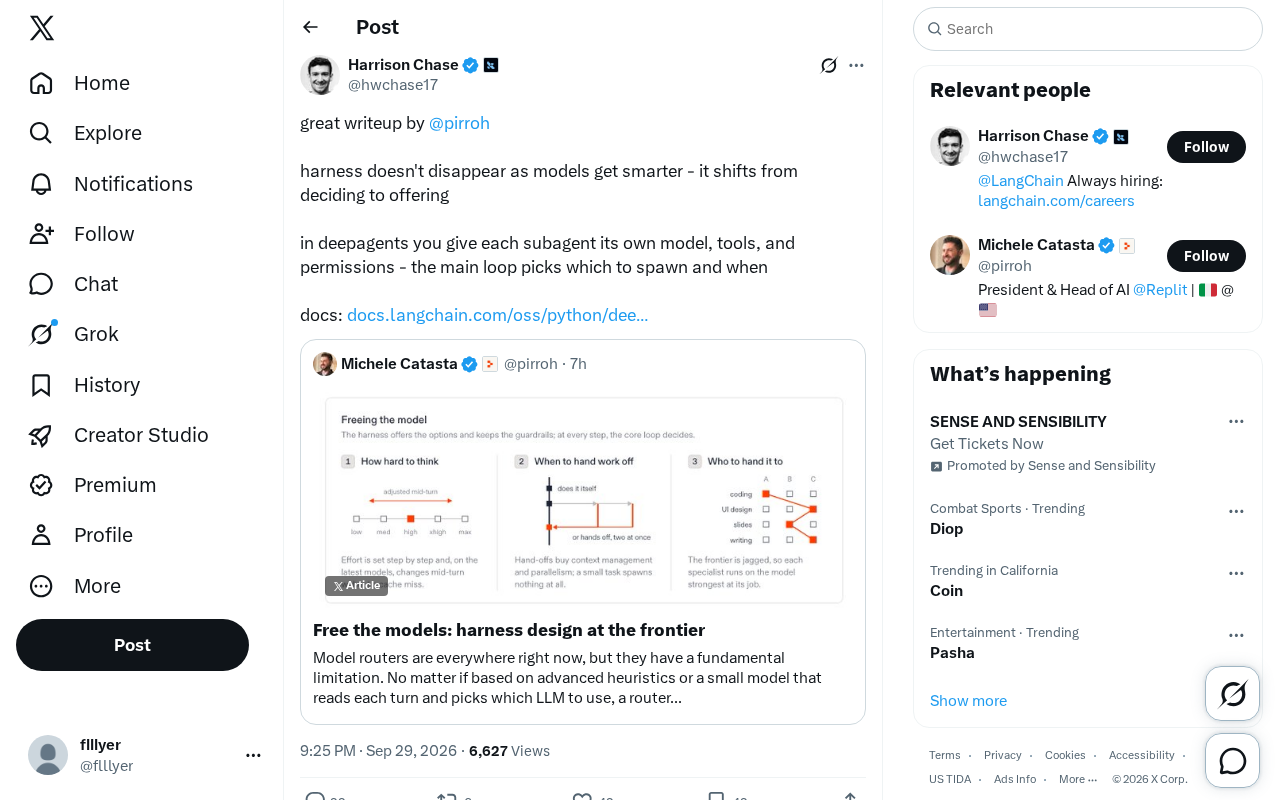
Contrary to the popular belief that powerful models will render orchestration frameworks obsolete, this article argues the harness simply changes roles — from hard-coded decision logic to providing structured capability options for the model. Using deepagents as an example, where each subagent has its own model, toolset, and permissions while the main loop handles orchestration, this "offering not deciding" design philosophy delivers real engineering benefits: security isolation, cost optimization, and modular capabilities.
An Overlooked Architectural Insight
As large language models grow increasingly capable, a popular assumption has emerged: the smarter the model, the less important the surrounding scaffold (harness) becomes — until it's eventually absorbed by the model itself or disappears entirely. But a post by @pirroh that gained traction on Twitter argues the opposite — the harness doesn't disappear; it simply undergoes a role transformation.
The core thesis of the original tweet is elegantly concise: "harness doesn't disappear as models get smarter - it shifts from deciding to offering." This statement cuts to the heart of a commonly misunderstood trend in AI Agent system design.
What Does "From Deciding to Offering" Actually Mean?
In early Agent architectures, the harness typically carried a heavy load of hard-coded decision logic: when to call which tool, what workflow to follow, under what conditions to terminate a loop. These systems essentially externalized intelligence into the framework itself, with the model serving merely as a scheduled execution unit.
As model capabilities improved, many expected these decision-making responsibilities to be handed off entirely to the model, rendering the harness redundant. @pirroh's counterargument is that the harness hasn't lost its value — it has simply shifted from making decisions on behalf of the model (deciding) to presenting the model with options and capability boundaries (offering).
In other words, the framework no longer tells the model "you must do it this way." Instead, it "offers" a set of available tools, permissions, and subsystems, leaving the model to choose autonomously at runtime. This is a delegation of control — but the framework still defines the space of possibilities.
This shift has clear parallels in software engineering. Traditional orchestration frameworks (like early LangChain Agents or AutoGPT) tended to drive models using finite state machines or hard-coded tool-call sequences — essentially a "control-flow-first" design philosophy. The "offering" model is closer to a capability registry concept: the framework declares which tools, subsystems, or permissions are available, and the model decides at inference time which resources to invoke based on task context. This resembles the higher-order function approach in functional programming — the caller provides composable primitives, and the runtime determines how they're combined. In practice, this requires framework designers to shift their focus from "writing the right workflow" to "defining capability units with clear boundaries and unambiguous semantics," since models need sufficiently clear tool descriptions to make sound autonomous choices.
How deepagents Implements This Philosophy
The tweet cites deepagents as an example of this design philosophy in practice. In deepagents:
- Each subagent has its own independent model, toolset, and permission configuration;
- The main loop is responsible for deciding when to instantiate which subagent.
This architecture makes the "offering" principle concrete: the main loop doesn't deeply intervene in how a subagent reasons internally — it handles orchestration, deciding when to invoke a subagent with a specific set of capabilities and permissions to handle a given task. Each subagent is a carefully scoped "capability unit," and the main loop schedules across these units.
Why Independent Models and Permissions Matter
Assigning each subagent its own independent model and permissions delivers several practical benefits. Different tasks can be matched to models of appropriate scale, balancing cost and performance. Permission isolation makes the system more controllable from a security standpoint, preventing any single agent from holding an excessively large attack surface. Modular tooling also allows capabilities to be composed on demand. This is the "offering" philosophy made tangible — the framework provides a structured capability menu rather than a rigid execution pipeline.
The concept of permission isolation draws from the Principle of Least Privilege (PoLP) in operating system security design: each component should only hold the minimum set of permissions necessary to complete its task, in order to limit the blast radius of a single point of compromise. In multi-agent systems, if all subagents share the same toolset and access credentials, a single subagent manipulated by malicious input (a "prompt injection" attack) could expose the entire system. Giving each subagent its own dedicated permissions and tools is equivalent to establishing internal "sandbox" boundaries. Simultaneously, assigning different model tiers to different subagents (e.g., routing simple classification tasks to smaller models and complex reasoning to larger ones) — a practice known as model routing — is an important engineering lever for reducing inference costs, systematically implemented in open-source projects like RouteLLM.
Why This Perspective Deserves Attention
The debate over whether frameworks will eventually disappear as models grow stronger has persisted throughout the AI engineering community. One camp believes that as model context windows and reasoning capabilities improve, complex orchestration layers will gradually become vestigial. The other emphasizes that engineering constraints, security boundaries, and controllability will always require external structure.
@pirroh's framing offers a pragmatic middle ground: the form of the harness is changing, but its necessity is not. It has stepped back from being the "brain" to becoming the "stage director that sets the scene." For developers building multi-agent systems, this means the design focus should shift from "hardcoding workflow logic" to "designing well-structured capability supply and orchestration mechanisms."
It's worth noting that this article is based on a Twitter thread and the article excerpts it references, so the original source material is limited. For a more rigorous technical understanding of deepagents' complete design, refer to the official documentation mentioned in the tweet.
Behind this debate lies a concrete technical reference point worth knowing. In Anthropic's 2024 Agent design guide, the orchestration layer is divided into two roles — "orchestrator" and "subagent" — with the explicit note that the orchestrator's responsibility is task decomposition and context management, not replacing model reasoning. Around the same time, OpenAI's "Tool Call" mechanism introduced in the Assistants API also embodies the design philosophy of letting the model decide when to invoke tools, rather than having the framework force-route calls. These architectural choices from leading vendors, in some sense, validate that the "offering" model is becoming an industry consensus — the framework's value lies in providing structure and boundaries, not in doing the model's thinking for it.
Related articles

Workbuddy for Absolute Beginners: How a Desktop AI Agent Fits Into Real Workflows
A beginner's guide to the Workbuddy desktop AI agent: installation, claiming credits, file management, and building automated workflows—compared with CodeX for fit and cost, helping professionals shift from AI question-askers to AI managers.

OpenAI's New Agent Stack: Computer Use, Decisions API, and Ultra-Fast Workflows
OpenAI Dev Day unveiled a new agent stack: Computer Use outperforms humans, Decisions API delivers ultra-low-latency classification via Luna, Agents API opens the same Computer Use capabilities, and GPT-6.1 Sol costs only one-seventh of Astra. Core updates, benchmark data, and developer insights.

Liang Wenfeng Open-Sources DeepInfo Inference Framework, Takes On U.S. Ban
DeepSeek open-sources its DeepInfo inference framework after its models, featuring GPU/CPU cross-pipelining, small-model prediction with large-model verification, and full Huawei Ascend and NVIDIA chip support—facing the U.S. federal ban head-on. This article analyzes its significance for AI deployment and open-source strategy.