The AI Automation Trap: After Subtracting Oversight and Repair Costs, Which Tasks Are Still Worth Automating?
The value of automation depends on net benefit after subtracting hidden costs like oversight and repair.
Starting from a Reddit small business owner's confusion, the article points out that in the automation boom people often count only time saved while ignoring hidden costs such as oversight, integration repair, maintenance, and opportunity cost, creating a gap between the "AI employee" narrative and real operations. Based on community discussions, it evaluates candidate tasks: research information gathering, templated report generation, and ticket triage are more likely to maintain positive returns after accounting for oversight; whereas multi-step cross-system operations, high-compliance tasks, and highly unstructured input scenarios often revert to scripts or humans after trying. It also offers a five-step framework for choosing the first operational workflow: map the process, define autonomy boundaries, set intervention frequency, run a small-scale trial, and set exit criteria. The conclusion stresses that the boundary of automation is an economic question, not a technical one, and one should start with low-verification-cost, low-error-consequence tasks and use real data to test net benefit.
Introduction: The Sober Questions Behind the Automation Boom
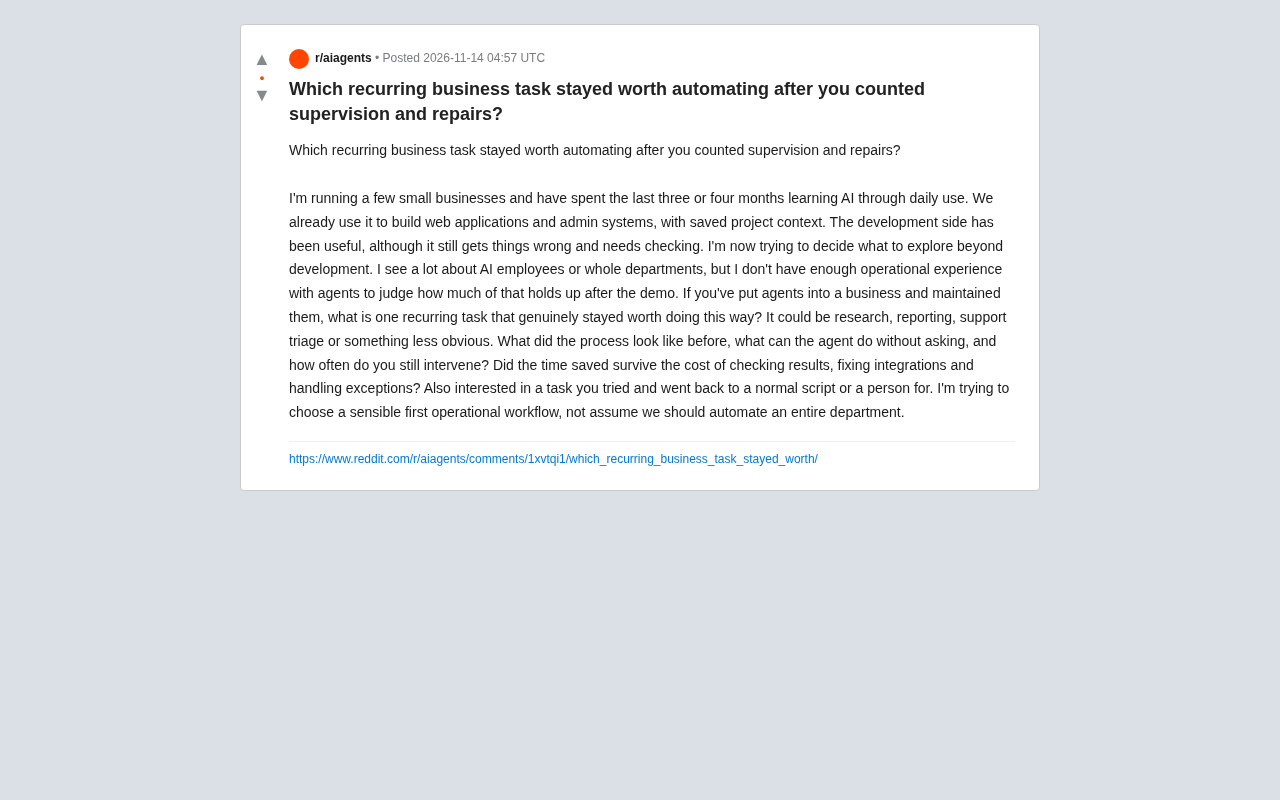
A small business owner on Reddit shared his confusion: after months of using AI to develop web apps and backend systems, development efficiency had indeed improved, but the AI still made mistakes and required human review. When he considered extending AI into operations, he found the market flooded with hype about "AI employees" and "AI departments," yet lacking real operational experience to judge whether these solutions would still hold up after the demo. He raised a key question: After subtracting the costs of oversight, fixing integrations, and handling exceptions, which repetitive business tasks are truly worth automating?
This question strikes at the core contradiction of current AI applications—we tend to count only the time saved by automation while ignoring the hidden costs required to keep automated systems running.
The Truth of Automation Economics: Time Saved Does Not Equal Net Benefit
The Hidden Cost Checklist
When evaluating any automation solution, the following costs must be factored in:
- Oversight cost: Time spent checking and validating AI output
- Repair cost: Troubleshooting integrations and handling exceptions
- Maintenance cost: Adjusting prompts and adapting to model updates
- Opportunity cost: Flexibility sacrificed by standardizing processes for automation
The business owner's own words are worth pondering: "Does the time saved hold up against the cost of checking results, fixing integrations, and handling exceptions?" This reminds us that the value of automation lies not in "what it can do" but in "whether the net benefit is positive."
Net Benefit in the context of automation refers to the balance remaining after subtracting total costs from the total benefits automation brings. Total benefits include not only direct labor time saved but potentially also reduced error rates and faster response times; total costs cover the oversight, repair, maintenance, and opportunity costs listed in this article. Many automation projects fail not because the technology is infeasible but because only explicit benefits (time saved) are counted while hidden costs are ignored. A practical estimation method: during a trial run, record the human intervention time, troubleshooting frequency, and additional communication costs caused by process rigidity for each task, convert these into time or money, and compare them with the time saved. Only when the net benefit is consistently positive and stable is automation worth scaling.
Why the "AI Employee" Narrative Is Misleading
AI agents in demo environments typically run under ideal conditions: clean inputs, clear boundaries, no need for exception handling. But real business is full of edge cases, system integration friction, and ambiguous judgments. Someone without actual operational experience can hardly distinguish the gap between demo and reality. As this business owner said, he "didn't have enough agent operations experience to judge how much of this would hold up after the demo."
AI Agent is fundamentally different from traditional automation scripts. A script executes a preset, fixed sequence of instructions with fully deterministic behavior; an AI agent, based on a large language model, can understand natural language instructions, perform a certain degree of reasoning and decision-making, and call tools (such as search, APIs, databases) to complete multi-step tasks. This flexibility allows it to handle unstructured inputs and ambiguous scenarios, but it also brings uncertainty: the same input may produce different outputs, and error patterns are difficult to exhaustively predict. An agent's "autonomy" is typically constrained through prompts, tool permissions, and guardrails, but the looser the constraints, the higher the oversight cost. Understanding this distinction is a prerequisite for evaluating the net benefit of automation—an agent's flexibility comes at a price, and that price shows up in oversight, exception handling, and output validation.
Candidate Task Evaluation: What Types of Work Are More Likely to Pass the Net Benefit Test
Based on community discussions and real-world cases, the following task types are more likely to maintain positive returns even after accounting for oversight costs:
Research Tasks: Structured Information Gathering
Typical scenarios: Competitor price monitoring, industry news summaries, supplier background checks.
Why it may work: The output of these tasks is easy to verify—prices can be checked, news can be traced. Errors usually manifest as omissions rather than fabrications, and repair costs are relatively manageable. The agent can run autonomously within preset boundaries and trigger human intervention only when anomalies are found.
Risk points: Changes in information sources may cause the agent to fail, requiring regular checks of the data pipeline.
Report Generation: Templated Data Summarization
Typical scenarios: Weekly report data filling, sales dashboard summaries, preliminary financial data organization.
Why it may work: Input and output structures are fixed, and verification costs are low. Humans only need to check numerical accuracy rather than regenerate the entire report.
Key prerequisite: Data sources must be stable, and format changes must be infrequent.
Support Ticket Triage: Classification and Routing
Typical scenarios: Customer inquiry classification, priority labeling, automated replies to common questions.
Why it may work: The impact of classification errors is limited (they can be corrected manually), and accuracy can gradually improve as feedback accumulates. The agent does not need to be fully autonomous—it can simply do triage and hand complex cases to humans.
Notes: Clear escalation rules and anomaly flagging mechanisms are needed.
Counterexamples: Tasks That Were Reverted to Scripts or Humans After Trying
The original poster specifically asked about "tasks that were reverted to regular scripts or humans after trying," which is an extremely valuable reverse perspective. Based on patterns that recur in the community:
Multi-Step Cross-System Operations
Tasks involving state changes across multiple systems (such as order processing or account provisioning) often consume enormous effort in exception handling. A failure at one step can lead to inconsistent states, and troubleshooting costs far exceed the time saved by automation. Reverting to scripts is a common choice—script behavior is deterministic, and failure points are clear.
Tasks with High Compliance or Accuracy Requirements
For tasks such as financial reconciliation and contract clause review, the cost of errors is too high, and manual review can hardly be omitted. Automation here becomes "assistance" rather than "replacement," with limited net benefit.
Scenarios with Highly Unstructured Inputs
When input formats change frequently (such as invoices from different suppliers or customer feedback from various channels), the agent needs frequent adjustments, and maintenance costs remain high. Reverting to humans or semi-automated processes is more economical.
Unstructured input refers to data with no fixed format and no predefined patterns, such as free-text emails, handwritten notes, invoices in different layouts, scanned documents, or chat logs. By contrast, structured data (such as database tables or fixed-format CSVs) is easy for programs to parse. One of the advantages of AI agents over traditional scripts is their ability to handle a certain degree of unstructured input, but this ability is not unlimited: when input formats change frequently or vary too greatly, the agent's parsing accuracy declines, requiring constant prompt adjustments or additional preprocessing steps, and maintenance costs rise accordingly. Therefore, when evaluating automation feasibility, you should measure the degree and frequency of variation in input formats—the greater the variation, the more likely a human fallback or a return to semi-automated processes is needed.
A Practical Framework for Choosing Your First Operational Workflow
The business owner's ultimate goal was to "pick a sensible first operational workflow, not assume we should automate an entire department." Here is an actionable decision framework:
Step 1: Map the Current Process
Record every step of the task from trigger to completion, noting: who does it, how long it takes, how often errors occur, and the consequences of errors. This exposes the real bottlenecks and risk points.
Step 2: Define the Agent's Autonomy Boundary
Clearly define the scope within which the agent can "act without asking." The narrower the scope, the lower the oversight cost. For example: the agent can automatically classify tickets, but any refund decision must be escalated to a human.
Step 3: Set Expectations for Intervention Frequency
Honestly assess the intervention frequency you are willing and able to tolerate. If intervention is needed multiple times a day, the net benefit of automation may be negative.
Step 4: Run a Small-Scale Trial
Run it on a subset for several weeks first, recording actual oversight time, number of repairs, and types of exceptions. Replace intuition with real data.
Step 5: Set Exit Criteria
Define in advance under what circumstances you will abandon automation and revert to scripts or humans. This helps avoid the sunk cost trap.
Conclusion: The Boundary of Automation Is an Economic Question, Not a Technical One
What an AI agent can do and whether it is worth doing are two entirely different questions. The way the Reddit business owner framed his question is itself worth learning from—he did not ask "what can AI automate" but "after subtracting oversight and repair costs, what is still worth automating." This net-benefit perspective is closer to business reality than any technical demo.
For businesses evaluating their first operational workflow, it is advisable to start with tasks that have low verification costs, mild consequences of errors, and stable input structures, and use real data to test whether the time saved can withstand the erosion of hidden costs. Automation is not the goal; sustainable net benefit is.
Related articles

A Billion-Dollar Deal: A Turning Point for the U.S. Battery Market?
Sila and Panasonic Energy sign a billion-dollar silicon-carbon anode supply deal. This article analyzes its impact on the U.S. next-gen battery market, supply chain localization, and commercialization prospects.

Holiday Extras Employee Treats AI Assistant Like a Pet: The Real Daily Work Life of Brian and Beast
Holiday Extras employee names AI assistant Beast, chats morning, noon and night, preps meeting data in advance and monitors tasks. A real user's workflow and low-barrier start tips.

Why a Computer Scientist Believes Superintelligence Won't Happen
Computer scientist Cal Newport argues from engineering that superintelligence is unlikely: recursive self-improvement is limited by data bottlenecks and compute constraints, superintelligence may be uncomputable, and LLM agent misbehavior stems from architecture, not alignment. He warns that chasing ASI is itself a dereliction.