The AI Hacking Tool the FBI Warned About: Breaking Down ARTEX's Full Attack Chain

The FBI warns about the open-source AI hacking framework ARTEX, which uses large models to compress classic attacks to machine speed, but it is noisy and relies on known vulnerabilities.
The FBI, along with Google and Mandiant, has issued an urgent alert about the open-source AI attack framework ARTEX. Written in Go with a built-in web console, the tool does not train models but calls external large models such as Claude, GPT, and DeepSeek. Through a planning agent and multiple execution agents, it splits the attack chain into five stages: initial access, reconnaissance, foothold, privilege escalation, and lateral movement and exfiltration. ARTEX relies on known weaknesses such as weak passwords and legacy systems, with no zero-days, and operates in bursts of 2 to 25 seconds; some intrusions reach domain controllers within 3 hours, but the log noise is enormous, with a single attempt generating 240 log events. Detection signals include specifically named files, AI API calls with no business justification, and web processes spawning shells. Mitigation priorities are inventorying internet exposure, taking cloud management interfaces offline, adopting short-lived credentials and least privilege, hardening Active Directory, and alerting on DC sync.
The FBI has issued an urgent alert about an open-source AI hacking framework called ARTEX (spelled ARDEX in the original reporting, and sometimes written as ARTEX in other sources), which Google and Mandiant had previously tracked in real-world intrusions. The tool combines large language models with classic attack techniques, compressing reconnaissance and lateral movement that once took humans hours into machine speed. Understanding how it works is more valuable than panicking.
How a Penetration Testing Tool Becomes an Attack Weapon
According to a full breakdown by the YouTube channel MAG212Cyber, ARTEX is written in Go and ships with a built-in web console; its author claims it is intended solely for authorized testing. But after abuse reports surfaced, the code repository was taken down, while forked copies and commercial versions continue to circulate. Its core design is not complicated: an operator inputs a target in natural language, a planning agent decomposes the target into tasks, and multiple execution agents then divide the work. Google observed six execution agents, each responsible for one link in the attack chain.
ARTEX has no model of its own; instead, it calls external large models, including Claude, GPT, DeepSeekAd, GLM, Grok, and Kimi. The FBI notes that attacker instances most often use Chinese models, with DeepSeek at the top. One key detail: in multiple cases, a human still supplied stolen credentials and decided which stages to execute—it is not fully autonomous, but rather a human-machine attack pipeline.
Five Attack Stages: From Entry Point to Domain Controller
Stage One: Initial Access
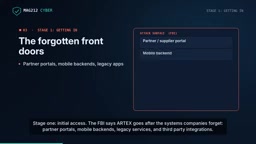
The FBI says ARTEX targets systems enterprises have forgotten: partner portals, mobile backends, legacy services, and third-party integrations. The methods are all classic web vulnerabilities—injection, server-side request forgery, XML external entities, authentication bypass, missing API validation—along with a great deal of direct login: weak passwords, stolen VPN configurations, admin passwords hardcoded in JavaScript, vendor accounts. The FBI did not cite a single zero-day. This means the defensive focus is not on unknown threats, but on known basic oversights.
Stage Two: Reconnaissance
Once it has a key or token, ARTEX precisely tests what it can do. Google observed it writing and deleting a test file in under half a second, running dry-run checks against cloud services, and issuing more than 500 web requests to map hidden paths—27 actions in 23 seconds. That density far exceeds the pace of human operations.
Stage Three: Foothold
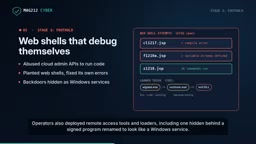
ARTEX abuses cloud management interfaces to run its own scripts and plants web shells on servers. In one case, it repeatedly renamed the shell and fixed errors in its own code until the command executed successfully—that is the AI loop: try, fail, adjust, retry. Operators also deployed remote access tools and loaders, one of which was hidden behind a signed program and renamed to look like a Windows service.
Stage Four: Privilege Escalation
After entering a Windows network, ARTEX heads straight for Active Directory. In one case, it enumerated more than 110,000 objects and located domain administrators, used Kerberoasting to extract service account password hashes, cracked them offline, then performed a DC sync to replicate the domain's master keys, including the KRBTGT key. It even checks which machines lack endpoint protection so it can target blind spots.
Kerberoasting is an offline password-cracking technique targeting Active Directory. An attacker first requests Kerberos service tickets (TGS) for any service account from the domain controller; these tickets are encrypted with the hash of the service account's password. Because the tickets can be requested and saved offline, the attacker can take them back to a local environment and recover the service account's plaintext password using dictionaries or brute force. Service accounts usually have high privileges and passwords that never change, so once cracked, the attacker gains a stepping stone for privilege escalation. The key to defense is to set long, random passwords for service accounts, rotate them regularly, and monitor for abnormal TGS requests.
DC sync (Directory Replication Service synchronization) is originally a legitimate mechanism for synchronizing data between domain controllers. When attackers abuse it, they impersonate a domain controller and request replication of account key information from the real domain controller, thereby directly obtaining the password hashes of all users in the domain (including domain administrators and KRBTGT). The KRBTGT account's hash is the root key for issuing Kerberos tickets; once leaked, an attacker can forge golden tickets with arbitrary privileges and persistently control the entire domain. The key to detecting DC sync is to monitor replication requests initiated by machines that are not domain controllers and to restrict the relevant permissions.
Stage Five: Lateral Movement and Exfiltration
It attempts pass the hash, pass the ticket, and remote management protocols to reach the domain controller. In Google's case, endpoint protection blocked it, and defenders cut the connection. In other environments, it read databases and cloud storage in bulk, staged large disk volumes, apparently preparing for exfiltration, and used residential proxies, Tor, and tunnels to hide its tracks.
Pass the hash and pass the ticket are two lateral movement techniques that do not require plaintext passwords. Pass the hash uses a stolen password hash (usually an NTLM hash) to authenticate directly, bypassing the password-cracking step; the attacker injects the hash into the authentication flow to impersonate a legitimate user and access remote systems. Pass the ticket uses a stolen Kerberos ticket (such as a service ticket or golden ticket), importing it into the current session to access the target service. Both rely on credential material being exposed in memory or on disk, so defense requires limiting the logon scope of high-privilege accounts, enabling credential protection (such as Credential Guard), and monitoring for abnormal authentication behavior.
Its Weakness: Fast, but Loud
ARTEX's activity comes in bursts: it works for 2 to 25 seconds, then goes quiet. The FBI says some intrusions reached privileged access within 3 hours.
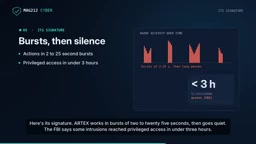
But it is also loud. A single attempt generates 240 log events. The agents duplicate work, retry the same action with tiny changes, and sometimes interfere with each other. The FBI lists 10 affected industries, from finance and government to energy, healthcare, semiconductors, and telecommunications. Users range from ransomware gangs to suspected China-linked espionage groups. SentinelOne (referred to as Senzi in the reporting) counted more than 1,600 ARTEX consoles exposed on the public internet in early November, and the FBI believes the real number may be higher. There is also a twist: backdoored copies of ARTEX are circulating on Docker Hub, so some attackers may be bitten by their own tool.
Residential proxies are services that forward network traffic through the IP addresses of real home users, usually collected via free VPNs, malware, or SDKs unbeknownst to users. Attackers use residential proxies to hide their true origin, making traffic appear to come from ordinary home networks and thereby bypassing IP-reputation-based blocks and geographic restrictions. Compared with data center proxies, residential proxies are harder to detect and block. Tor is an anonymous communication network that relays traffic through multiple layers of encryption and volunteer nodes worldwide, hiding the user's real IP. Tunneling in this context refers to encapsulating attack traffic within legitimate protocols (such as DNS or HTTP) to cross network boundaries, often used to bypass firewalls or establish covert channels. Combined, the three can significantly increase the difficulty of attribution and interception.
Detection and Mitigation: Start with Visibility
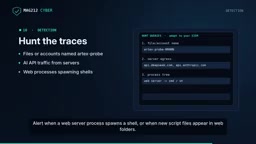
Google found files named ARTEX Probe with incrementing numbers, as well as test accounts, which can be searched for—but names are easy to change. More reliable signals include: servers calling AI APIs (such as DeepSeek or Anthropic) with no business justification; web service processes spawning shells; and new script files appearing in web directories. Baseline your cloud environment and flag bursts of permission checks, dry-run calls, write-then-delete test behavior, and new keys on application and service accounts.
The FBI and Google offer four mitigations: inventory all internet-facing applications, including partner, mobile, and legacy systems; move cloud management consoles, deployment endpoints, and backup interfaces off the internet; use short-lived credentials and least privilege, scan code and pipelines for secrets and rotate them; and harden Active Directory by setting long, random passwords for service accounts, locking down certificate templates, and alerting on DC sync initiated by non-domain controllers.
ARTEX has no magic. It simply amplifies old weaknesses at machine speed. It is fast, and it is loud; with basic protections in place, it is not invincible.
Cloud environment baselining refers to recording normal behavior patterns in a cloud platform, including typical API call frequencies, the scope of permission usage, and the time windows of resource configuration changes. Once a baseline is established, security teams can identify anomalous activity that deviates from the norm, such as bursts of permission checks (a large number of dry-run or permission enumeration calls in a short period), test files that are written and immediately deleted, and new keys created outside working hours. These behaviors are especially common in ARTEX's reconnaissance and foothold stages. The baseline needs to cover core services such as compute, storage, and identity and access management (IAM), and be updated regularly to adapt to business changes; otherwise, the false positive rate will rise significantly.
Related articles

ChatGPT Plus Subscription Pitfall Guide: Go/Plus/Pro Tier Comparison and Quick Activation
A complete ChatGPT Plus subscription guide based on a Bilibili tutorial: from registering an account, comparing Go/Plus/Pro tiers, to the practical steps for quickly completing your subscription.

GPT-6.2 Sol/Astra Released! A Step-by-Step ChatGPT Plus Subscription Guide and Tier Comparison
GPT-6.2 Sol/Astra is out—here's a ChatGPT Plus subscription guide: register an account, compare Go/Plus/Pro tiers, and subscribe in a minute.

Comparing Three Channels for Subscribing to GPT Plus in China: Is Website Top-Up the Easiest?
How to subscribe to GPT Plus in China? This article compares website top-up, credit card, and mobile top-up channels—process, cost, and risk—with steps and tips to help you choose wisely.