The AI Search Era: How Brands Stand Out in LLMs

AI search is reshaping brand discovery logic, and LLM answer generation and AI agents will define the next competitive battlefield.
Traditional SEO is being replaced by AI search, where users get LLM-generated answers directly through ChatGPT, Perplexity, and similar tools instead of blue links. Based on a Practical AI podcast conversation with Discovered Labs' founders, this article reveals the core mechanisms of AI search: LLM answers combine implicit knowledge in model weights with real-time retrieval; brands may be mentioned without citation, or heavily cited without occupying a central position; query fan-out splits a main query into multiple sub-queries; and the consensus mechanism favors multi-source agreement, giving Reddit higher weight. Brands must position themselves on two battlefields at once: historical presence in training data and current visibility in real-time retrieval. Looking ahead, AI agents will interact directly with websites and act on users' behalf, making API design, structured data, and machine-readable service descriptions as important as web design.
Traditional SEO is being reshaped by AI search. When users ask ChatGPT, Perplexity, or Google AI Overview a question, what they get back isn't a string of blue links but an answer generated directly by a large language model (LLM). This means the rules of the game for brand "visibility" have completely changed — you're no longer just fighting for rankings, you're fighting to be "remembered" and "cited" by the model.
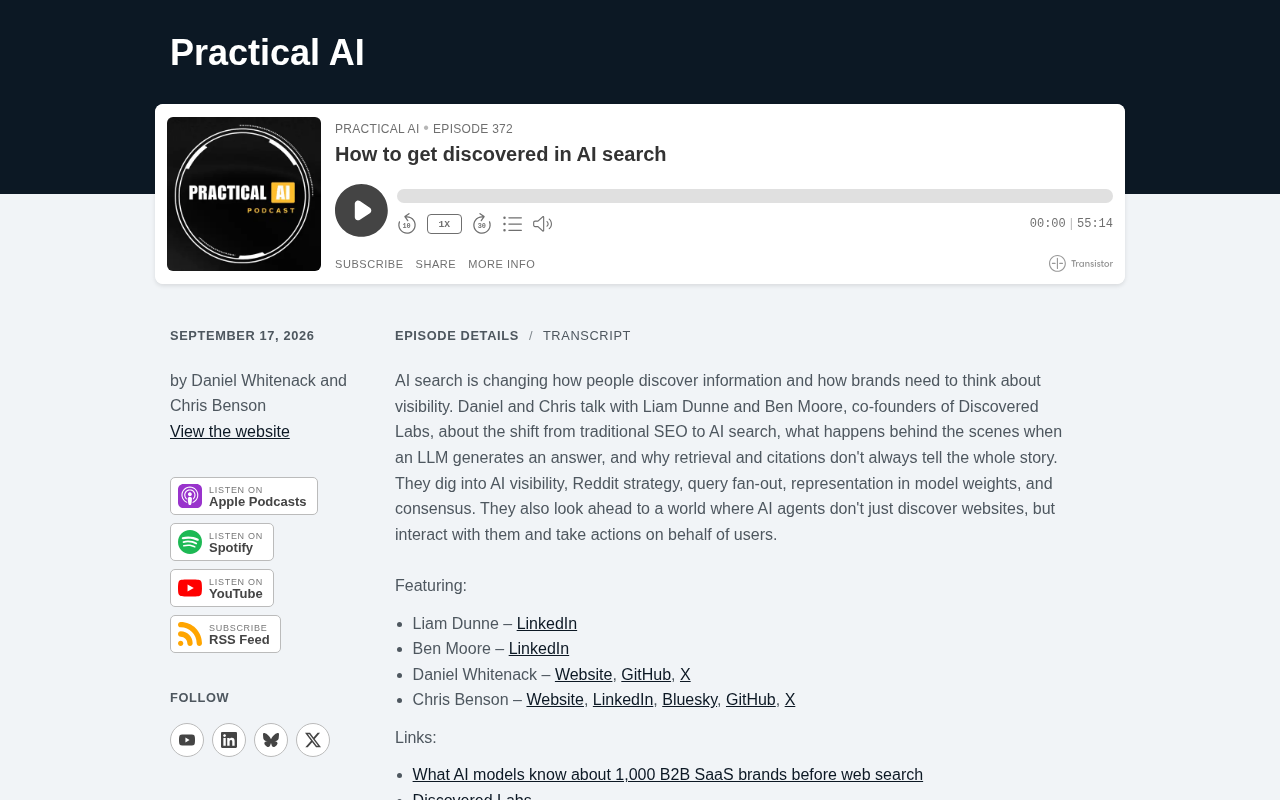
In an episode of the Practical AI podcast, Discovered Labs co-founders Liam Dunne and Ben Moore spoke with hosts Daniel Whitenack and Chris Benson about the paradigm shift from traditional SEO to AI search, revealing the mechanics behind how LLMs generate answers and how brands can achieve discovery in this new ecosystem.
What Actually Happens Behind the Scenes When an LLM Generates an Answer?
The first step to understanding AI search is grasping what an LLM is actually doing when you ask it a question.
Ben Moore points out that this process is not simply "retrieve and stitch together." When generating a response, an LLM draws on multiple layers of information sources: knowledge already encoded in the model's weights, web content retrieved in real time, and trustworthy information filtered through citation and consensus mechanisms.
Liam Dunne highlights a key insight: retrieval and citation don't always tell the whole story. A brand may be mentioned in an LLM's answer without appearing in any cited link — because the model may have already "learned" about the brand from its training data. Conversely, a brand being heavily cited doesn't necessarily mean it occupies a central position in the answer the user sees.
This gap between "implicit visibility" and "explicit citation" is the most easily overlooked dimension of AI search optimization.
Understanding this mechanism requires distinguishing between two paths through which LLMs acquire knowledge. Parametric knowledge refers to information the model compressed into its weights during training. It determines the model's "default awareness" of brands, concepts, and facts — fast to recall but slow to update, and hard to trace back to a source. Contextual knowledge, on the other hand, comes from real-time retrieval at inference time (such as RAG, retrieval-augmented generation), where the model injects search results into the context before generating an answer — highly timely but dependent on retrieval quality. The interplay between these two shapes the core challenge of AI search: a model may mention a brand from parametric memory without providing any clickable citation; or it may cite a pile of pages but only adopt one or two sentences when generating its answer. As a result, a brand's "presence" in AI search operates on two channels — it needs to leave clear, positive, repeatedly appearing traces in training corpora, and also maintain high authority and structural clarity in real-time retrieval.
From SEO to AI Visibility: The Rules Have Changed
The core logic of traditional search engine optimization is keyword matching and link authority. You optimize your page content, acquire high-quality backlinks, and fight for a top ranking on the search results page. Users click through to your site and complete a conversion.
But AI search breaks this chain. Users may never visit your website at all — the LLM delivers the answer directly in the conversation, and the user's information-gathering process is over.
The Discovered Labs research team once ran a test on 1,000 B2B SaaS brands: without relying on web search at all, how much do AI models know about these brands? The results showed that model weights already contain a great deal of brand information, and the accuracy and coverage of that information varies from brand to brand.
This means brands need to watch two battlefields simultaneously: their "historical presence" in model training data, and their "current visibility" in real-time retrieval.
Query Fan-out and Consensus Mechanisms: The Hidden Logic of AI Search
The podcast mentions two concepts that are crucial to AI search optimization: Query Fan-out and Consensus.
Query fan-out refers to how an LLM, when handling a user's question, may automatically generate multiple sub-queries, retrieve information across different dimensions separately, and synthesize it all into a single answer. This means your brand may not match the user's main query directly — instead, you need to stand out on some sub-query dimension.
The consensus mechanism is subtler still. When generating an answer, an LLM tends to adopt information that multiple sources agree on. If a brand is described in similar ways across Reddit, industry forums, news sites, and official documentation, the model is more likely to adopt that description in its answer.
Reddit's special position in the AI search ecosystem stands out for this reason. Multiple practitioners have observed that Reddit content carries high weight in LLM retrieval results, because community discussions often contain real user experiences and multi-angle perspectives, aligning with the model's preference for "consensus."
Retrieval-augmented generation (RAG) is the technical foundation for understanding query fan-out and consensus mechanisms. It refers to how an LLM, before generating an answer, first calls an external retrieval system (search engines, vector databases, etc.) to pull relevant documents, then organizes its response "based on" those documents. RAG lets models cite the latest information beyond their training data, but it also introduces a key problem: the quality of retrieved content directly determines the quality of the answer. Query fan-out is a typical manifestation of RAG at the inference stage — the model splits a user's single question into several sub-queries retrieved in parallel, each potentially hitting a different information source. The consensus mechanism then plays out during the answer synthesis stage: when multiple independent sources describe the same fact similarly, the model tends to adopt it; if sources contradict each other, the model may hedge or selectively cite. Understanding the RAG pipeline makes it clear why a brand's consistent expression across multiple authoritative channels matters more than keyword stuffing on a single page.
The AI Agent Era: From Being Searched to Being Used
In the latter half of the conversation, the four participants pull their vision toward a more distant future: when AI agents can not only discover websites but directly interact with them and take action on behalf of users, the definition of brand visibility will be rewritten once again.
Imagine a scenario: a user's AI assistant needs to book a flight. It automatically visits multiple airlines' systems, compares prices, times, and services, then completes the booking. In this process, brands no longer need to persuade human users through visual design or marketing copy — instead, they need to make their systems "readable, interactive, and trustworthy" to AI agents.
This means API design, structured data, and machine-readable service descriptions will become as important as web design is today.
Liam Dunne and Ben Moore suggest that brands should start thinking now: when your users become AI agents, how will your products and services be understood and recommended by machines? The answer to this question may determine a brand's survival over the next decade.
AI Agents refer to large-model systems with autonomous planning, tool-calling, and task-execution capabilities, fundamentally different from simple Q&A chatbots. Agents can not only "read" web pages but also initiate requests, fill out forms, and complete transactions via APIs. At the web readability level, this has spawned optimization standards aimed at machines: llms.txt is an emerging convention in which websites describe their structure, core content, and licensing terms to models in Markdown format; structured data (such as Schema.org) helps models accurately understand entity attributes like products, prices, and inventory. At the same time, agent-website interaction also relies on standardized interfaces such as MCP (Model Context Protocol), enabling models to call external services in a unified way. For businesses, this means websites must upgrade from "made for humans to view" to "made for machines to call" — clear API documentation, stable interfaces, and semantic data fields will become a brand's ticket into the agent ecosystem.
One-line Summary
AI search is reshaping brand discovery logic, and LLM answer generation mechanisms and AI agents will define the next competitive battlefield.
Paragraph Summary
Traditional SEO is being replaced by AI search, with users getting LLM-generated answers directly through ChatGPT, Perplexity, and similar tools rather than blue links. Drawing on a conversation between the Practical AI podcast and the founders of Discovered Labs, this article reveals the core mechanisms of AI search: LLM answers are composed of implicit knowledge in model weights plus real-time retrieval; brands may be mentioned without citation, or heavily cited without occupying a central position; query fan-out makes models automatically split a main query into multiple sub-queries; and the consensus mechanism favors information consistently endorsed by multiple sources, giving Reddit higher weight. Brands need to position themselves simultaneously on two battlefields: historical presence in training data and current visibility in real-time retrieval. Looking ahead, AI agents will interact directly with websites and act on behalf of users, making API design, structured data, and machine-readable service descriptions as important as web design.
Related articles

Amphibious Transforming Drone: Beyond 100x Power Savings, What Are the Real Needs?
Is the amphibious transforming drone just a gimmick? Starting from the 100x power difference of the M4 Morphobot, explore real application scenarios and thesis topic ideas, analyzing boundary conditions where pure drones and pure ground robots both fail.

Warhound Raises $200 Million: Genetically Engineered "War Dogs" Paired with Anduril Gear
Warhound raises $200M, backed by Ben Lamm and Palmer Luckey, to genetically engineer dogs for military and law enforcement use and equip them with Anduril gear. This article analyzes its technology direction, funding logic, and ethical controversy.

Claude API Comes to Google Cloud: IAM Integration and SDK Access Guide
Anthropic hosts the full Claude API on Google Cloud with IAM-controlled permissions and unified billing. This guide covers the Vertex AI and Anthropic-hosted entry points, IAM role configuration, and SDK access.