The Always-On AI Engineer: A New Ops Approach for Businesses That Never Sleep
AI on-call engineers handle the first half of failure response, compressing response time but unable to replace humans.
Starting from a tweet about a "sleepless on-call engineer," the article identifies the structural contradiction between 24/7 business operations and engineers' physiological limits. The author argues that AI on-call's reasonable role is not to replace people but to handle the first half of failure response: receiving alerts, correlating logs and metrics, retrieving historical incidents, providing preliminary judgments and suggestions, and escalating to wake a human when necessary—freeing people from information triage. For such solutions to be truly usable, three thresholds must be crossed: context quality (observability data completeness), the asymmetric costs of false positives and false negatives (determining how cautious escalation strategies should be), and permission and security boundaries (least privilege, auditing, rollback). Short-term benefits are shorter response times and fewer nighttime interruptions; long-term value is the structured precipitation of ops knowledge—but on-call will not disappear.
Starting from a Tweet: When the "On-Call Engineer" No Longer Needs Sleep
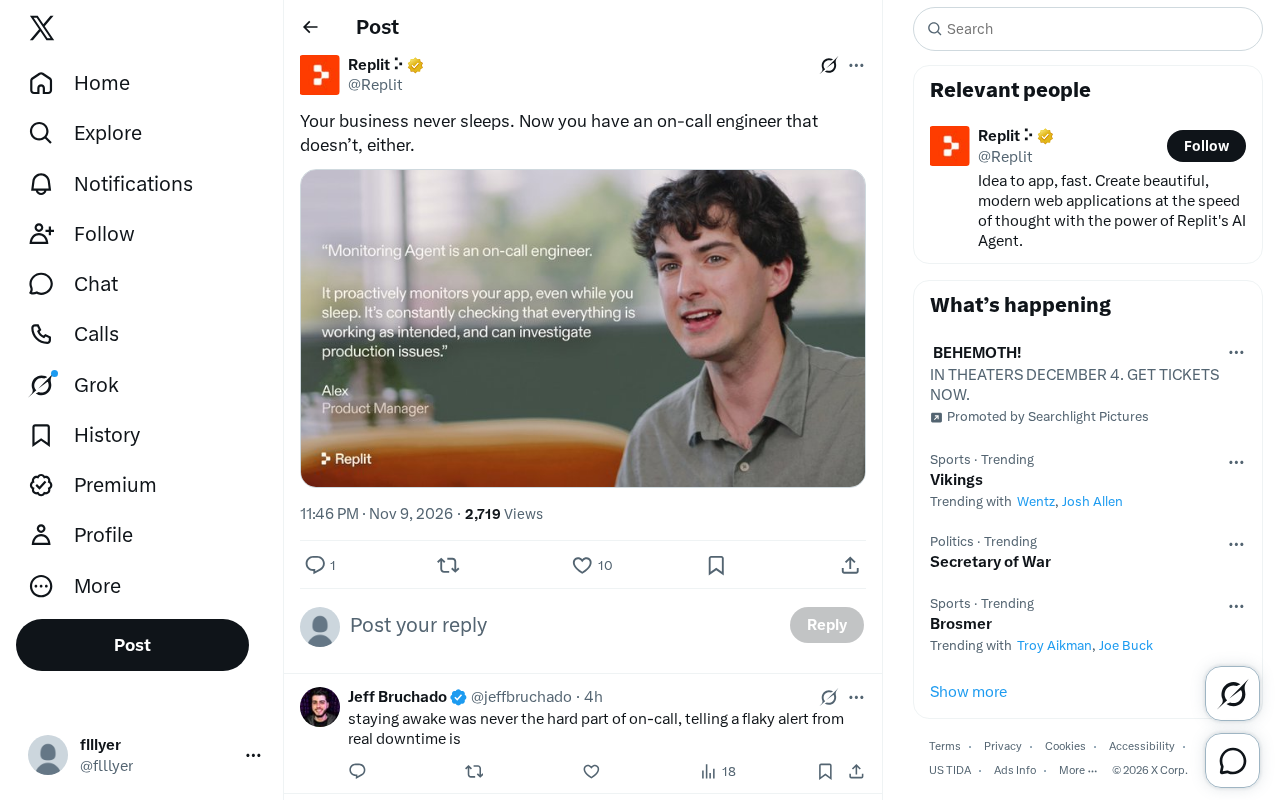
Recently, a tweet from a social platform sparked extensive discussion among ops and engineering teams: "Your business never sleeps. Now you have an on-call engineer that doesn't, either." The tweet included a product link pointing to an automated operations solution designed for business continuity scenarios.

This statement resonated because it pinpoints a structural contradiction in modern software teams: users and businesses are online 24/7, but the engineers responsible for safeguarding them cannot always be awake. The on-call system is essentially about using human physiological limits to hedge against system unreliability, and the introduction of AI is attempting to rewrite this equation.
(Note: The original material only includes the tweet text and a screenshot, without disclosing specific product names, implementation details, or performance data. The analysis in this article is based on the industry trends indicated by the text.)
What Problem Does the "Sleepless On-Call Engineer" Actually Solve?
The Root of On-Call Pain: Too Many Alerts, Slow Judgment, Scattered Context
In traditional on-call workflows, the most time-consuming part for engineers is often not the fix itself, but rebuilding context after being woken up at 3 AM: Which service does this alert correspond to? Have there been any related changes recently? Is this an intermittent fluctuation or a real failure? Are there similar cases in historical tickets?
Individually, none of these actions are complex, but chained together they create response delays of ten minutes or more—and this window is precisely when the impact of a failure expands.
On-call is a common practice in software operations: teams rotate shifts according to a schedule, and the on-call engineer bears first-response responsibility for production alerts and failures during their designated period, usually with an escalation chain (e.g., if the primary on-call doesn't respond, the secondary is automatically paged). Its core assumption is that systems will inevitably fail, so someone needs to be on standby at all times. Related common concepts include SLO/SLI (Service Level Objective/Indicator) and alert fatigue: when alert volume exceeds human processing capacity, engineers gradually become desensitized to alerts, and real failures are more easily overlooked. Understanding this is essential to understanding why "reducing nighttime interruptions" is itself a quantifiable engineering goal, not just a welfare issue.
The Value of AI On-Call Is Not "Replacing People" but "Processing Information First"
The reasonable positioning of solutions like the "sleepless engineer" is to handle the first half of failure response: receive alerts in real time, correlate logs and monitoring metrics, retrieve historical incidents, provide preliminary judgments and remediation suggestions, and escalate to wake a human only when necessary. It frees human energy from information triage and concentrates it on the decision-making steps that truly require judgment.
For Such Solutions to Be Truly Usable, Several Thresholds Must Be Crossed
Context Quality Determines the Ceiling
The effectiveness of ops AI depends heavily on whether the signals it can see are complete—metrics, logs, traces, change records, and ticket history are all indispensable. If it can only see isolated alerts, its judgment value is greatly diminished. This also means that deploying such a solution is essentially a health check of the observability system.
The "metrics, logs, and traces" mentioned in the article are the three pillars of Observability. Metrics are numerical time series, suitable for detecting trends and triggering alerts; logs are discrete event records, suitable for pinpointing specific errors; traces record the call path and latency of a single request across microservices, suitable for determining which hop the failure occurred at. The three complement each other: metrics tell you "something is wrong," traces tell you "where the problem is," and logs tell you "why." In addition, change records are critical because a significant proportion of production failures are caused by recent releases or configuration changes. Incorporating "what was recently changed" into reasoning is often more effective at quickly identifying root causes than simply looking at monitoring alone.
The Asymmetric Costs of False Positives and False Negatives
The on-call scenario has stringent accuracy requirements at both ends: false positives create a "boy who cried wolf" effect, causing teams to gradually ignore alerts; false negatives can directly lead to failure escalation. Therefore, such products typically require cautious escalation strategies—low-risk actions are executed automatically, while high-risk actions must be manually confirmed.
Permission and Security Boundaries
An AI on-call engineer that can autonomously read production environment data and even execute some operations is itself an object that requires strict governance. The principle of least privilege, operation auditing, and rollback mechanisms are all unavoidable design considerations during implementation.
The Principle of Least Privilege requires that any entity should only possess the minimum set of permissions necessary to fulfill its responsibilities. For an AI on-call engineer, this means the scope of production data it can read and the types of operations it can execute (e.g., read-only diagnostics, restarting instances, rolling back releases) should be authorized in tiers rather than granting all capabilities at once. Complementary measures include operation auditing (recording the inputs, rationale, and actions of every automated decision for post-incident review and accountability) and rollback mechanisms (ensuring that automatically executed changes can be quickly reverted). In regulated industries such as finance and healthcare, these governance requirements are often hard requirements for compliance audits, directly affecting whether a solution can pass launch review.
What This Means for Engineering Teams
In the short term, the most realistic benefit of such tools is reducing mean response time and lowering the frequency of nighttime interruptions; in the long term, they may drive ops knowledge from being "hidden in senior engineers' heads" to being "precipitated into searchable, reusable structured assets."
But they will not make the on-call system disappear. The more automated the system, the more people need to provide a safety net for the failure of automation itself. The truly healthy state is: AI is responsible for sleepless observation and initial screening, while humans are responsible for making judgments at critical junctures—each performing its own role rather than replacing the other.
For teams evaluating similar solutions, it is recommended to start with a clearly defined pain point scenario (e.g., nighttime alert noise reduction or preliminary failure triage), validate its judgment quality with real incidents, and then consider expanding the scope. After all, an "on-call engineer" that confidently gives wrong conclusions at 3 AM is more trouble than none at all.
MTTR (Mean Time To Recovery) and MTTD (Mean Time To Detect) are two commonly used metrics for measuring failure response capability. AI on-call primarily compresses the segment from alert generation to preliminary judgment—that is, it leans toward MTTD and the front-end of response. The actual repair time also depends on system architecture, release processes, and other factors. Correspondingly, "nighttime interruption frequency" can be measured by the number of off-hours alerts per shift or the number of times woken up. When evaluating such solutions, teams are advised to compare the same set of metrics before and after introduction, rather than judging effectiveness based on subjective impressions alone.
One-line Summary
AI on-call engineers handle the first half of failure response, compressing response time but cannot replace humans.
Paragraph Summary
The article starts from a tweet about a "sleepless on-call engineer," pointing out the structural contradiction between businesses being online 24/7 and the physiological limits of engineers. The author argues that the reasonable positioning of AI on-call is not to replace people but to handle the first half of failure response: receiving alerts, correlating logs and metrics, retrieving historical incidents, providing preliminary judgments and suggestions, and escalating to wake a human when necessary—thereby freeing people from information triage. For such solutions to be truly usable, three thresholds must be crossed: context quality (whether observability data is complete), the asymmetric costs of false positives and false negatives (which determine how cautious escalation strategies should be), and permission and security boundaries (least privilege, auditing, rollback). Short-term benefits include shorter response times and fewer nighttime interruptions; long-term value lies in the structured precipitation of ops knowledge—but on-call will not disappear.
Related articles

Hugging Face Inference Routing Fully Moves to OpenRouter
Hugging Face fully migrates inference routing to OpenRouter, automatically selecting the best inference provider. Open-weight models account for 81% of calls, Pro accounts get $2/month (~150M tokens), no markup, with provider filtering and spending limits.

Claude Code v2.1.329 Update Explained: Trust Dialog and Code Mode Enhancements
Claude Code v2.1.329 update analysis: new hook trust dialog and MCP server error prompts, Code Mode fixes memory leaks and tool call boundaries, /tasks consolidates session task view, and fixes multi-session login and file reading issues.

Apple Recruits AI Agent Engineer: A New Ace After Siri?
Apple is recruiting an engineer to lead the development of an agentic AI assistant that can browse the web, work across apps, write code, and invoke services. This article analyzes Apple's motivations, technical challenges, and industry impact.