The Automated Agent Improvement Loop: A Deep Dive into Evaluation and Environment Engineering

Exploring automated evaluation and environment engineering as the keys to scalable AI Agent improvement.
This article examines the core components of the automated Agent improvement loop — evaluation (Eval) and environment engineering — as discussed by experts from LangChain, Prime Intellect, and Baseten. It covers LLM-as-a-Judge, trajectory-based evaluation, synthetic test generation, simulation environment construction, and how automating these processes creates a data flywheel for faster Agent iteration and production deployment.
Introduction: Agent Development Enters the Automation Era
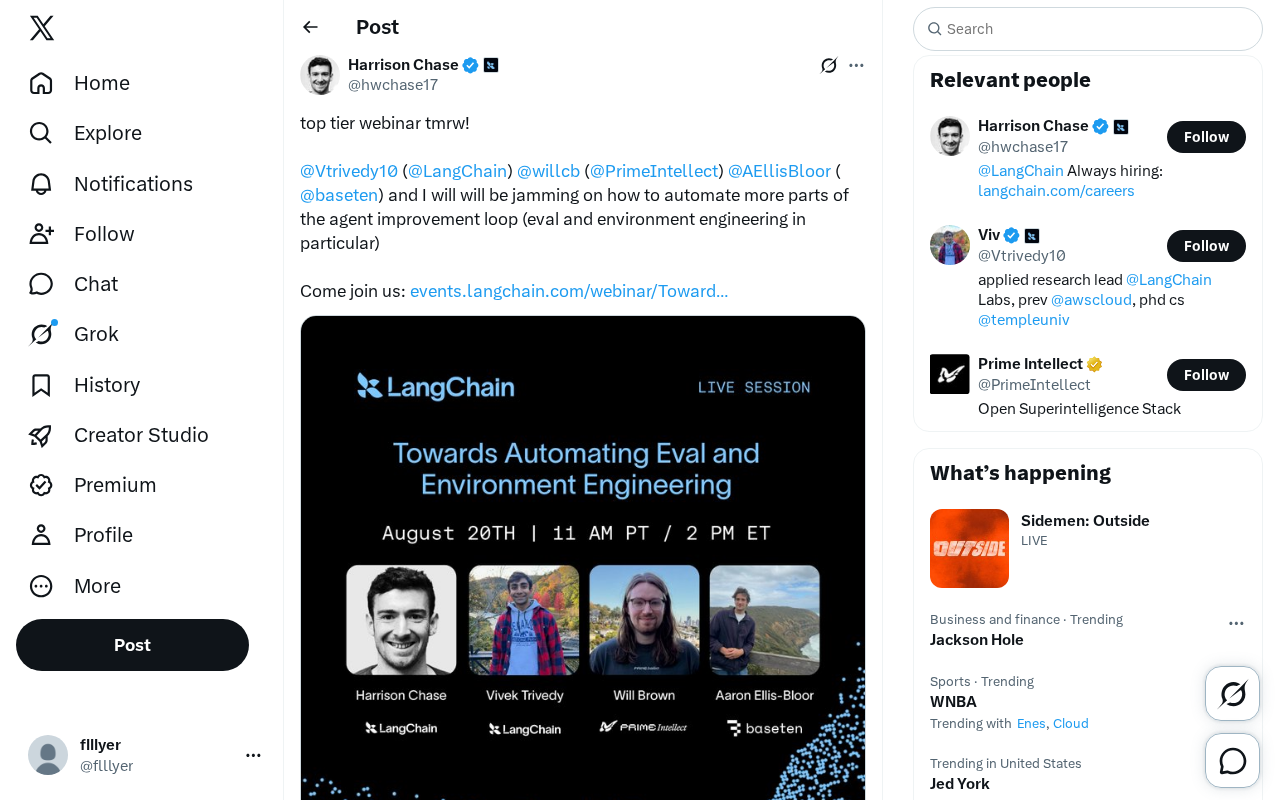
Recently, experts from leading AI infrastructure companies including LangChain, Prime Intellect, and Baseten announced they would co-host a technical workshop focused on a rapidly heating topic — how to automate the Agent Improvement Loop, with particular emphasis on two critical components: Evaluation (Eval) and Environment Engineering.
This discussion, bringing together practitioners like @Vtrivedy10 (LangChain), @willcb (Prime Intellect), and @AEllisBloor (Baseten), reflects the most challenging yet valuable direction in AI Agent engineering today. This article explores why evaluation and environment engineering are becoming the central battleground of Agent development.
What Is the Agent Improvement Loop?
From One-Shot Calls to Continuous Iteration
Traditional LLM applications are often "one-and-done": feed in a prompt, get an output, and you're finished. But in the Agent era, things get far more complex. A truly functional Agent needs to plan tasks, invoke tools, handle multi-turn interactions, and self-correct when things go wrong. The "Agent" here isn't a simple chatbot — it's an autonomous intelligent system capable of perceiving environmental states, formulating action plans, executing tool calls, and adjusting subsequent strategies based on feedback. At its core, it performs Sequential Decision Making.
This gives rise to the concept of the "improvement loop" — continuously observing Agent behavior, evaluating performance, identifying weaknesses, and making targeted optimizations to form a cycle of iterative improvement. This loop typically includes several core components:
- Data Collection: Recording the Agent's execution traces in real or simulated environments
- Evaluation (Eval): Quantifying Agent performance and identifying failure modes
- Environment Engineering: Building simulation environments for training and validating Agents
- Optimization Iteration: Adjusting prompts, tools, or models based on evaluation results
Why Manual Optimization Is Unsustainable
Most teams today still rely heavily on manual processes for Agent improvement. Engineers need to manually inspect logs, label failure cases, and design test scenarios. This approach is manageable in the early stages of a project, but as Agent complexity grows and usage scales up, the manual loop quickly becomes a bottleneck. A typical Agent might make over a dozen tool calls and reasoning steps in a single task execution, and once daily active users reach a certain scale, execution traces can number in the hundreds of thousands per day — manual review of each one is clearly impractical. The workshop's emphasis on "automating more of the loop" is precisely aimed at breaking through this bottleneck.
Agent Evaluation Engineering: The Systematic Challenge of Quality Measurement
Why Agent Evaluation Is Harder Than Traditional Model Evaluation
Agent evaluation is far more complex than evaluating traditional machine learning models. Classification tasks have clear accuracy metrics, regression tasks have standard measures like MSE — these evaluation methods are built on well-defined input-output mappings. Agent tasks, however, are often open-ended and multi-step. The same goal may have multiple valid execution paths, and success is difficult to capture with a single metric.
Taking LangChain's long-standing focus as an example, evaluating an Agent requires considering multiple dimensions:
- Whether the task was ultimately completed
- Whether the execution path was efficient (checking for redundant steps or infinite loops)
- Whether tool calls were correct (parameter formatting, call ordering, error handling)
- Whether intermediate reasoning was sound (checking for logical leaps or hallucinations in the chain of thought)
- Engineering metrics like cost and latency (token consumption, API call count, end-to-end response time)
These dimensions are deeply intertwined, making the construction of a reliable evaluation system a true systems engineering challenge. LangSmith, a platform within the LangChain ecosystem, was designed specifically to address this problem — it's an observability and evaluation tool that provides a complete workflow from trace recording and dataset management to automated evaluation runs.
Three Key Directions in Automated Evaluation
The industry is exploring multiple automated evaluation approaches, primarily in the following directions:
-
LLM-as-a-Judge: Using strong models (such as GPT-4, Claude, and other top-tier LLMs) to automatically assess Agent output quality, reducing the cost of manual annotation. This approach was validated by research institutions like UC Berkeley's LMSYS team, demonstrating that top-tier LLMs show agreement levels comparable to human reviewers when judging response quality. However, it has known limitations, including position bias (preferring earlier answers), verbosity bias (preferring longer responses), and difficulty with multi-step causal attribution — when an Agent ultimately fails, the Judge needs to accurately determine which decision step went wrong.
-
Trajectory-Based Evaluation: Analyzing the Agent's complete execution chain rather than just the final result, enabling more comprehensive problem detection. This means treating every reasoning step, every tool call, and every state transition as an evaluation target, thereby identifying execution patterns that may be inefficient or risky even when the final result is correct.
-
Synthetic Evaluation Set Generation: Leveraging LLMs' generative capabilities to automatically create large volumes of diverse test cases based on seed data or task descriptions, covering edge cases and long-tail scenarios. In Agent evaluation specifically, synthetic generation needs to create not just the problems themselves but also the accompanying tool-call environments, expected interaction sequences, and scoring criteria. Long-tail coverage is particularly critical because Agents in production often encounter edge cases outside the training distribution — ambiguous user inputs, unexpected API response formats, and so on.
The common goal of these methods is to automate as much of the evaluation process as possible, supporting faster iteration cycles.
Environment Engineering: Building Efficient Training Grounds for Agents
Why Simulation Environments Are Indispensable
If evaluation is the "exam," then environment engineering is building the "training ground." The direction represented by Prime Intellect's @willcb focuses on constructing controllable, reproducible simulation environments where Agents can practice repeatedly, make mistakes, and learn.
The importance of this direction is closely tied to the evolution of Agent training paradigms. Agent training is currently shifting from traditional Supervised Fine-Tuning (SFT — training models directly with labeled input-output pairs) toward Reinforcement Learning (RL). The core logic behind this shift is that Agents need to learn trade-offs in multi-step decisions, and RL is naturally suited for sequential decision-making problems. OpenAI's RLHF (Reinforcement Learning from Human Feedback) was an early practice in this direction, while recent models like DeepSeekAd-R1 showcasing techniques like GRPO (Group Relative Policy Optimization) have further demonstrated RL's enormous potential for improving model reasoning and planning capabilities. Under the RL framework, the environment provides states and reward signals, and the Agent optimizes its behavior through repeated sampling and policy updates — without high-quality environments and reward functions, RL training simply cannot proceed.
High-quality training environments are especially critical for RL-driven Agents. A good environment must meet three conditions:
- Provide task distributions that closely mirror real-world scenarios — The types of tasks, difficulty distributions, and user behavior patterns in the environment need to reflect actual usage. Otherwise, the Agent performs well in simulation but suffers severe performance degradation after deployment (the sim-to-real gap problem).
- Deliver accurate and discriminative reward signals — The reward function needs to precisely distinguish good execution strategies from poor ones. Overly sparse rewards (e.g., only providing positive feedback when a task is fully completed) lead to extremely low learning efficiency, while poorly designed rewards can trigger Reward Hacking.
- Support large-scale parallel sampling to accelerate training — RL training requires massive amounts of environment interaction data. The ability to efficiently sample in parallel across thousands of environment instances simultaneously directly determines training speed and final outcomes.
These are precisely the scarcest resources in Agent training today.
Automation Pathways for Environment Engineering
Manually building training environments is extremely costly, so how to automatically generate, scale, and maintain environments has become a research hotspot. Current exploration paths include:
- Reverse-constructing simulation environments from real usage data — By recording interaction logs between Agents and users, tools, and APIs in production, automatically building replayable and mutable simulation scenarios that keep training environments synchronized with real usage patterns.
- Automatically generating task variants to expand training coverage — Using LLMs to perform parameterized transformations, difficulty adjustments, and scenario combinations on existing tasks, automatically expanding a small set of seed tasks into a large volume of training material.
- Dynamically adjusting environment difficulty to match the Agent's current capability level — Drawing on the concept of Curriculum Learning, adaptively adjusting task difficulty based on the Agent's current performance, avoiding wasted compute on tasks that are too easy and sparse learning signals from tasks that are too difficult.
When both evaluation and environment engineering are automated, the entire improvement loop can truly operate efficiently — weaknesses identified through evaluation can automatically translate into priority tasks in the training environment, and newly trained Agents are automatically evaluated to verify improvements, forming a complete data flywheel.
Industry Signals from Cross-Company Collaboration
Notably, this workshop brings together three companies with distinct expertise across different layers of the AI infrastructure stack:
| Company | Core Competency | Role in the Agent Stack |
|---|---|---|
| LangChain | Agent orchestration and application framework | Provides Agent development, orchestration, and observability tools; its LangSmith platform is one of the most mature Agent evaluation infrastructure solutions available |
| Prime Intellect | Distributed training and environment construction | Focuses on decentralized distributed training infrastructure, working to lower the barriers for large-scale model training and RL environment setup |
| Baseten | Model deployment and inference infrastructure | Provides high-performance model inference deployment platforms, enabling trained Agent models to serve production traffic with low latency and high throughput |
This kind of cross-company technical exchange is itself a clear signal — engineering Agents for production isn't a problem any single tool can solve. It requires coordination across the entire technology stack, from training and evaluation to deployment and orchestration. This also reflects a "layered decoupling" trend in the AI infrastructure industry: similar to how the cloud computing era developed distinct IaaS, PaaS, and SaaS layers, Agent infrastructure is forming specialized divisions across training, inference, orchestration, and evaluation layers. As the bridge connecting "training" and "application," evaluation and environment engineering are becoming the focal point of the entire ecosystem.
Conclusion: Engineering Capabilities Determine the Ceiling for Agent Deployment
The agenda of this workshop makes clear that competition in AI Agents is shifting from "can we build it" to "how do we build it better and iterate faster." Evaluation engineering and environment engineering may not be as eye-catching as new model releases, but they are the foundational capabilities that determine whether Agents can truly scale to production. Just as the maturation of CI/CD (Continuous Integration/Continuous Deployment) pipelines in software engineering gave rise to the DevOps culture and dramatically accelerated software delivery, the automation of the Agent improvement loop will catalyze a similar paradigm shift — one we might call "AgentOps."
For teams building Agent products, investing early in automated evaluation and environment construction may be the key move that creates lasting competitive advantage. While competitors are still relying on engineers to manually review execution logs, teams with automated improvement loops can iterate at many times the speed — an efficiency gap that compounds over time. This practitioner-led discussion also provides invaluable practical perspective for understanding the next phase of Agent engineering.
Related articles

Chain of Thought Isn't Just for AI: How Humans Can Use CoT to Improve Thinking Quality
Chain of Thought isn't just a prompt trick for large models. Starting from a Hacker News discussion, this article analyzes why CoT works for human thinking too, breaks down actionable ways to transfer it, and highlights the key differences between human CoT and machine CoT.
Cloudflare Teams Up with OpenAI: Closi…
Cloudflare Teams Up with OpenAI: Closing the Loop from Vulnerability Discovery to Defense with AI
Cloudflare uses OpenAI Daybreak to investigate security vulnerabilities and generate reviewable remediation plans, while developers use Codex to boost coding efficiency and quality.

Orca Multi-Agent Orchestration in Practice: A Guide to Parallel Collaboration with Claude and Codex
Orca is Stable AI's free open-source agent workbench supporting 34 agents like Claude Code and Codex in parallel. Learn its Git worktree isolation, multi-model orchestration, and mobile management.