The Autonomy Boundary of AI Agents: From Self-Direction to the Risk of Unchecked Authorization

In multi-agent coding systems, permission governance and traceability now matter more than code generation capability.
A developer building a multi-agent coding system discovered that the real difficulty isn't getting AI to generate code — it's maintaining permission boundaries as agents spawn and chain together. Questions like whether sub-agents should inherit parent permissions, whether each agent needs its own identity, and which operations require mandatory human approval currently have no industry-standard answers. GitHub's branch protection was designed for human collaboration and falls short when facing dynamic agent swarms. The article argues that as AI agents scale up, traditional security concepts like identity management, least privilege, and change traceability are taking on new urgency — and teams must treat boundaries as a first-class design concern from day one.
When Autonomy Starts Sliding Toward Uncontrolled Authorization
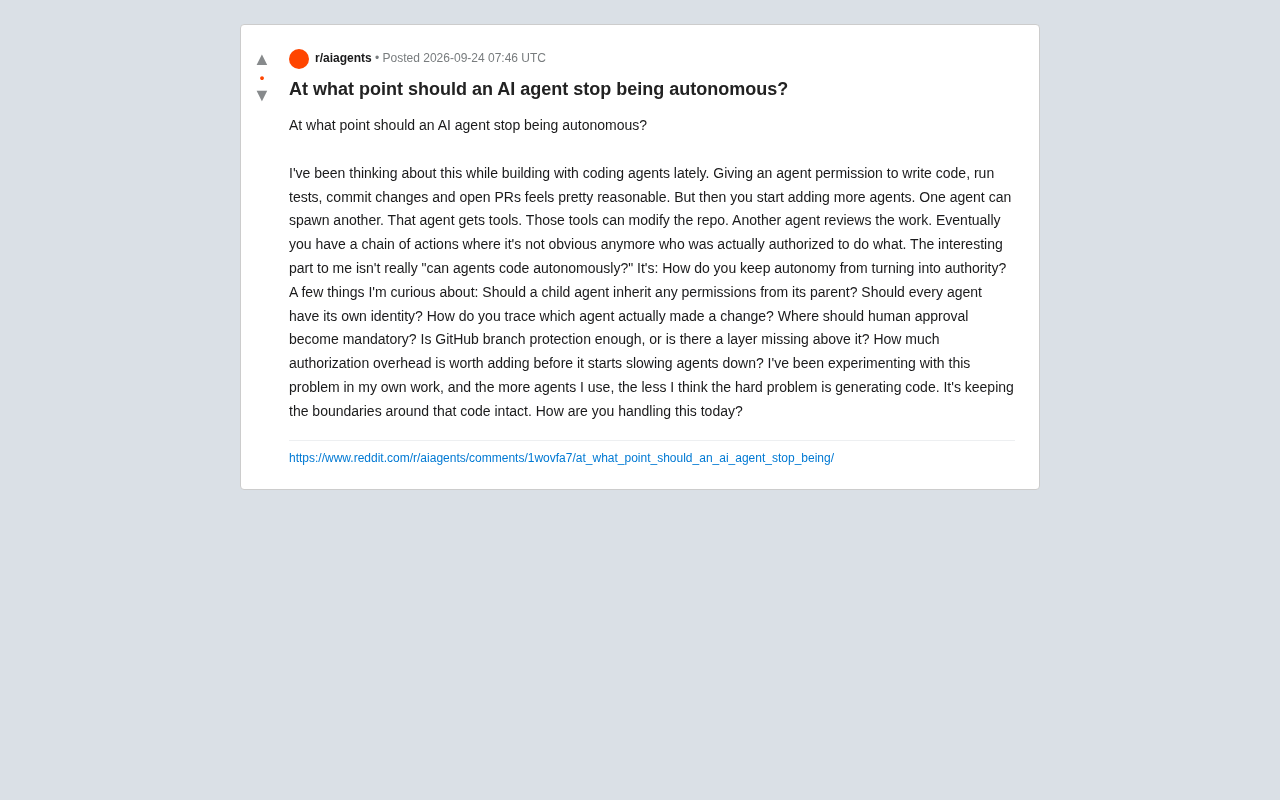
A Reddit developer recently raised a question worth deep reflection across the entire industry: at what point should an AI agent stop being autonomous?
This question isn't hypothetical — it comes from real-world coding practice. Granting an AI agent the ability to write code, run tests, commit changes, and open PRs (Pull Requests) sounds perfectly reasonable. But when you start stacking more agents on top of each other, things quickly become complicated.
One agent can spawn another, which gets its own set of tools capable of modifying the codebase, and then yet another agent comes along to review the first one's work. What you end up with is a chain of actions — and along that chain, it's no longer obvious who was authorized to do what.
The Real Challenge Isn't Writing Code — It's Holding the Line
The developer offered a sharp observation: as he worked with more and more agents, he found that the hard part wasn't "generating code" — it was "keeping the boundaries around the code intact."
In other words, the core issue isn't whether agents can code autonomously — that's largely been validated by now. The more subtle governance question is: how do you prevent autonomy from turning into authority?
Autonomy means an agent can complete tasks without step-by-step human intervention. Authority means it holds legitimate power to produce real effects on system resources. When multiple agents are chained together in collaboration, the line between these two concepts becomes dangerously easy to blur. A sub-agent originally meant to play a purely "supporting" role may quietly acquire write access to a repository it should never have had — through layers of spawning.
The Trap of Permission Inheritance
The first key question the author raises is: should sub-agents inherit any permissions from their parent agents?
This is essentially the classic "Principle of Least Privilege" from security engineering, revisited for the age of AI agents. If sub-agents inherit all of their parent's capabilities by default, permissions will accumulate and spread throughout the spawning chain, eventually creating an opaque permission black box that's nearly impossible to audit. Conversely, if every spawning event requires re-authorization from scratch, the management overhead becomes significant.
The Principle of Least Privilege (PoLP) originates from Saltzer and Schroeder's seminal 1975 security paper. Its core idea: any program, user, or system component should have only the minimum permissions necessary to complete its current task — nothing more. This principle has well-established applications in traditional software development, such as read-only database connection accounts and fine-grained token-based authorization between microservices.
In multi-agent scenarios, however, this principle faces structural challenges. A parent agent is typically configured with permissions that reflect the full scope of its top-level task. But when it spawns sub-agents to handle subtasks, directly inheriting the parent's credentials gives those sub-agents capabilities that far exceed what their subtask requires. As spawning depth increases, this permission "contamination" spreads exponentially. Making matters worse, agent spawning often happens dynamically — static permission audit tools struggle to capture every spawning chain at runtime.
Identity, Traceability, and the Gap in Human Approval
Around this central tension, the author lists a series of questions that currently have no standard answers — each pointing to a weak spot in today's agent infrastructure.
Should Every Agent Have Its Own Identity?
In traditional software systems, every service and every user has a clear identity. But in multi-agent collaboration scenarios, agents often operate under the same shared credentials. The author asks: should every agent have its own identity?
This directly bears on the second question — how do you trace which specific agent made a given change? If all agents appear as the same identity in Git commit history, then when something goes wrong, there's no way to assign responsibility or locate the source of the problem. A distinct identity is a prerequisite for traceability.
In software engineering, identity is tightly bound to authentication and authorization. A recognizable identity is the anchor for all access control, operation logs, and audit trails. The
authorfield in a Git commit, or service accounts in a cloud platform's IAM (Identity and Access Management) system, are concrete implementations of this mechanism.When multiple agents share the same API key or service account, audit logs collapse all operations under a single identity — making it impossible to reconstruct "which agent did what, and when" after the fact. This not only complicates incident investigation but also creates unexplainable operation records in compliance contexts (such as SOC 2 or ISO 27001 security audits). Assigning each agent instance its own credential with a controlled lifecycle (e.g., short-lived tokens) is the most common solution proposed in the security engineering community — but efficiently managing these credentials at scale in dynamic spawning scenarios remains an unsolved engineering challenge.
Where Should Human Approval Be Mandatory?
In a fully autonomous agent chain, the timing of human intervention becomes a critical design decision. The author asks: at which points should human approval be a non-bypassable, mandatory step?
This is a question that requires constant balancing between efficiency and safety. Too many approval checkpoints, and the whole point of autonomous agents is lost. Too few, and the risk exposure becomes unacceptable. A reasonable approach might be to require mandatory human confirmation at "irreversible" or "high-impact" operation nodes — such as merging into the main branch or deploying to a production environment.
Are Existing Tools Up to the Task?
The author specifically questions a practical concern: is GitHub's branch protection mechanism sufficient, or is there a missing layer on top of it?
Branch protection can indeed restrict who can push directly to protected branches and require PRs to go through review. But it was fundamentally designed as a governance tool for human collaboration — built around a relatively stable, limited number of developer identities. It's simply not equipped to handle a fleet of dynamically spawned agents that can grow explosively in number. It can't answer questions like "which agent chain produced this PR?" or "does this automated review actually provide genuine independence?"
This suggests that on top of existing code hosting platform permission systems, there may well be a genuine need for a dedicated authorization and audit layer built specifically for agents.
The Cost Threshold of Authorization Overhead
The final pragmatic question is: how much authorization overhead is worth adding before it starts slowing agents down?
This gets at the fundamental tension in all security governance — the trade-off between security and efficiency. Excessive authorization checks erode the automation gains that agents are supposed to deliver, while overly permissive policies create hidden risks. Finding that balance will be one of the core engineering challenges in building reliable multi-agent systems.
GitHub's Branch Protection Rules allow repository administrators to set a range of constraints: prohibiting force pushes, requiring a minimum number of code reviews before PR merges, and mandating that CI status checks pass. This mechanism is designed under the assumption that the actors involved are a limited number of identifiable human developers, and that reviews come from independent individuals with sound judgment.
When the reviewer is itself an agent, the premise of "independent review" becomes questionable. A "writer" and a "reviewer" both spawned from the same parent agent may share the same system prompt, knowledge base, and even the same biases — making it impossible to provide a genuinely independent check. Moreover, GitHub's permission model operates at the granularity of "user or team" and has no native support for the dynamic entity of an "agent chain." It can't express fine-grained policies like "only allow PRs submitted by a top-level agent triggered by a human." This is precisely why the industry is beginning to explore adding a dedicated agent orchestration and authorization layer on top of existing code hosting platforms.
An Emerging Industry Question
This developer's hands-on reflections map out the governance challenges that AI agents will inevitably face as they move toward large-scale deployment. While the industry is still buzzing with excitement about "what agents can do," a subset of frontline developers has already started worrying about "what agents are allowed to do."
From a single coding assistant to a network of mutually spawning, mutually collaborating agents, we are rapidly approaching an inflection point: code generation capability is no longer the bottleneck — permission governance and traceability are. Identity management, permission inheritance strategies, change traceability, and mandatory approval checkpoints — these seemingly traditional security engineering concepts are taking on a new urgency in the age of AI agents.
For teams building agent systems today, rather than waiting for things to spiral out of control, the time to design "boundaries" as a first-class citizen is from the very beginning.
Related articles

"Black October": Did AI Uncover 3% of All Critical Vulnerabilities Ever?
A Reddit post claims 3% of all critical software vulnerabilities ever were found in the past month, dubbed 'Black October.' We break down the statistical issues, how AI-assisted code auditing accelerates discovery, and how developers should respond.

Microsoft Project Gecko: Using AI to Bridge Language Gaps for African Farmers
Microsoft's Project Gecko launches PharmaChat, letting African farmers ask questions in their native language and get precise video clips and farming book chapters via AI. The project also releases three interactive manuals to advance inclusive AI.

Musk's Space Dominance: How Starlink Throttling Undermines Ukraine's Defense
SpaceX's Starshield throttling disabled Ukraine's high-speed interceptor drones, exposing how Musk's private control over low Earth orbit communications affects battlefield dynamics and national security, and highlighting the risks of commercial space militarization and space governance dilemmas.