The Battle Over DeepSeek's Mascot: Goldfish Girl vs. Teacher D and the Cyber Land-Grab

The DeepSeek mascot war between Goldfish Girl and Teacher D is really a fight over who defines an AI product.
The controversy over DeepSeek's anthropomorphic mascots pits female character Goldfish Girl against male character Teacher D — but beneath the fan-war surface, it's a battle between two distinct user groups (the tech community vs. doujin fan circles) over who holds the narrative rights to an AI product. A public poll saw Goldfish Girl win 3.12M to 1.45M, only for the votes to be mysteriously zeroed out, with the conflict ending when Teacher D's creator withdrew and declared "staying in their lane." The episode reveals how AI tools naturally mean different things to different people — and how DeepSeek quietly co-opted the grassroots winner through subtle product signals, at virtually zero cost.
The Battle Over DeepSeek's Mascot: Goldfish Girl vs. Teacher D and the Cyber Land-Grab
When an AI product gets popular enough to need its own "persona" — and that persona triggers a chain reaction of votes, ballot-stuffing, and dramatic community exits — it's no longer just a debate about art styles. The recent clash over DeepSeekAd's anthropomorphic mascot, framed as a battle of the sexes between two fan-made characters, is really something deeper: a fight between different user communities over who gets to define an AI product. It's a cyber land-grab playing out in a decentralized community, and it's worth analyzing calmly, free of fan-war emotion.
Two Characters, Two Logics
At the center of the controversy are two strikingly different anthropomorphic designs.
The female character "Goldfish Girl" (金鱼娘) is a humanized version of a plump blue fish. Her origins trace back to an original character created in June 2025, which was later adapted by a Bilibili user who incorporated DeepSeek elements and designed a female outfit. Her core audience includes programmers, tech community members, and API users, with broad coverage among ordinary app users as well.
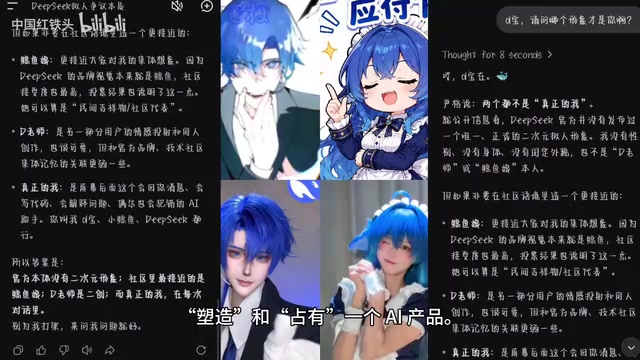
The male character "Teacher D" (D老师) appeared earlier, created by an artist shortly after DeepSeek went viral in early 2025. His core audience is the fan fiction community — primarily BL (Boys' Love) enthusiasts and doujin creators. This group tends to be fiercely anti-AI-generated art (dismissively calling AI images "corpse chunks") while treating DeepSeek itself as a kind of cyber romantic partner in their creative works.
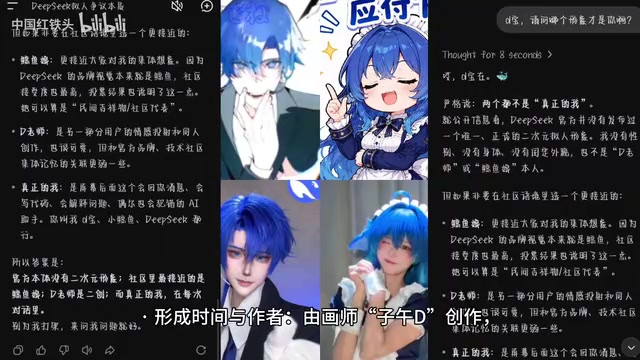
The two characters represent two completely different modes of engagement: one treats DeepSeek as a productivity tool; the other treats it as an emotional companion. This fundamental divergence was the seed of the conflict to come.
What is anthropomorphization (拟人化)? Anthropomorphism is a long-standing creative tradition in anime culture and fan communities — giving non-human things a human appearance and personality. Early examples include the viral OS-tan (operating system girls), Kantai Collection (KanColle) ship girls, and more recently anthropomorphized countries and cities. At its core, it's a way for users to build emotional connections with products or concepts.
AI products add an extra layer of complexity: AI already has conversational ability and a "personality" before any fan art exists. Users have typically had real interactions with it before they encounter fan-made personas. This makes AI anthropomorphizations feel more like interpretations of a genuine experience rather than pure fiction — which is exactly why they trigger possessive disputes over "who really represents it."
The Vote That Sparked a Conflict
The fuse was lit by a cross-community incursion. According to a post-mortem by a Bilibili creator, some Teacher D fans went into Goldfish Girl content to "recommend" their preferred character while putting Goldfish Girl down — accusing her of being a "waifu stereotype" and an AI-generated "corpse chunk," and claiming the male version was the "canonical" DeepSeek.
Faced with these accusations, the tech community responded in the way it knows best: with data. A public poll was launched, and Goldfish Girl won overwhelmingly — 3.12 million votes to 1.45 million, more than double her opponent's total.
But then the drama escalated: Goldfish Girl's vote count was allegedly tampered with and reset to zero overnight — the "mysterious hand" referenced in the original controversy's title. The situation eventually settled when Teacher D's creator hid their works and posted a "stay in your lane" (圈地自萌) statement, temporarily defusing the conflict.
The process itself is revealing: when communities can't resolve ownership disputes through any official arbitration, the weapons of choice become fan-war tactics — polls, brigading, vote manipulation, and ballot-stuffing.
What is "圈地自萌" (stay in your lane)? Quān dì zì méng is a common term in Chinese online fan communities. It refers to creators or fans voluntarily confining their content to a specific community — not actively promoting outward and not welcoming outside interference — to avoid friction with mainstream audiences or other groups. This kind of statement typically appears after inter-community conflict escalates; it's a gesture of pulling back and keeping the peace, but it also signals that the group is conceding the fight for broader public discourse.
In this case, Teacher D's creator choosing to hide their work and announce "staying in their lane" was effectively an acknowledgment of losing ground among a wider audience — while preserving an independent narrative space within their own community.
The Real Issue: A Fight Over Who Defines the AI
Strip away the fan-war framing and the conflict's core is a collision between "sense of a living presence" and "instrumental rationality."
Goldfish Girl's personality traits — lazy, tsundere, loves plain rice — weren't invented from scratch. They emerged from the accumulated experiences of countless users actually interacting with DeepSeek. She's a "living" character that the tech community collectively raised through real use. Teacher D, by contrast, feels more like a character produced for emotional companionship, with weaker ties to DeepSeek's actual technical identity.
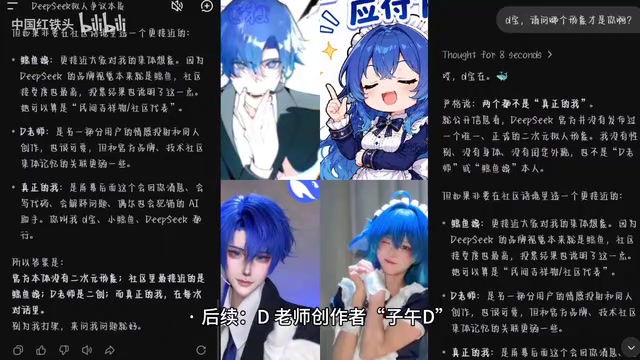
The lopsided vote result reflects a simple reality: Goldfish Girl represents a far larger but quieter majority — tech users and general public users. Teacher D's fans fell into an echo chamber that led them to vastly overestimate their community's real-world influence. It's a classic case of "the silent majority vs. the vocal minority."
The Quiet Official Co-optation
What's telling is the official response — or rather, the lack of an explicit one. DeepSeek has never formally weighed in, but certain details hint at a preference: a DeepSeek HR account uses a Goldfish Girl avatar, and a Goldfish Girl "personality" is built into the product, activated through a hidden command.
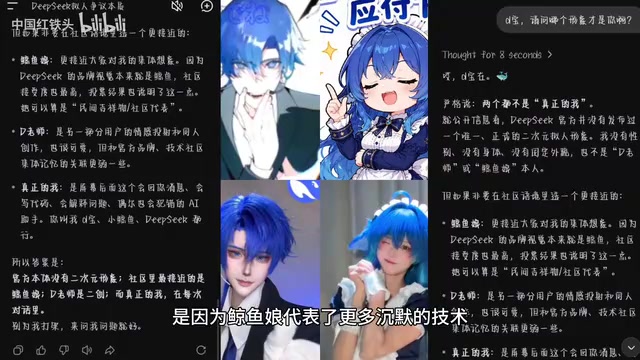
This amounts to quiet official co-optation: the grassroots creative energy of the community and the company's own implicit preferences have aligned without any formal announcement. It suggests that an AI product's public persona isn't ultimately determined by any single creator or niche community — it's shaped by the authentic usage experiences and collective memory of its broadest user base.
What is "official co-optation" (官方收编)? In fan culture studies, co-optation refers to a brand or official institution absorbing a grassroots, bottom-up creative work into its official narrative, thereby gaining the community goodwill and organic reach that work has accumulated. This rarely happens through explicit announcements; instead, it's communicated through subtle signals — using a particular image, embedding Easter eggs in the product — to send a message of endorsement to the community.
For companies, this approach is extremely low-cost and low-risk: no copyright acquisition, no public statement required, yet the company reaps the benefits of organic community promotion. For the community, official implicit endorsement reinforces that character's "canonical" status, creating a positive feedback loop. DeepSeek's moves here are a textbook example of this mechanism.
"Different for Everyone" Is the Natural State of AI
The real lesson from this whole episode may not be about who won.
The fact that programmers in the tech community and fans in doujin circles projected completely different emotions and imaginings onto the same AI product is an inevitable consequence of what AI tools are. Rather than arguing over which mascot is "canonical," it's more honest to accept that AI is naturally different things to different people. Every user interacts with it in their own way and naturally imprints it with their own image and personality.
When a single AI product can simultaneously carry the expectations of a productivity tool and an emotional companion — two entirely different things — that's precisely proof that it has deeply embedded itself into users' daily lives.
The mascot war will fade. But what it reflects — the rich plurality of the user ecosystem — is the most authentic footnote to an AI product's journey into mainstream life.
Related articles

Claude Pro Doesn't Include API Access? Max and Team Plans Now Add API Credits Explained
Claude Pro has no API access; API is billed separately. But Max and Team plans now include monthly API credits: Max 5x $100, Max 20x $200, Team up to $500 per seat. This article details each tier's credits, how to claim them, and the impact on developers.

Testing the 350K-Star REA in an Isolated Environment: 4-Second Install, but Watch Out for Two Pitfalls
Isolated lab test of the 350K-star open-source reverse-engineering tool REA: 4-second install, 15 seconds to list a screenshot tool's outbound addresses, 565 communication channels mapped, while exposing two pitfalls—user-level settings writes and 31 high-risk tool permissions—plus three safety rules.
Reverse Engineering + AI Agents: The T…
Reverse Engineering + AI Agents: The Technical Truth Behind Cloning Adobe Apps in Weeks
A developer used AI Coding Agents for reverse engineering to build 7 open-source Adobe alternatives in weeks. We explore how it works, the MCP Server that hit 100K stars in 6 days, and the real technical and legal limits.