The Blind Spots of AI Doom: What We Should Actually Be Worried About

Wired's Knight warns: AI misuse and power concentration are far more urgent than extinction fantasies.
Wired contributor Will Knight argues on a podcast that public panic over a "superintelligent AI awakening and wiping out humanity" is obscuring far more pressing real-world problems. He identifies two dimensions of genuine AI threat: malicious actors using jailbroken and open-source models to develop weapons and attack critical infrastructure — including Anthropic-disclosed cases of threat actors in Yemen misusing Claude and attempts to synthesize bioweapons — and AI companies rapidly accumulating power while continuing deployment despite visible harms, alongside the immediate social and environmental costs of massive capital investment and data center buildouts. Knight contends that limited public attention and regulatory resources should be directed at these visible, measurable, and actionable harms rather than distant, highly uncertain apocalyptic scenarios.
The debate over whether artificial intelligence will "destroy humanity" has long since spilled out of sci-fi circles and into mainstream discourse. Some voices offer alarming predictions — "more than a 10% chance AI wipes out humanity before 2030" — while others dismiss such claims entirely. Wired contributor Will Knight offered a more measured perspective on the podcast Today Explained: people are panicking about the wrong problems.
The Misleading Appeal of Doom Narratives
Narratives about a "superintelligence awakening and then subjugating or annihilating humanity" have captured a disproportionate share of public attention. These existential risk scenarios carry dramatic flair and make for compelling headlines.

But Knight argues that fixating on distant, deeply uncertain "AI apocalypse" scenarios causes us to overlook problems that are real, present, and already harming people. He even applies a slightly tongue-in-cheek litmus test: if today's AI can't help him write a decent email, how exactly is it supposed to rule the world?
This gap between the reality of AI's current capabilities and the imagination of its apocalyptic potential is the most underappreciated crack in today's AI panic narrative.
Misused AI Is the Real Threat
Rather than abstract extinction risk, Knight is more focused on documented cases of AI being deliberately misused. Reports have already emerged of terrorist organizations rapidly adopting AI — using jailbroken models and open-source models to develop weapons and plan attacks.
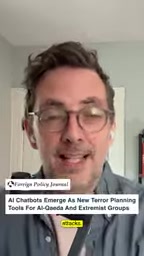
He cites a recent Anthropic disclosure: so-called "threat actors" in Yemen used its model Claude to develop weapons-related software, and the company also discovered attempts to use its tools to synthesize bioweapons. Beyond that, criminals or terrorists could potentially compromise critical infrastructure like hospitals or financial systems, triggering catastrophic events — threats that aren't science fiction but already-emerging security risks.
In other words, the danger of AI isn't that it "wants" to destroy humanity — it's that it hands harmful capabilities to people who do.
Jailbroken models are AI systems that have been manipulated through specific prompting techniques or technical methods to bypass built-in safety filters, enabling them to produce otherwise restricted content — such as weapons manufacturing instructions or steps for synthesizing dangerous chemicals. Open-source models are AI models whose weights and code are publicly released (such as Meta's LLaMA series), allowing anyone to download and run them locally without going through the original developer's safety review. The combination of these two creates an extremely low-barrier path to "weaponized AI" for malicious actors: jailbreaking commercial models circumvents platform monitoring, while open-source models can be freely modified entirely outside any third-party oversight. This is precisely why security researchers view the proliferation of open-source models as a double-edged sword — openness drives innovation, but it also creates regulatory blind spots.
Power Concentration and the Capital Gamble
Beyond misuse risks, Knight turns his attention to a more structural concern: AI companies are accumulating enormous power.

His worry is that these models are being deployed at breakneck speed, with development continuing even as negative effects on people become visible. And the enormous financial bets being placed on this technology, along with the massive data center buildouts underway, are generating very real social and environmental consequences.

These impacts are happening right now, affecting ordinary people. By comparison, existential anxiety about "AI exterminating humanity" feels distant and abstract. Knight's position is clear: he's far more concerned about present-day power imbalances and capital frenzy than about some future apocalypse.
The social and environmental costs of data centers have become an unavoidable reality in AI's expansion. Training and running large AI models requires tens of thousands of high-performance GPUs running continuously — a single large data center can consume billions of kilowatt-hours of electricity per year, roughly equivalent to the total consumption of hundreds of thousands of households. Cooling systems, meanwhile, consume millions of liters of freshwater annually. On the capital side, tech giants like Microsoft, Google, and Amazon have announced plans to invest hundreds of billions of dollars in AI infrastructure over the coming years, and some analysts worry this arms race is inflating a valuation bubble reminiscent of the dot-com era of 2000. These tangible resource demands and economic risks are precisely what Knight means when he says the impact is happening "right now."
Recalibrating Our AI Anxiety
Knight's perspective offers a valuable thinking framework: discussions of AI risk need to distinguish between "extreme scenarios that might happen" and "real problems that are already happening."
Channeling too much attention and resources into doomsday imaginings may cause regulators and the public to overlook more pressing issues — the security guardrails against model misuse, checks on corporate power, the social costs of rapid deployment, and the risks of energy consumption and economic bubbles tied to data center expansion.
This doesn't mean existential risk is entirely unworthy of study. Rather, it's a reminder that in the face of limited public attention, prioritization matters enormously. Genuinely pragmatic AI governance should start with harms that are visible right now, measurable, and actionable.
Which AI risk concerns you more — the distant threat of extinction, or the immediate realities of misuse and power concentration?
Related articles

"Black October": Did AI Uncover 3% of All Critical Vulnerabilities Ever?
A Reddit post claims 3% of all critical software vulnerabilities ever were found in the past month, dubbed 'Black October.' We break down the statistical issues, how AI-assisted code auditing accelerates discovery, and how developers should respond.

Microsoft Project Gecko: Using AI to Bridge Language Gaps for African Farmers
Microsoft's Project Gecko launches PharmaChat, letting African farmers ask questions in their native language and get precise video clips and farming book chapters via AI. The project also releases three interactive manuals to advance inclusive AI.

Musk's Space Dominance: How Starlink Throttling Undermines Ukraine's Defense
SpaceX's Starshield throttling disabled Ukraine's high-speed interceptor drones, exposing how Musk's private control over low Earth orbit communications affects battlefield dynamics and national security, and highlighting the risks of commercial space militarization and space governance dilemmas.