The Brain Is Not a Computer: Rethinking the Information Processing Metaphor

The brain-as-computer metaphor may fundamentally mislead our understanding of intelligence.
This article revisits a classic cognitive science debate: humans have always modeled the brain on their era's most advanced technology, and the computer age produced the dominant paradigm of the brain as an information processing system — a metaphor that may be fundamentally misleading. Memory isn't stored and retrieved like a file; it's reconstructed anew each time, shaped by context. The piece maintains critical balance, noting that the original author defines "information processing" too narrowly, and that distributed representation in neuroscience already transcends simple file-storage analogies. For AI practitioners, the key takeaway is to distinguish "an effective engineering model" from "a true account of intelligence," and to remain skeptical of any single metaphor.
A Popular — and Possibly Wrong — Metaphor
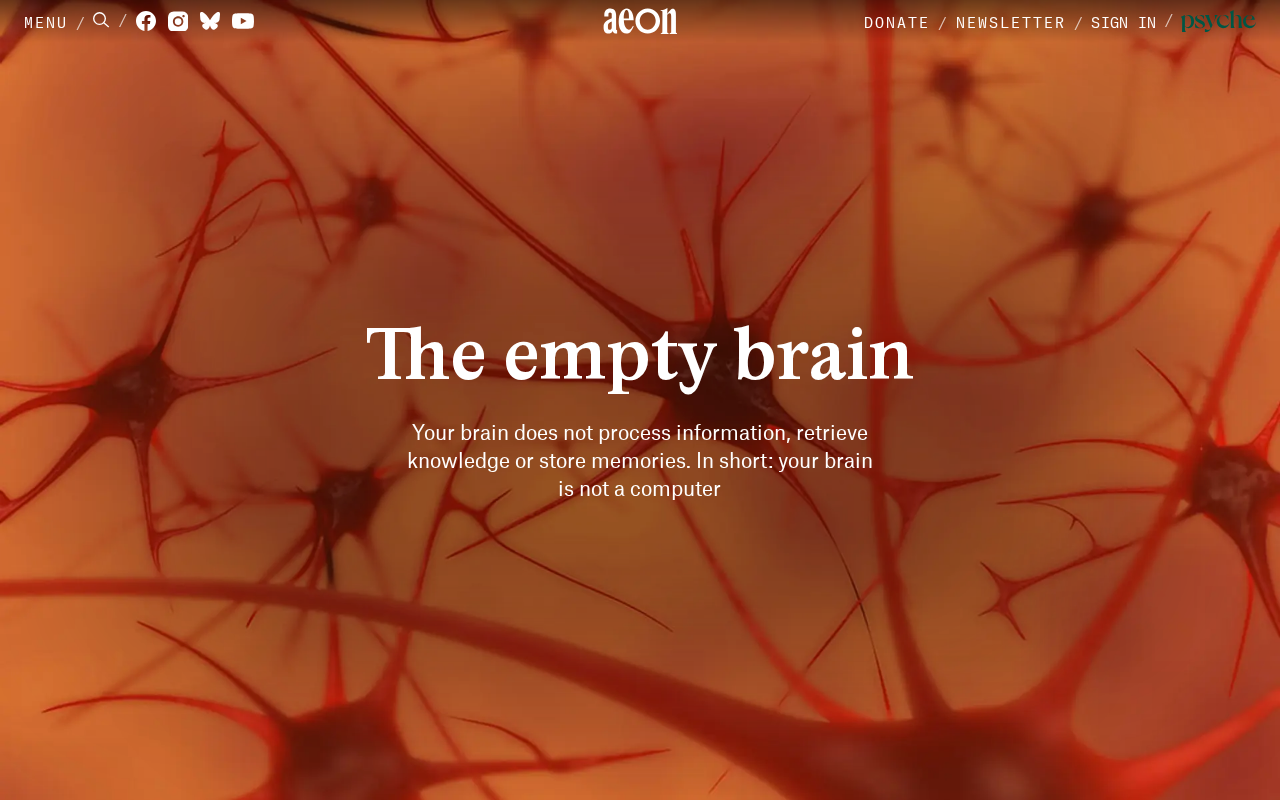
We're accustomed to understanding the brain through the lens of computers: input, storage, processing, output. This vocabulary has seeped into everyday language — we talk about the brain "retrieving memories," "processing information," and even compare forgetting to "data loss." A 2016 article recently resurfaced on Hacker News makes exactly this argument: the brain does not process information, and it is not a computer.
The claim sounds provocative, but it touches on a long-standing debate in cognitive science — are we actually describing how the brain works, or are we simply borrowing vocabulary from the most advanced technology of our time?
How Metaphors Shape Our Understanding
Throughout history, humans have almost always used the most cutting-edge technology of their era to make sense of the mind. Ancient Greeks compared memory to writing on a wax tablet; hydraulic and mechanical devices were popular analogies in the 17th century; after the telegraph emerged, the nervous system was imagined as a network of signal wires. In the digital age, "the brain as computer" became the default framework.
This history makes an important point: each generation believed it had found the right metaphor, yet in hindsight, these analogies reflected the technological imagination of the time more than any truth about the brain. The Information Processing paradigm has held such a firm grip partly because computers are the most powerful "thinking machines" we've ever encountered.
The Core Problem with the "Information Processing" Assumption
The article's central argument is this: computers genuinely store, copy, and retrieve symbolic data — but the brain does not work this way. When you recall a face, there is no "file" stored in the brain that gets precisely retrieved. Instead, every act of recall is a process of reconstruction, shaped by present context, emotion, and prior experience, shifting each time.
This stands in sharp contrast to the deterministic storage of computers: read the same file a hundred times and the content is identical every time. Human memory, on the other hand, may differ slightly with each "read" — and can even be altered. This difference suggests that describing memory through the "storage-and-retrieval" framework of computation may be fundamentally misleading.
The reconstructive nature of memory has solid experimental support in neuroscience. Psychologist Frederic Bartlett demonstrated as early as 1932, through his "War of the Ghosts" story experiment, that people unconsciously fill in unfamiliar details with elements from their own cultural background when retelling a story. Elizabeth Loftus's series of eyewitness memory studies further showed that simply changing the wording of a question can "implant" details of events that never occurred. At the neurobiological level, each time a memory is activated, it briefly enters an unstable state — a process known as reconsolidation — during which it is susceptible to being rewritten by new information. This is fundamentally different from the physical process of reading and writing in computer RAM, where reading does not alter stored content. In the brain, "reading" and "writing" are nearly inseparable in time.
Why This Debate Matters
For readers who follow AI, this topic has particular practical relevance. Current artificial neural networks and large language models were developed largely as extensions of the assumption that the brain is an information processing system. If the brain's actual operation doesn't conform to the information processing paradigm, then our pursuit of "brain-like intelligence" may have been built on a questionable analogy from the very start.
Of course, this doesn't mean computational models have no value — they have achieved enormous engineering success. But engineering effectiveness is not the same as accurately describing the biological brain. Distinguishing between "a useful model" and "the actual mechanism" is perhaps the core insight this discussion offers.
To be more specific: current mainstream deep learning architectures — including Transformers and convolutional neural networks — do inherit several core assumptions of the information processing paradigm in their design philosophy: information can be encoded as numerical vectors, hierarchically transformed, and read from or written to well-defined memory locations. At the same time, alternative research directions exist that attempt to move beyond this framework. Predictive Coding theory, for instance, understands the brain as a system that continuously generates and revises predictions rather than passively processing inputs. Embodied Cognition emphasizes that intelligence cannot be separated from the dynamic interaction between body and environment. These alternative frameworks have also inspired corresponding explorations in AI, such as Active Inference models. However, as of now, none of these directions have displaced the information-processing-centric mainstream paradigm in terms of engineering practicality.
A Critical View of the Article
It's worth noting that the original article is itself contested. Many cognitive scientists argue that the author defines "information processing" too narrowly — equating it with computer-style symbolic storage — and thereby constructs an easy target. Broadly conceived information processing theory does not require the brain to store data like a hard drive; concepts like neural coding and distributed representation moved well beyond the simple "file storage" metaphor long ago.
In other words, the brain is not the PC on your desk — this is hardly controversial. But "the brain does not process information at all" is a much stronger and harder-to-sustain claim. The genuinely valuable insight may not lie in choosing between "yes" and "no," but in recognizing that any single metaphor has its limitations.
Conclusion: Thinking Beyond Metaphor
The reason this old article keeps getting rediscovered and discussed years later is precisely that it presses on a fundamental unresolved question: we still don't have a descriptive language that truly belongs to the brain itself. Whether it's computers, hydraulic systems, or wax tablets — all of these are borrowed words.
For practitioners building artificial intelligence, staying alert to metaphor may be a healthy habit — leveraging the engineering power of the computational framework while resisting the temptation to mistake it for a final explanation of the nature of intelligence.
Related articles

Random Pruning of the DPO Computation Graph: 1.4x Training Speedup and Lower Peak Memory
DPO training too slow and memory-hungry? This paper proposes a random pruning framework for the DPO computation graph, sampling independently across position, sequence, and branch dimensions; branch pruning achieves a 1.426x step-time speedup and cuts training time by about 30%, with in-depth attribution of memory and time gains.

Why Does JEPA Underperform MLM in Longitudinal EHR Representation Learning?
New study compares JEPA and MLM for longitudinal EHR representation learning on MIMIC-IV: three JEPA variants train stably without collapse but underperform MLM; target size, not heterogeneity, drives prediction error.

Transfer Learning + Visible Light Communication: A New Approach to Energy-Efficient Indoor Positioning
A study proposes a transfer learning-based visible light communication indoor positioning method, achieving 47% accuracy improvement on the BOSCH factory dataset, 67.5% model efficiency under high noise, and introducing the ME composite metric for energy-efficient positioning in energy-constrained industrial IoT scenarios.