The Career Power of a Highly Cited Paper: From Research to Top-Tier Entrepreneurship

Top research papers aren't just academic trophies — they're launchpads for industry-defining careers and companies.
Using Ashish Vaswani (core author of *Attention Is All You Need*, ~200,000 citations) and Aravind Srinivas (co-founder of Perplexity) as case studies, this piece argues that "doing research" and "achieving commercial success" are not opposing paths in AI. The presenter guides readers to verify the data on Google Scholar themselves, making the citation gap viscerally clear, while candidly acknowledging the gap between his own numbers and theirs. The central argument: a paper that truly lays technical groundwork generates not just academic prestige, but massive personal and commercial value — potentially the fastest route to the industry frontier.
How Highly Cited Papers Fuel Career Breakthroughs
In AI research circles, a paper with a massive citation count is rarely just an academic honor — it's a lever that can transform an entire career. Using two iconic figures in the AI field as examples, a YouTube talk vividly illustrated how sustained research investment can convert into enormous personal and commercial value.
The presenter encouraged viewers to search two names on Google Scholar themselves — Ashish Vaswani and Aravind Srinivas — and take a look at the citation numbers behind their names. This "verify it yourself" approach is far more compelling than any lecture.

Two Protagonists: The Transformer Author and the Perplexity Founder
Ashish Vaswani is one of the core authors behind the seminal paper Attention Is All You Need, which introduced the Transformer architecture. The presenter made a point of emphasizing that the large language models (LLMs) we use today are built directly on the foundation of that work. According to the video, this researcher's paper has accumulated approximately two lakh citations (200,000) — a staggering figure by any measure.

Aravind Srinivas, on the other hand, is the co-founder of Perplexity, the AI-powered search product. What both men share is a starting point of rigorous research experience that ultimately propelled them to the top of the industry — whether through entrepreneurship or otherwise.
The Transformer architecture was introduced by Vaswani et al. in 2017 in Attention Is All You Need, and it fundamentally displaced the previously dominant recurrent neural networks (RNNs) and long short-term memory networks (LSTMs). Its core innovation — the self-attention mechanism — allows a model to directly compute dependencies between any two positions in a sequence without step-by-step recursion. This design dramatically improved training parallelism while enabling models to capture long-range semantic relationships. Nearly every modern large language model, including GPT, BERT, and LLaMA, directly inherits this architecture, making the paper one of the most widely cited works in the entire deep learning era. The ~200,000 citations are no accident — they reflect the degree to which a single piece of research has become foundational infrastructure for an entire industry.
A Candid Note for Students: What Citation Counts Really Mean
One of the more honest moments in the talk was when the presenter admitted that his own most-cited paper had a relatively modest citation count — and then pointed to a researcher with nearly 200,000 citations.

He acknowledged directly that many students may not immediately grasp what "200,000 citations" actually means. For anyone outside academia, the number feels abstract. But in a research context, it represents a body of work that has become a cornerstone of an entire field — something that countless subsequent studies depend on and build upon. That's a level of impact only a tiny fraction of researchers ever achieve.
In academic evaluation, citation count is one of the core metrics of research influence. A typical journal paper might accumulate single-digit to tens of citations over its lifetime; reaching hundreds of citations already marks a significant contribution within a subfield; crossing one thousand is generally considered a "highly cited paper," placing it in the global top 1%. Two hundred thousand citations means this paper has, on average, been cited dozens of times per day by researchers worldwide over the past several years — an influence that has crossed disciplinary boundaries and permeated every corner of industrial AI product development. Google Scholar's h-index and citation data are the most widely used public tools for assessing academic influence, freely accessible to anyone. This is exactly why the presenter suggested students "look it up themselves" — the raw numbers carry far more impact than any verbal description.
Research Can Lead to Commercial Success
The core message the presenter really wanted to convey was this: if you're willing to invest five years in research, that path doesn't close you off from the business world or commercial success — it might actually take you higher and further than the conventional route.
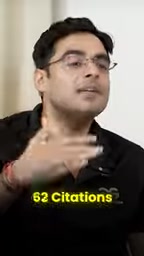
Conventional wisdom tends to treat "doing research" and "joining industry / making money" as two diverging roads. But the cases of Vaswani and Srinivas demonstrate precisely the opposite — a deep research foundation can become a springboard into top-tier companies, or even into founding your own. The "valuation" that comes with a truly impactful paper — whether in personal brand or commercial opportunity — often exceeds imagination.
What This Means for Young Researchers
This talk is brief, but it points toward something worth serious reflection for anyone early in their career. In the current AI wave, the value of foundational research has been amplified like never before. Many of the authors behind papers that established the technical bedrock of today's AI have gained critical influence and opportunity across the industry.
For students wrestling with whether pursuing a PhD or a research path is "worth it," this perspective offers a different kind of answer: research isn't synonymous with an ivory tower — it may actually be one of the shortest paths to the very frontier of the industry. The real question is whether you're willing to go deep enough to produce work that genuinely matters, work that gets cited, used, and built upon by the world.
Related articles
uGAP: An AI Platform Unifying 100+ African Geospatial Datasets
uGAP is an African geospatial AI platform by a University of Cape Town team, unifying 120+ African datasets with a Python SDK for discovery, processing, and model training, already used in cyclone flood mapping.

Cursor Can Now Control Your Computer: AI Agents Can Drive Desktop Apps for Testing
Cursor adds desktop control: AI agents can drive desktop apps like the iOS Simulator to test their own features. We analyze the impact on dev workflows, possible technical approaches, and reliability concerns.

Vibecoding a Custom Inference Engine: High Hopes, Harsh Reality
A Reddit developer shares the real experience of vibecoding a custom inference engine: running GGUF Q4 models in the browser with WebGL2 and GLSL, only to fall into tokenizer debugging hell. This article analyzes the engineering challenges of browser-side LLM inference and why cloning llama.cpp is the more rational choice.