The Child ASR Adaptation Challenge: Improving Kids' Speech Recognition Without Forgetting Adults

Systematic comparison of three methods for balancing child speech adaptation with adult speech retention in ASR.
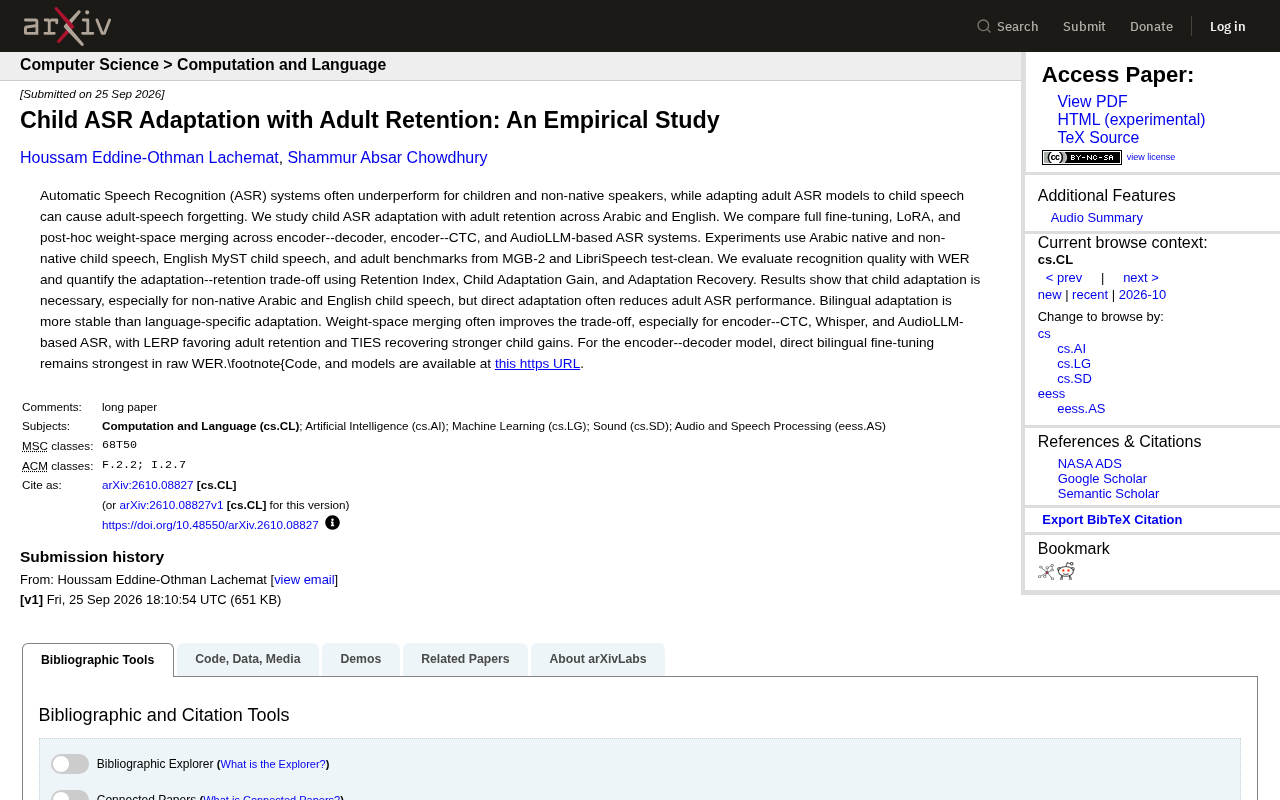
Adapting adult ASR models to child speech triggers catastrophic forgetting, degrading adult recognition performance. This QCRI study systematically compares full fine-tuning, LoRA, and weight-space merging across encoder-decoder, encoder-CTC, and AudioLLM architectures in Arabic and English. Using three purpose-built metrics — Retention Index, Child Adaptation Gain, and Adaptation Recovery — the study finds that bilingual adaptation is more stable than monolingual, weight-space merging effectively eases the trade-off (LERP favoring adult retention, TIES favoring child gains), while encoder-decoder models still perform best with direct bilingual fine-tuning. Code and models are open-sourced.
Why Children's Speech Recognition Is Such a Hard Problem
Automatic speech recognition (ASR) technology has matured considerably for adult speakers, but performance drops noticeably when dealing with children and non-native speakers. Children's vocal tract structures, articulation patterns, and speaking rates differ dramatically from adults, and directly applying adult-trained models to child speech typically yields unsatisfactory recognition accuracy.
One seemingly straightforward fix is to fine-tune adult models on child speech data. But this runs straight into a classic machine learning trap — catastrophic forgetting. When a model is retrained to adapt to children's voices, its previously acquired capabilities on adult speech degrade, a phenomenon known as "adult speech forgetting."
This empirical study from the Qatar Computing Research Institute (QCRI) centers on exactly this core tension: how to teach a model to recognize children's voices while preserving as much of its adult speech recognition ability as possible. The research covers both Arabic and English, giving it meaningful cross-lingual relevance.
Catastrophic Forgetting is a classic challenge in deep learning, first described by McCloskey and Cohen in 1989. When a neural network is continuously trained on a new task, the gradient descent updates overwrite previously learned weight distributions, causing a sharp performance drop on old tasks. This problem is especially pronounced in transfer learning: the model's parameter space is finite, and writing in new knowledge often comes at the cost of erasing the old. The continual learning field has developed a range of mitigation strategies, including Elastic Weight Consolidation (EWC), Progressive Networks, and the weight-space merging approaches explored in this paper. In the ASR context, the acoustic gap between adults and children is enormous — children have higher fundamental frequency (F0), higher formant frequencies, and greater articulatory variability — making parameter conflicts between the two data types particularly severe, and catastrophic forgetting worse than in most domain adaptation scenarios.
A Comprehensive Comparison of Three Adaptation Methods Across Three Architectures
What makes this study rigorous is its systematic experimental design. The team compared three distinct adaptation strategies:
- Full Fine-tuning: All model parameters are updated. Maximum adaptation capacity, but highest forgetting risk.
- LoRA (Low-Rank Adaptation): Only a small set of newly added parameters are trained, achieving adaptation at lower cost.
- Post-hoc Weight-space Merging: After training, the adapted model and the original model are merged at the parameter level.
All three methods were tested across three mainstream ASR architectures: encoder-decoder, encoder-CTC, and AudioLLM-based ASR systems.
The experimental data sources are quite broad: native and non-native Arabic child speech, the English MyST child speech dataset, and adult benchmarks from MGB-2 and LibriSpeech test-clean. This multi-lingual, multi-source combination gives the conclusions broader generalizability.
LoRA (Low-Rank Adaptation) was proposed by Microsoft Research in 2021 as a parameter-efficient fine-tuning method. The core idea is that weight matrix changes during adaptation tend to be low-rank, so the change can be approximated as the product of two small matrices (ΔW = A×B), while the original weights are frozen. Only the low-rank matrices A and B are updated during training, typically representing just 0.1%–1% of the parameters in full fine-tuning, significantly reducing computation and storage costs. Since the original weights are not directly modified, LoRA also theoretically suppresses catastrophic forgetting to some degree. Originally applied widely to large language models, LoRA has since extended into the speech domain and is now one of the mainstream approaches to parameter-efficient adaptation.
Weight-space merging is a post-hoc approach: train a model specialized for child speech and keep the original adult-capable model, then mathematically combine the two sets of weights directly in parameter space. LERP (linear interpolation) is the simplest merging method: θ_merged = (1-α)×θ_adult + α×θ_child. TIES (Trim, Elect, Disjoint Merge) first prunes parameters and resolves conflicts before merging, retaining more important weight updates and generally recovering more task-specific performance.
Three Metrics to Quantify the Adaptation–Retention Trade-off
Evaluating this kind of problem can't rely on a single number. Beyond the traditional Word Error Rate (WER), the research team introduced three purpose-built metrics to characterize the balance between adaptation and retention:
- Retention Index: Measures how well the adapted model retains its adult speech capabilities.
- Child Adaptation Gain: Measures the improvement in children's speech recognition.
- Adaptation Recovery: Measures how well performance is recovered during the trade-off process.
The value of this evaluation framework is that it converts a vague "is it good?" question into a quantifiable, multi-dimensional assessment, making the strengths and weaknesses of different methods immediately comparable.
Key Findings: Child Adaptation Is Necessary, but Method Matters Enormously
The study produced several important findings:
Child adaptation is genuinely necessary. Especially for non-native Arabic and English child speech, unadapted models fall clearly short. In other words, simply applying adult models to child speech scenarios doesn't work.
Direct adaptation degrades adult recognition. This confirms the catastrophic forgetting concern — naive fine-tuning often trades away existing capabilities.
Bilingual adaptation is more stable than monolingual. This is a particularly interesting finding: adapting across two languages simultaneously actually maintains more stable performance than adapting to a single language. This may be related to the regularization effect brought by multilingual training.
Weight-space merging effectively improves the trade-off. For encoder-CTC, Whisper, and AudioLLM-based systems, post-hoc weight merging generally improves the balance between adaptation and retention. The two merging strategies have different emphases: LERP tends to favor preserving adult recognition ability, while TIES recovers stronger child recognition gains.
There is one notable exception — for encoder-decoder models, direct bilingual fine-tuning still achieves the best raw WER scores. This shows there is no universally optimal method; architecture characteristics determine the best strategy.
The stability of bilingual adaptation aligns with the "positive transfer" effect observed in multilingual pre-training research. In multi-task or multilingual training frameworks, gradient updates from different tasks and languages mutually constrain each other, effectively acting as a regularizer that prevents the model from overfitting to a single data distribution. This is consistent with observations that multilingual models like Whisper naturally generalize across languages. For child speech adaptation specifically, introducing both Arabic and English child data simultaneously may help the model learn more universal acoustic representations of children's speech, rather than memorizing the phonetic characteristics of a single language, thereby showing greater robustness in retaining adult capabilities.
Implications for Real-World Applications
For developers and product teams looking to deploy children's speech recognition, this research offers practical decision-making guidance: if raw recognition accuracy is the primary concern and you're working with an encoder-decoder architecture, bilingual full fine-tuning is a reliable choice; if the goal is to improve child speech performance without sacrificing adult recognition capability, weight-space merging is worth trying, with the choice between LERP and TIES depending on whether preservation or gain is the priority.
The research team has also open-sourced their code and models (hosted at the qcri/Child-ASR-Adaptation repository on GitHub), providing a reproducible foundation for follow-on research and engineering work. As voice interaction becomes more prevalent in education, children's companion devices, and similar applications, making ASR systems genuinely capable of "understanding kids" will remain an important area of ongoing focus.
Related articles

Amphibious Transforming Drone: Beyond 100x Power Savings, What Are the Real Needs?
Is the amphibious transforming drone just a gimmick? Starting from the 100x power difference of the M4 Morphobot, explore real application scenarios and thesis topic ideas, analyzing boundary conditions where pure drones and pure ground robots both fail.

Warhound Raises $200 Million: Genetically Engineered "War Dogs" Paired with Anduril Gear
Warhound raises $200M, backed by Ben Lamm and Palmer Luckey, to genetically engineer dogs for military and law enforcement use and equip them with Anduril gear. This article analyzes its technology direction, funding logic, and ethical controversy.

Claude API Comes to Google Cloud: IAM Integration and SDK Access Guide
Anthropic hosts the full Claude API on Google Cloud with IAM-controlled permissions and unified billing. This guide covers the Vertex AI and Anthropic-hosted entry points, IAM role configuration, and SDK access.