The Complete Guide to AI Agents: Concepts, Principles, and Top Development Tools
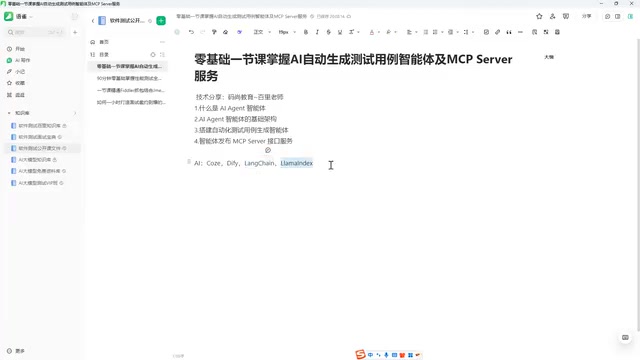
A complete guide to AI agents — concepts, architecture, and a comparison of top development tools.
This guide breaks down what AI agents are, how they differ from large language models, and explains the core formula: Agent = LLM + Workflow + Knowledge Base. It also compares the four leading tools — Coze, Dify, LangChain, and LlamaIndex — to help developers choose the right path for building intelligent agent applications.
What Is an AI Agent?
As AI technology sweeps across industries, "Agent" has become one of the hottest buzzwords. Yet many people still have only a vague understanding of what it actually means — and how it differs from the AI large language models they use every day.
It's worth noting that "intelligent agent" is not a new concept. Back in the 1990s, academia already defined it as "an autonomous system capable of perceiving its environment and taking actions to achieve goals." However, due to the limitations of early computing power and model capabilities, agents were largely confined to closed environments like board games and rule-based systems. It wasn't until around 2022, when large language models like GPT-4 broke through the barriers of natural language understanding and reasoning, that "LLM-powered agents" truly moved from the lab into practical engineering.
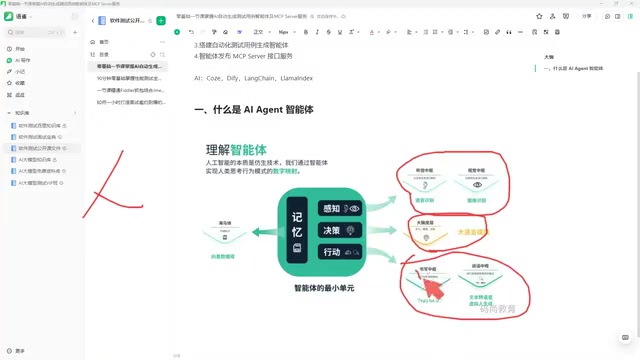
At its core, artificial intelligence is a form of "biomimetic technology" — modeled after human beings themselves. The central goal of an AI agent is to create a digital mirror of human thought and behavior through technological means.
Think of it like the human body: we have hearing and vision (audio, images) to perceive the world; a brain to learn, think, and make decisions; the ability to act through writing or speaking; and memory. In short, humans possess four core capabilities: perception, decision-making, action, and memory.
AI agents are designed around exactly this architecture. They interact through natural language and support a complete loop of perception, decision-making, and action — and that is what we call an agent.
The Essential Difference Between AI Agents and LLMs
Many people conflate AI agents with large language models (like DeepSeek), but the two are fundamentally different.
The core of a large language model is "interaction." It works through natural language and prompts — you ask, it answers. But it can only go as far as answering. For example, if you ask an LLM to order food delivery for you, it simply can't do it. It can tell you how to place an order, but it cannot actually execute the steps on your behalf.
AI agents are an entirely different story. Given the same request — "order food delivery for me" — an agent can: open the Meituan app → search for the target item → complete payment, handling the entire sequence of actions independently.
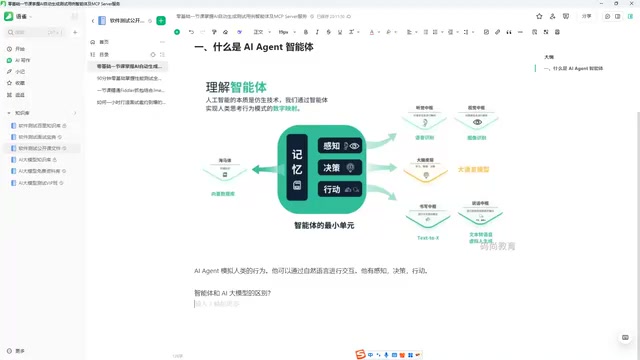
The underlying logic is this: an agent can perceive what you want, make a decision based on that, and then take action. Perceive → Think → Act forms the core operational loop of an agent.
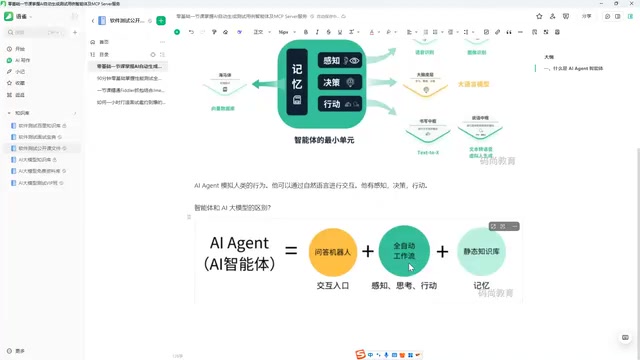
Therefore, a large language model is just one component of an agent — not the whole thing.
The Agent Formula
Here's a formula that captures what an AI agent is:
AI Agent = LLM + Workflow + Knowledge Base
- LLM: The agent's "brain," responsible for natural language interaction and reasoning — for example, a conversational model like DeepSeek.
- Workflow: The execution process corresponding to the perceive–think–act loop, defining what the agent does at each step. In the food delivery example, the workflow is "open Meituan → search for item → place order → pay." For more complex scenarios, modern agent architectures also adopt a multi-agent collaboration model: an Orchestrator Agent handles task decomposition and scheduling, while specialized sub-agents handle tasks like search, code execution, and data analysis, with results aggregated at the end. This design draws on the microservices philosophy from software engineering and significantly improves the quality and fault tolerance of complex task completion.
- Knowledge Base: Supplements the LLM with domain-specific knowledge beyond its training data.
Why Is a Knowledge Base Indispensable?
Large language models have a natural limitation: their knowledge comes from training data, which often cannot cover the latest information or content from specialized domains. The knowledge base exists to fill exactly this gap.
The core technology behind a knowledge base is RAG (Retrieval-Augmented Generation). It works by chunking specialized documents into vector embeddings and storing them in a vector database. When a user asks a question, the system first retrieves the most relevant knowledge chunks, then injects them as context into the LLM's prompt, guiding the model to generate more accurate responses. This mechanism effectively addresses the problems of LLM "hallucination" and knowledge staleness, and is a key piece of infrastructure for deploying enterprise-grade agents.
Take a healthcare agent as an example: it needs to be fed large amounts of clinical case data. Institutions like Xiangya Hospital have accumulated decades of clinical cases and diagnostic outcomes — specialized data that general-purpose LLMs simply don't have. By injecting domain knowledge into the knowledge base via RAG, an agent can truly develop vertical expertise.
Comparing the Top Tools for Building AI Agents
The main technical approaches to building agents fall into two categories: visual no-code/low-code tools and code frameworks.
Visual Tools: Coze and Dify
Coze is an online agent development platform launched by ByteDance. It has a low barrier to entry, is currently free, and is well-suited for individual developers who want to quickly validate ideas. However, as an online hosted platform, its flexibility for enterprise private deployment is relatively limited.
Dify is currently the go-to choice for enterprise-grade agent development. Industry research suggests that around 80% of companies use Dify to build agent applications. Dify went open-source in 2023 and accumulated tens of thousands of GitHub stars within a year, making it one of the fastest-growing open-source projects in the AI application development space. Built on Python and supporting one-click private deployment via Docker, it includes core modules like Prompt orchestration, RAG pipelines, and Tool Use, and is compatible with OpenAI, Anthropic, local Ollama, and other mainstream model providers. This openness gives it a clear advantage in industries requiring data compliance and private deployment — such as finance, healthcare, and government — and it has become the de facto standard for agent development.
Code Frameworks: LangChain and LlamaIndex
For teams that need deep customization and prefer building agents through code, two major frameworks stand out:
- LangChain: With a mature ecosystem and active community, LangChain is one of the most widely used agent development frameworks, well-suited for building complex multi-step task chains. Its core design philosophy is to abstract LLM calls into composable "Chains," and it introduces the ReAct (Reasoning + Acting) paradigm: at each step, the model first reasons (Thought), then decides which tool to call (Action), continues reasoning based on the tool's output, and loops until the task is complete. This mechanism gives agents the ability to handle multi-step, uncertain tasks and is the mainstream methodology for implementing agent reasoning at the code level.
- LlamaIndex: Its iteration pace has noticeably accelerated recently, with capabilities continuously expanding. It performs especially well in data indexing and knowledge base retrieval scenarios, is tightly integrated with RAG, and is well worth following closely.
Choosing the right tool: Coze and Dify belong to the "tool camp" — ideal for rapid prototyping and enterprise deployment. LangChain and LlamaIndex belong to the "code camp" — better suited for development scenarios that demand flexibility and deep customization.
Summary: A Practical Path from Concepts to Implementation
To truly understand AI agents, focus on two key ideas:
- The operational loop: Perceive → Decide → Act
- The compositional structure: LLM + Workflow + Knowledge Base
An agent is no longer just an AI that talks — it's a digital assistant that can genuinely complete tasks on your behalf.
For developers just getting started, the recommended path is to begin with a visual tool like Dify to quickly build an intuitive understanding of how agents work. As requirements grow more complex and deeper customization becomes necessary, gradually transition to code frameworks like LangChain or LlamaIndex. Mastering this complete path from concepts to tools is a solid first step into AI agent development.
Key Takeaways
Related articles

The Truth Behind Codex 'Build a Website in 5 Minutes': AI Isn't Creating Sites—It's Helping You Copy Them
Exposing the truth behind viral Codex 5-minute website videos: creators aren't building original sites with AI—they're copying shared prompts or scraping others' work. Learn AI coding tools' real limits.

Getting Started with AI Agent Development: A Complete Guide from Concept to Practice
A comprehensive guide to AI Agent architecture and development, covering automated marketing, intelligent customer service, and investment analysis scenarios with single and multi-agent collaboration.

The Truth Behind Codex 'Build a Website in 5 Minutes': AI Isn't Creating Sites — It's Helping You Copy Them
Exposing the truth behind viral Codex 5-minute website videos: creators aren't building original sites with AI — they're copying shared prompts or scraping others' work.