The Complete Guide to n8n: An Open-Source Automation Platform with 400+ Integrations That Combines Code and Visual Workflows

n8n: an open-source automation platform combining 400+ integrations, native AI, and code/visual dual modes.
n8n is an open-source workflow automation platform with 400+ integrations and native LangChain AI capabilities. Its dual-mode design — visual drag-and-drop plus inline JavaScript/Python code — bridges the gap between no-code tools like Zapier and code-heavy solutions like Airflow. With built-in RAG nodes, vector database support, flexible deployment from a single npx command to enterprise K8s, and a thriving community of 900+ templates, n8n is positioned as the go-to platform for AI-driven automation.
What Is n8n?
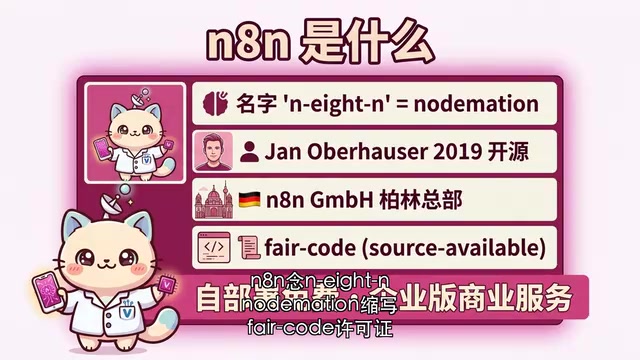
n8n (pronounced "node-a-tion") is an open-source workflow automation platform created by Jan Oberhauser in 2019. The company, n8n GmbH, is headquartered in Berlin, Germany. Its name carries a dual meaning: it uses a Node-based visual design, and it's built on Node.js under the hood. The "8" in "n8n" represents the 8 letters omitted from "automatio" — derived from the word "Automation."
On GitHub, n8n has become a star project in the automation space. Its core positioning is clear: an automation platform with 400+ integrations and native AI capabilities — essentially a Swiss Army knife for technical teams.
Notably, n8n uses a licensing model called Fair Code — the source code is visible (Source Available), self-hosting is free, and commercial services are paid. This is a middle ground between pure open source and closed-source commercial software, ensuring both community vitality and a sustainable business model for the company.
Fair Code isn't a concept invented by n8n. It's a software distribution philosophy that has gained traction in the developer tools space in recent years. Specifically, n8n uses the Sustainable Use License, which allows users to view, modify, and self-host the source code, but prohibits offering it as a competing service to third parties. The rise of this model has deep roots: well-known open-source companies like Elastic, MongoDB, and HashiCorp have successively shifted from traditional open-source licenses (such as MIT, Apache 2.0) to similar Source Available licenses. The core driver is preventing cloud providers (like AWS, Azure) from directly packaging open-source projects as managed services for profit while the original developers see no benefit. Fair Code is essentially a pragmatic solution to the open-source commercialization dilemma — it preserves the transparency and community engagement of open source while establishing a sustainable revenue stream for the core team.
400+ Integrations: n8n's Platform Effect Advantage
What does 400+ integrations mean in practice? Virtually every mainstream service you can think of is on the list:
- Collaboration & Communication: Slack, Discord
- Project Management: GitHub, Linear, Notion, Airtable
- Office Suites: Google Workspace, Microsoft 365
- CRM/Marketing: Salesforce, HubSpot
- E-commerce/Payments: Stripe, Shopify
Beyond official integrations, the community has contributed 900+ ready-to-use workflow templates. This means automation workflows that others have already built can be directly adopted with minor modifications, dramatically lowering the barrier to entry.
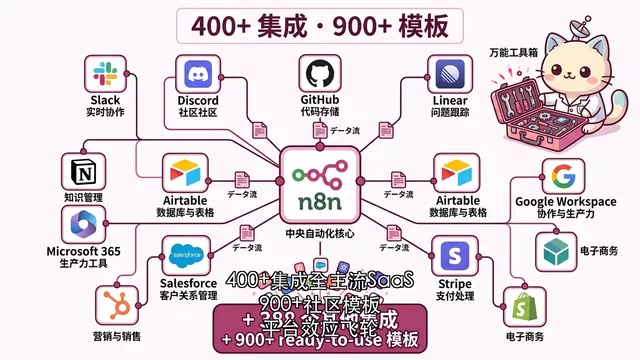
This is a textbook example of platform effects (Network Effects) — more integrations attract more users; more users create richer templates; richer templates attract even more people. Once this flywheel starts spinning, competitors find it extremely difficult to catch up.
From an economics perspective, platform effects refer to the phenomenon where the value of a product or service grows exponentially with the number of users. In n8n's ecosystem, this manifests as a three-layer flywheel: the official team maintains core integration nodes → users build workflow templates based on these nodes and share them with the community → new users choose n8n because of the rich template library → more users drive more integration demands and community contributions. This follows the exact same ecosystem logic as Salesforce AppExchange and Shopify App Store. Once the number of integrations crosses a critical threshold, the platform develops a powerful lock-in effect, because migrating to another platform means re-adapting all existing integrations and workflows — this is precisely where n8n's moat lies.
Core Differentiator: Dual-Mode Operation with Code and Visual Workflows
n8n's most compelling competitive advantage is the combination of code and visual workflows.
For simple automation processes, you can build workflows entirely through drag-and-drop, without writing a single line of code. But when you encounter complex business logic, you can write JavaScript or Python code directly within any node, and even import any third-party package via npm install.
The advantages of this design philosophy are clear:
- Simple workflows: Completed via drag-and-drop — product managers and operations staff can handle it
- Complex logic: Handled with code — developers face no limitations
- One platform for everyone: A single tool serving users of varying technical levels
In contrast, purely visual tools like Zapier and Make struggle when faced with even moderately complex data processing scenarios. Meanwhile, pure-code solutions like Apache Airflow and Temporal aren't friendly enough for non-technical users. n8n occupies exactly this middle ground.
To better understand this positioning, it helps to know the background of these competitors. Apache Airflow is a workflow orchestration tool open-sourced by Airbnb in 2014, primarily targeting the data engineering domain. It uses Python code to define DAGs (Directed Acyclic Graphs) for orchestrating ETL (Extract-Transform-Load) data pipeline tasks. Temporal (formerly the Cadence project internal to Uber) is a distributed workflow engine that excels at handling long-running business processes requiring high reliability guarantees, such as payment processing and order fulfillment. Both are purely code-driven solutions — extremely powerful but with steep learning curves, typically requiring professional backend engineers to deploy and maintain. Zapier and Make (formerly Integromat) go to the other extreme, offering purely visual interfaces suitable for non-technical users to quickly build simple automation workflows, but falling short when custom data transformations, complex conditional branches, or non-standard API calls are needed. n8n's "dual-mode" design fills precisely the gap between these two extremes.
n8n's AI Capabilities: Native LangChain Integration
n8n natively integrates LangChain, which means you can build AI Agents directly within visual workflows without maintaining a separate LangChain project.
LangChain is an open-source framework created by Harrison Chase in 2022, specifically designed for building applications based on large language models (LLMs). Its core value lies in providing a standardized abstraction layer that encapsulates common AI application patterns — Prompt management, model invocation, Memory management, Tool Use, Retrieval-Augmented Generation (RAG) — into composable modules. Traditionally, developers need to write substantial Python code to initialize and orchestrate LangChain's Chain, Agent, Tool, and other components. In n8n, these concepts are mapped to visual nodes, allowing users to accomplish the same work through drag-and-drop and configuration, dramatically lowering the technical barrier to building AI Agents.
Several typical AI automation scenarios:
- 📧 Email arrives → LLM auto-summarizes → Sends to Slack
- 🛒 New order comes in → Automatically creates a Linear task
- 📊 Weekly automatic GitHub data aggregation → Generates a weekly report
- 🌐 Monitor webpage changes → AI determines intent → Automatically creates a task
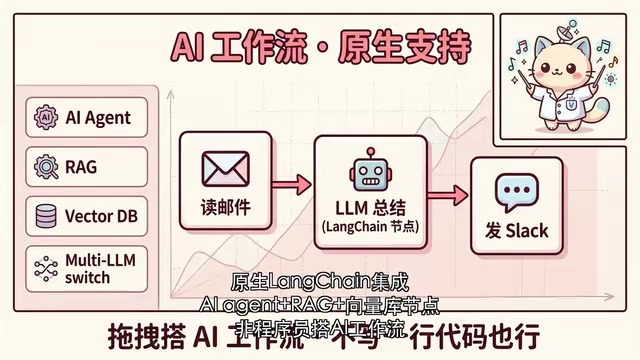
Combined with RAG nodes, vector database nodes, multi-LLM switching, and other capabilities, n8n has evolved from a simple process automation tool into an AI decision-driven automation platform.
RAG (Retrieval-Augmented Generation) is one of the most important architectural patterns in current AI applications. Here's how it works: enterprise documents, knowledge bases, FAQs, and other data are first converted into high-dimensional vector representations using Embedding models (such as OpenAI's text-embedding-ada-002) and stored in specialized vector databases (such as Pinecone, Weaviate, Qdrant, Chroma). When a user asks a question, the system first retrieves the most relevant document fragments from the vector database via semantic similarity search, then injects these fragments as context into the LLM's Prompt, enabling the model to generate answers based on real, up-to-date enterprise data. This approach effectively addresses two major LLM pain points: the knowledge cutoff date problem (training data has a time limit) and the hallucination problem (the model fabricates non-existent information). n8n provides out-of-the-box RAG nodes and vector database connection nodes, so users don't need to build complex retrieval pipelines themselves. This is especially friendly for non-programmers — you don't need to understand LangChain's code architecture; you just drag and drop AI nodes in the visual interface to build intelligent workflows.
n8n Deployment Options: From Local Experimentation to Enterprise-Grade Production
n8n offers extremely flexible deployment options covering every scenario from individual developers to large enterprises:
| Deployment Method | Use Case | Complexity |
|---|---|---|
npx n8n | Quick local experimentation | ⭐ |
| Docker Run | Individual/small team | ⭐⭐ |
| n8n Cloud | Managed service, no ops required | ⭐ |
| Self-Host + K8s | Production environment | ⭐⭐⭐ |
| Enterprise | SSO, advanced permissions, Air-Gapped deployment | ⭐⭐⭐⭐ |
The fastest way is a single command npx n8n — you can get it running locally. For production environments, Docker or Kubernetes deployment is recommended. The Enterprise edition additionally provides SSO single sign-on, fine-grained permission control, and offline deployment features.
Several key concepts here are worth elaborating on. Kubernetes (abbreviated K8s) is a container orchestration platform open-sourced by Google in 2014, and it has become the de facto standard for cloud-native application deployment. In n8n's production deployment, K8s provides auto-scaling (dynamically adjusting instance counts based on workflow execution load), rolling updates (zero-downtime upgrades), service discovery, and self-healing capabilities (automatic restarts when nodes fail), ensuring the workflow engine runs stably even under high concurrency. Air-Gapped deployment refers to running software in a completely disconnected, isolated environment where all dependency packages and images must be pre-imported. This is a hard requirement in industries with extremely high data security and compliance demands, such as finance, healthcare, government, and defense. SSO (Single Sign-On) allows enterprise employees to log into n8n using a unified identity authentication system (such as Okta, Azure AD, Keycloak), avoiding password management chaos and the associated security risks, while also making it easier for IT departments to centrally manage user permissions and audit logs.
The community forum at community.n8n.io is also very active — you can find solutions to virtually any problem you encounter.
n8n's Position in the AI Era: The Winner of the Middle Ground
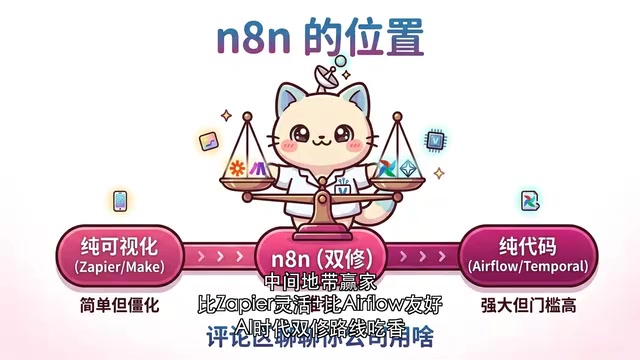
n8n increasingly looks like the winner of the middle ground:
- More flexible than purely visual tools like Zapier and Make
- More accessible than purely code-based solutions like Apache Airflow and Temporal
This "dual mastery" approach is particularly well-suited for the AI era. AI is increasingly blurring the boundary between code and visual interfaces, and tools that can serve users on both sides are the winners.
From a broader perspective, n8n represents the evolutionary direction of automation platforms in the AI era: from pure process triggering to AI decision-driven automation. Past automation was "if A happens, execute B" — this is classic rule-based automation, where the logic is deterministic and predefined. Today's automation is "if A happens, let AI decide whether to execute B or C, then execute automatically" — this is AI-driven automation, where the decision process is dynamic and based on contextual understanding. The significance of this shift is that automation is no longer limited to handling structured, predictable tasks. It can now handle unstructured data (such as natural language emails, customer feedback) and scenarios requiring judgment (such as priority ranking, intent recognition). By natively integrating LangChain and RAG capabilities, n8n makes this kind of AI decision-driven automation readily accessible.
If your team is still manually handling the flow between Slack messages, GitHub PRs, and Linear tasks, I strongly recommend giving n8n a try. Start with a single command, and you can build your first automated workflow in just a few minutes.
Key Takeaways
Related articles

The Truth Behind Codex 'Build a Website in 5 Minutes': AI Isn't Creating Sites—It's Helping You Copy Them
Exposing the truth behind viral Codex 5-minute website videos: creators aren't building original sites with AI—they're copying shared prompts or scraping others' work. Learn AI coding tools' real limits.

Getting Started with AI Agent Development: A Complete Guide from Concept to Practice
A comprehensive guide to AI Agent architecture and development, covering automated marketing, intelligent customer service, and investment analysis scenarios with single and multi-agent collaboration.

The Truth Behind Codex 'Build a Website in 5 Minutes': AI Isn't Creating Sites — It's Helping You Copy Them
Exposing the truth behind viral Codex 5-minute website videos: creators aren't building original sites with AI — they're copying shared prompts or scraping others' work.