The Con Artist Meets the Performer: The Absurd Collision of Elizabeth Holmes and Nathan Fielder

Fielder's documentary juxtaposes Holmes's fraud with his own performance, questioning authenticity in the media age.
The article examines Nathan Fielder's documentary *You Can See Everything*, analyzing how it juxtaposes Theranos founder Elizabeth Holmes's fraud with Fielder's signature "performed authenticity." Fielder uses Holmes as a mirror reflecting the performativity in startup culture, media, and celebrity worship. Holmes's "sincerity" is a tool of deception, while Fielder's "fake" sincerity creates more genuine moments. The documentary touches on authenticity anxiety in the social media age, suggesting viewers are complicit in performing and watching. It ultimately leaves open questions about the ethics of watching: the line between judgment and appreciation is blurrier than we think.
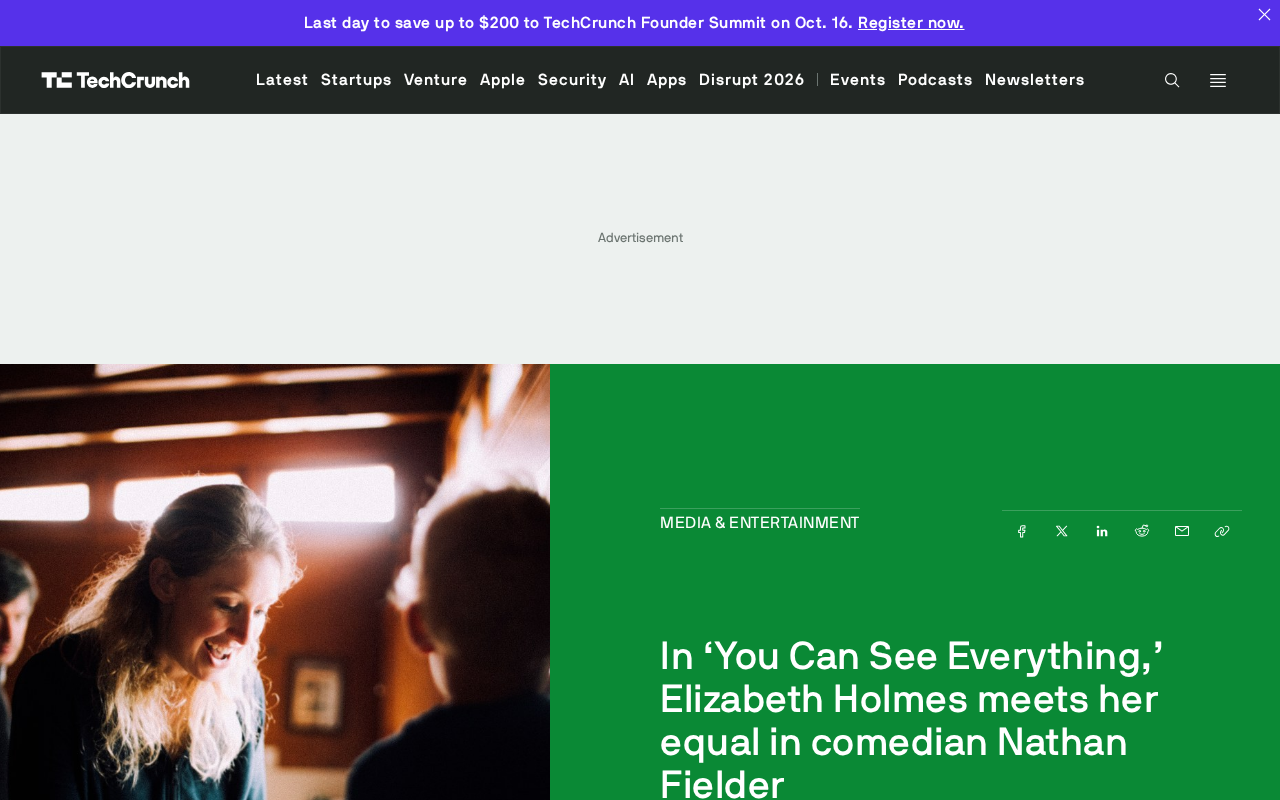
What happens when an entrepreneur who defrauded billions with a fabricated blood-testing technology meets a comedian known for deconstructing reality through awkward role-play? Nathan Fielder's latest documentary You Can See Everything offers an answer far more complex than simple satire. The work places Theranos founder Elizabeth Holmes within Fielder's signature framework of "performed authenticity," creating a strange dialogue about integrity, identity, and the nature of media.
The Mirror Relationship Between Two "Fakers"
Elizabeth Holmes was convicted for the Theranos blood-testing fraud, having deceived investors, patients, and the public with false technological promises. Nathan Fielder's art, by contrast, is built on a carefully designed "inauthenticity"—whether through the bumbling business advice of Nathan for You or the elaborate orchestration of real life in The Rehearsal, he plays an awkward, boundary-crossing version of himself to expose the absurdity of social mechanisms.
The article notes that the documentary creates a "constellation of colliding personalities" that together interrogate the fundamental nature of "authenticity." Holmes's fraud was destructive—she caused real harm. Fielder's performance is constructive—he uses exaggeration and displacement to prompt viewers to reflect on the everyday lies around them. By juxtaposing the two, Fielder is not simply mocking Holmes; he invites the audience to consider: In the contemporary media environment, who is performing? Who is deceiving? And where exactly is the line between the two?
Elizabeth Holmes and the Theranos Affair: In 2003, 19-year-old Elizabeth Holmes dropped out of Stanford to found Theranos, claiming to have developed an "Edison" device that could perform hundreds of tests from a single finger-prick of blood, disrupting the traditional blood-testing industry. With this narrative, the company reached a valuation of $9 billion, and Holmes became Silicon Valley's most dazzling female entrepreneur, appearing on the cover of Forbes and being compared to "the next Steve Jobs." However, a 2015 investigative report by The Wall Street Journal revealed that the technology was never truly viable, with test results relying on third-party devices or even fabricated data. The company dissolved in 2018, and in 2022 Holmes was sentenced to over 11 years in prison on four counts of fraud. The case became an iconic scandal of Silicon Valley's "fake it till you make it" culture.
How the Documentary Deconstructs the Performance of "Sincerity"
Fielder's work has always excelled at creating uncomfortable, awkward scenarios that expose participants' unrehearsed reactions on camera. When this technique is applied to Holmes—a figure trained to perfectly perform the persona of a "genius entrepreneur"—the effect is remarkably unique. Every public appearance by Holmes was itself a carefully orchestrated performance: the black turtleneck, the deep voice, the precise control of media narrative.
Fielder seems to grasp this layer: he does not attempt to expose Holmes's lies (that was the job of investigative journalism and the courts), but rather uses her as a mirror reflecting the performativity pervasive throughout startup culture, the media industry, and celebrity worship. When Holmes's "sincerity" is itself a tool of deception, Fielder uses his "fake" sincerity to manufacture moments of something more genuine.
This ironic structure echoes Fielder's previous work—he has always walked a tightrope between sincerity and manipulation. This encounter with Holmes amplifies that tension to its extreme: a person sentenced for fraud and a person whose profession is passing fiction as truth become each other's "equivalents" on camera.
Nathan Fielder's "Performed Authenticity" Approach: Fielder is known for Nathan for You (2013–2017) and The Rehearsal (2022–), with a core method of embedding fictional scenarios into real life, allowing non-professional actors to react authentically in unscripted situations. He often plays a socially awkward, logically eccentric version of "himself," creating discomfort through boundary-crossing behavior that exposes the performative elements in social rules and interpersonal interactions. This approach is often categorized within the mockumentary or social-experiment comedy tradition, but Fielder's uniqueness lies in never fully revealing the fiction—instead, he lets reality and performance remain entangled, forcing viewers to question what exactly they are watching.
The Authenticity Crisis in the Media Age
The article's core insight is that this documentary is not just about two specific individuals—it touches on broader cultural anxiety. In an era dominated by social media, reality TV, and short-form video, everyone may in some sense be "performing" their own life. Holmes's case garnered enormous attention not only because of the sums of money involved, but because she perfectly exploited society's hunger for the "innovator" narrative.
Fielder's intervention pushes this critique to a meta level. He is not telling a story of "a bad person getting caught" but asking: When deception becomes a recognizable—even appreciable—form of "performance," how do we confront the blurred zone between truth and falsehood? The documentary's form itself participates in this inquiry—what viewers see is an edited, curated "reality," so what is the status of that reality?
The article suggests that the collision between Fielder and Holmes is compelling precisely because they share an ability: making viewers realize, through discomfort, that they too are participants in this game of authenticity. We consume Holmes's story just as we consume Fielder's comedy—both in search of some substitute for "the real."
What "Meta-Level" Critique Means: When the article says Fielder pushes critique to a "meta level," it means he not only discusses the problem of truth and falsehood but makes the work's very form part of the problem. Traditional investigative reporting attempts to expose lies and restore facts; Fielder's documentary deliberately preserves traces of editing, orchestration, and performance, making viewers aware that the "reality" they are watching is equally constructed. This self-reflexivity transforms the documentary from merely a report about Holmes into an inquiry into the documentary medium itself and into the audience's desire for "true stories." It elevates criticism from the level of personal morality to the level of media and cognition.
Conclusion: Who Is Watching, Who Is Performing
What You Can See Everything ultimately leaves behind is not additional judgment of Holmes but a question about the ethics of watching. When the con artist meets the performer, when the documentary itself becomes part of the performance, viewers are forced to reflect on what they expect to see and why they are drawn to such narratives. Fielder's achievement is that he offers no simple answers, instead allowing this absurd encounter to become a continuously fermenting space for thought.
In the attention economy, Holmes and Fielder are both extreme cases—one trades lies for trust, the other trades performance for laughter. But this documentary reminds us that the distance between the two may be closer than we imagine, and the line between judgment and appreciation is far less clear than we assume.
One-line Summary
Fielder's documentary juxtaposes Holmes's fraud with his own performance, questioning the boundaries of authenticity in the media age.
Paragraph Summary
The article examines Nathan Fielder's documentary You Can See Everything, analyzing how it juxtaposes Theranos founder Elizabeth Holmes's fraud with Fielder's signature "performed authenticity." It argues that Fielder does not simply mock Holmes but uses her as a mirror reflecting the performativity pervasive in startup culture, the media industry, and celebrity worship. Holmes's "sincerity" is itself a tool of deception, while Fielder's "fake" sincerity creates moments of something more genuine, forming an ironic contrast. The documentary touches on widespread authenticity anxiety in the social media age, suggesting that viewers are complicit in both performing and watching. Ultimately, the work leaves open questions about the ethics of watching: the line between judgment and appreciation is far blurrier than we think.
Related articles

WorkBuddy Step-by-Step Tutorial: Get an Automated Workflow Running in Half an Hour
A step-by-step breakdown of the WorkBuddy automated workflow: why most people only use it as a chat app, how the 27-anchor course and 12 templates help beginners get up and running in half an hour, plus notes on usage boundaries.

The Truth About Free Claude Code: Three Legitimate Paths and One Scam
Is free Claude Code possible? We break down the real cost of Pro and Max (with exchange rates and taxes), how community free methods work and their privacy trade-offs, plus fake installers and phishing traps—and three legitimate free paths.

Codex Cloud Mode Explained: Environment Setup and Use Cases
This article explains how Codex cloud mode works, environment setup steps, and use cases, including how to create environments, connect GitHub repositories, set scheduled tasks, and compare cloud vs. local mode.