The Cost of Not Planning: Parallel Sampling Depth Peaks at the Reconstruction Threshold
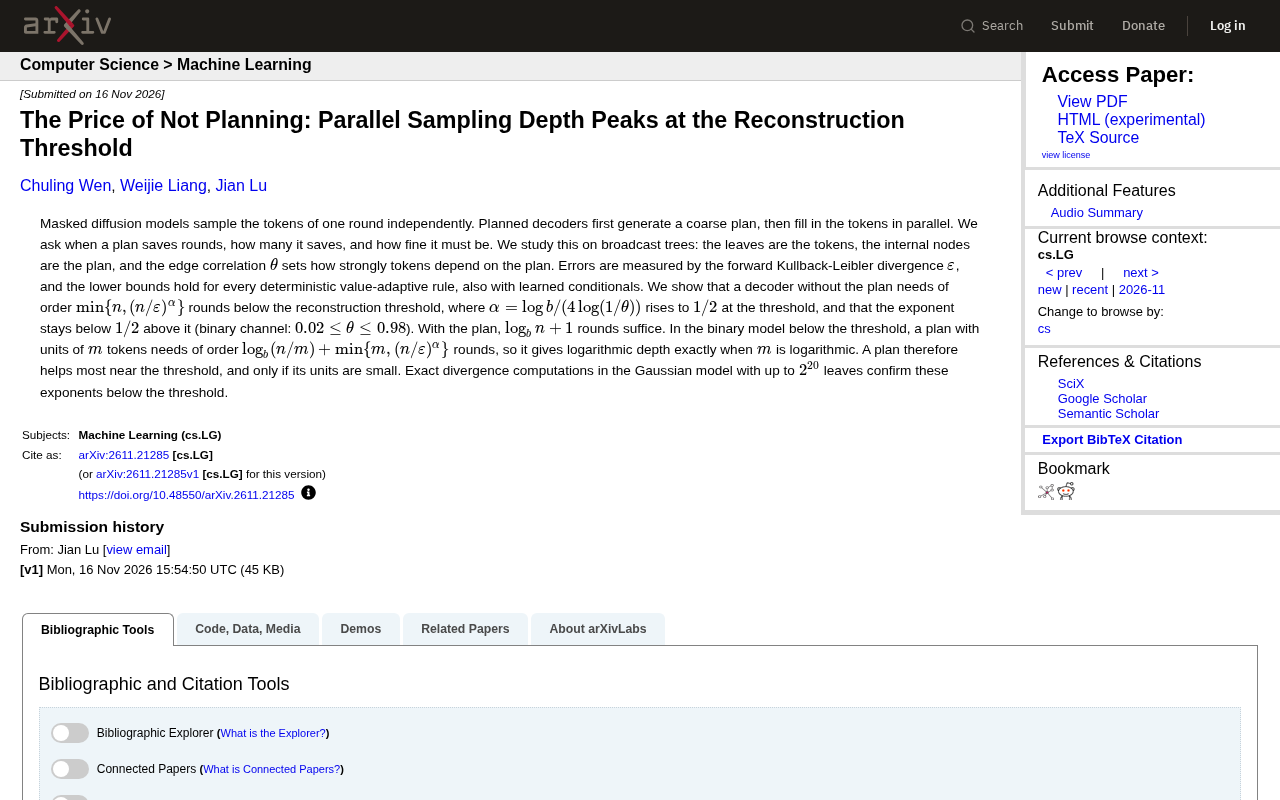
Theory proves parallel sampling without planning peaks in rounds at the reconstruction threshold, and fine-grained planning cuts depth to logarithmic order.
This study quantitatively analyzes the value of planning in parallel sampling via a broadcast tree model. Core conclusion: unplanned parallel decoding below the reconstruction threshold requires min{n, (n/ε)^α} rounds, with α rising to 1/2 at the threshold—i.e., the cost of not planning peaks near the reconstruction threshold. Planning reduces rounds to log_b n + 1, but only if planning units are small enough—if a unit contains m tokens, rounds are log_b(n/m) + min{m, (n/ε)^α}, and true logarithmic depth is achieved only when m is logarithmic. The lower bound applies to all deterministic value-adaptive rules; exact Gaussian model calculations (up to 2^20 leaves) verify the exponent relationship below the threshold. The study suggests planning helps most near the threshold, coarse-grained planning may fail to deliver the speedup, and engineering should match planning granularity to the round budget.
Parallel sampling is a key technique for accelerating diffusion model generation, but when planning is needed, how many rounds it can save, and how fine the planning granularity must be have remained vague empirical questions. A theoretical study provides quantitative answers through a broadcast tree model: parallel decoding without planning requires the most sampling rounds near the reconstruction threshold, while planning can reduce the rounds to logarithmic order—provided the planning units are small enough.
The Planning Dilemma of Parallel Sampling
When sampling, masked diffusion models generate a batch of tokens independently at each round. If planning is introduced, the decoder first produces a coarse-grained plan and then fills in all tokens in parallel. Intuitively, planning can reduce the number of rounds, but this study points out that the value of planning depends heavily on the state of the model—particularly its relationship to the reconstruction threshold.
The study models the problem on a broadcast tree: leaf nodes correspond to tokens, internal nodes constitute plans, and the edge correlation θ captures the strength of token dependence on the plan. The error is measured by forward KL divergence ε, and the lower bound applies to all deterministic value-adaptive rules, including cases using learned conditional distributions. This setup gives the theoretical conclusions broad applicability.
The broadcast tree model is a classic structure in theoretical computer science and statistical physics for analyzing hierarchical dependencies. In such models, a root node generates multiple child nodes through a branching process, each child branches independently, down to the leaf level. The article uses it to abstract the parallel sampling process: leaves represent the tokens to be generated, internal nodes represent "plans" at different granularities, and the correlation parameter θ on the edges captures the extent to which child nodes depend on the parent's plan information. The closer θ is to 1, the more tokens depend on the plan; the closer θ is to 0, the weaker the dependence. The advantage of this modeling is that it allows researchers to precisely quantify the relationship between "planning granularity" and "sampling rounds" using the tree's branching factor b and depth, thereby turning vague engineering intuition into computable mathematical propositions. Information propagation and error accumulation on broadcast trees already have mature analytical tools, making them a suitable theoretical sandbox for deriving lower bounds.
The Reconstruction Threshold: The Peak Cost of Not Planning
The core finding is that below the reconstruction threshold, the number of rounds required by an unplanned decoder scales as min{n, (n/ε)^α}, where α = log b / (4 log(1/θ)), rising to 1/2 at the threshold. Above the threshold, the exponent stays below 1/2 (0.02 ≤ θ ≤ 0.98 in the binary channel).
This means that parallel sampling without planning reaches peak depth when closest to the reconstruction threshold. In other words, the closer the model is to the critical state of "just barely able to reconstruct," the greater the cost of lacking planning. This conclusion is consistent with empirical observations: in tasks where generation quality is acceptable but the structure is complex, parallel sampling often requires more rounds to converge.
The reconstruction threshold here refers to the critical error level at which the model transitions from "able to reliably reconstruct the target distribution" to "unable to reliably reconstruct." Intuitively, when the sampling error ε is above a certain threshold, even without any planning, independent round-by-round sampling can converge fairly quickly; but when the error is below the threshold and the model approaches the limit of its expressive capacity, dependencies between tokens become crucial, and the lack of a global plan causes errors to accumulate repeatedly across rounds, requiring more rounds to reach the target accuracy. The exponent α in the article rises to 1/2 at the threshold precisely because, near that point, error propagation in unplanned decoding degrades from sublinear to square-root order, causing a peak in the required number of rounds. This phenomenon is similar to "critical slowing down" in statistical physics: near a phase transition point, the correlation length diverges and the relaxation time increases sharply. Understanding the location of the threshold helps determine when simple parallel sampling is sufficient and when planning must be introduced.
When Planning Yields Logarithmic Speedup
With planning introduced, the number of rounds drops to log_b n + 1. Below the threshold in the binary model, if a planning unit contains m tokens, the required number of rounds is log_b(n/m) + min{m, (n/ε)^α}. When m is of logarithmic order, planning yields exactly logarithmic depth.
Planning helps most near the threshold, and only when its units are small enough. This conclusion has direct implications for practical system design: coarse-grained planning may fail to deliver the theoretical speedup, and only fine-grained plans can compress parallel sampling depth to logarithmic order.
Logarithmic depth means that the number of sampling rounds grows only at a rate of log n with the problem size n, rather than linearly or polynomially. In parallel computing theory, logarithmic depth means an algorithm can complete in very few rounds, and it is the ideal upper bound for parallel efficiency. The article points out that with planning the number of rounds drops to log_b n + 1, but this conclusion depends on the size m of the planning unit: if m is constant, the number of rounds still contains a polynomial term min{m, (n/ε)^α} related to n, preventing pure logarithmic depth; only when m itself is of logarithmic order (i.e., m = Θ(log n)) is the polynomial term absorbed by the logarithmic term, and the total number of rounds truly reaches logarithmic order. This reveals a counterintuitive engineering implication: planning is not "better than nothing"; the speedup from coarse-grained planning may be offset by the extra rounds it itself introduces. The size of the planning unit must match the target round budget in order to deliver on the theoretical promise.
Gaussian Model Validation and Theoretical Boundaries
The study performed exact divergence calculations on a Gaussian model with up to 2^20 leaves, confirming the exponent relationship below the threshold. These numerical validations support the theoretical lower bound.
As a caveat, the analysis is based on the broadcast tree and a specific error metric, and the structure of actual diffusion models may be more complex. However, the lower bound holds generally for deterministic value-adaptive rules, indicating that the conclusions are robust. For researchers and engineers designing parallel sampling strategies, this study suggests: when near the reconstruction threshold, investing in fine-grained planning is more effective than simply adding more parallel rounds.
Forward KL divergence is used here as a measure of the error between the sampling distribution and the target distribution. Unlike forward KL, reverse KL tends to cover only a single mode, whereas forward KL penalizes missed modes more heavily, making it more suitable for assessing the goal of "whether all target structure has been reconstructed." The article emphasizes that the lower bound applies to all deterministic value-adaptive rules, meaning that whether the decoder decides dynamically what to generate next based on the values of already-generated tokens, or samples using a learned conditional distribution, the lower bound holds as long as the rule is deterministic and value-adaptive. This universality comes from the chain decomposition property of forward KL: the error can be decomposed token by token, and the hierarchical structure of the broadcast tree allows the contribution of each layer to be lower-bounded independently. The exact computation on the Gaussian model (with up to 2^20 leaves) is important because KL divergence has a closed-form solution under the Gaussian distribution, allowing direct validation of the theoretically predicted exponent relationship without approximation, thereby ruling out numerical error as a source of interference with the conclusions.
Practical Implications
From an engineering perspective, planning is not always necessary. When the model is far from the reconstruction threshold, simple parallel sampling may already be efficient enough. But when task complexity approaches the boundary of the model's reconstruction capability, fine-grained planning becomes the key lever for reducing sampling depth. The size of the planning unit should match the desired round budget—to achieve logarithmic depth, logarithmic-level unit granularity is required.
This study provides the first quantitative theoretical framework for planning strategies in parallel sampling, turning "whether planning is needed" from empirical intuition into a computable threshold judgment.
One-line Summary
Theoretical proof shows that parallel sampling without planning requires the most rounds at the reconstruction threshold, while fine-grained planning can reduce depth to logarithmic order.
Paragraph Summary
This study quantitatively analyzes the value of planning in parallel sampling through a broadcast tree model. The core conclusion: unplanned parallel decoding below the reconstruction threshold requires min{n, (n/ε)^α} rounds, with α rising to 1/2 at the threshold—i.e., the cost of not planning peaks near the reconstruction threshold. Introducing planning can reduce the rounds to log_b n + 1, but only if the planning unit is small enough—if the unit contains m tokens, the rounds are log_b(n/m) + min{m, (n/ε)^α}, and true logarithmic depth is achieved only when m is of logarithmic order. The lower bound applies to all deterministic value-adaptive rules, and exact Gaussian model calculations (up to 2^20 leaves) verify the exponent relationship below the threshold. The study suggests: planning helps most near the threshold; coarse-grained planning may fail to deliver the promised speedup; and engineering practice should match planning granularity to the round budget.
Related articles

Aphasia Discourse Analysis: Language Metric Differences Across Tasks
A study of 61 adults with aphasia found that narrative, descriptive, and procedural discourse tasks yield non-interchangeable language metrics. Total words and lexical diversity show a gradient; disfluency is higher in narrative tasks. Each metric must be labeled by task type and compared only within the same task.
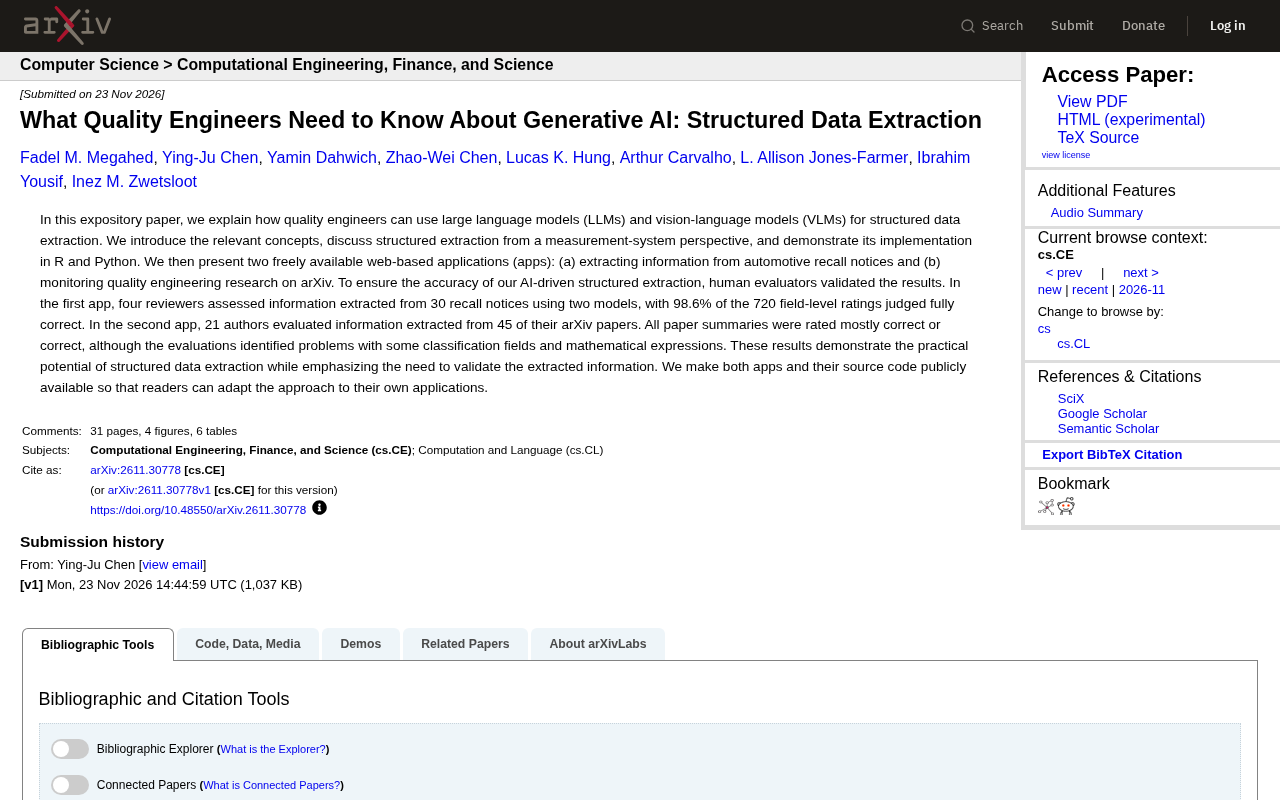
Must-Read for Quality Engineers: A Practical Guide to Structured Data Extraction with Generative AI
A paper shows how quality engineers use LLMs and VLMs for structured data extraction, validated through two web apps, with R and Python implementations.

CocoonBench: Can Multilingual Search Agents Break Out of the Language Information Cocoon?
CocoonBench evaluates whether multilingual search agents can escape the language information cocoon. Tests show 10 advanced models range from 33.8% to 69.7% accuracy, with the strongest system still below 70%, revealing key challenges in connecting cross-lingual evidence.