The Cross-Platform Testing Dilemma: One Unified Framework or Separate Stacks per Platform?

Unified framework or platform-specific stacks? How to solve the cross-platform testing dilemma.
When a product ships on Web, desktop, and mobile, teams often end up maintaining multiple independent test stacks with incomparable results. This article analyzes two approaches — converging on a single cross-platform framework vs. keeping specialized tools with a unified reporting layer — and argues that solving assertion semantic consistency should come before any tool selection.
A Real Testing Team's Predicament
If your product ships on Web, Windows desktop, macOS, and Android simultaneously, the automation testing nightmare that follows is probably all too familiar. A Reddit user recently posted a detailed account of the testing tech debt their team had accumulated over three years — a pitfall that virtually every multi-platform product team stumbles into.
According to this developer, they ship a product covering four platforms: a web app, a Windows desktop client, a macOS build, and an Android app. To automate testing across all four, the team gradually stacked up four completely independent automation stacks:
- Web: Playwright
- Windows desktop: A custom solution built on WinAppDriver
- Android: Appium
- Physical devices: A full rack of machines that someone has to physically walk over and reboot when things go wrong
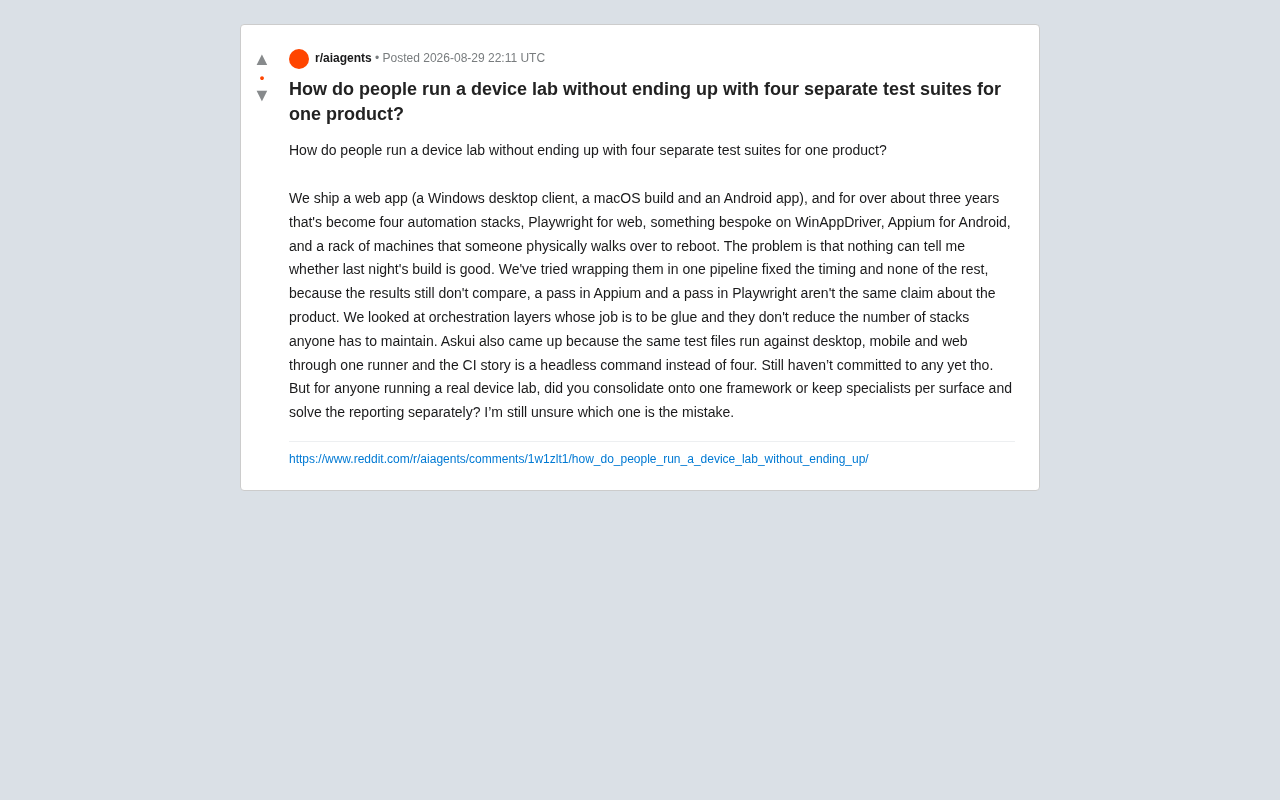
The Core Pain Point: Test Results Can't Be Compared Across Platforms
The developer nailed the central issue, and it's incredibly representative: there isn't a single signal that can tell them whether last night's build was actually good or not.
The team hadn't been sitting idle — they'd tried wrapping all four stacks into a single CI pipeline. But that only solved the timing problem; every other pain point remained untouched. The reason? Test results from different frameworks simply aren't comparable.
"A pass in Appium and a pass in Playwright are not making the same assertion about the product."
This statement hits the nail on the head. When your four automation frameworks each use different locator mechanisms, different assertion semantics, and different reporting formats, even if they all show "green," you can't draw a unified conclusion about product quality. Green doesn't equal green. Pass doesn't equal pass. This is the most insidious and most fatal problem with multi-stack testing.
Why an Orchestration Layer Doesn't Solve the Root Problem
The team also evaluated so-called "orchestration" solutions — tools that act as glue. But the conclusion was disappointing: these tools are designed to stitch existing things together, and they don't reduce the number of tech stacks anyone needs to maintain.
In other words, an orchestration layer solves scheduling, not unification. You still need Playwright engineers, custom WinAppDriver scripts, and piles of Appium configurations. Maintenance costs don't drop by a single cent, and cognitive overhead doesn't decrease one bit.
Two Paths to Choose From
The poster ultimately posed the question to the community, distilling it into a classic cross-platform test architecture decision:
Path One: Converge on a Single Cross-Platform Testing Framework
This means using one framework to cover all platforms. The post mentioned tools like Askui — where the same test file can run on desktop, mobile, and web through a single runner, and the CI step simplifies from "four commands" to "one headless command."
These visual or AI-driven cross-platform testing tools have been gaining traction in recent years. Their core value proposition is unified assertion semantics: regardless of the underlying platform, tests operate at the level of "what the user sees and can interact with," which inherently solves the "pass doesn't equal pass" problem.
However, the poster admitted: they haven't actually committed to adopting any particular solution yet.
Path Two: Keep Platform-Specific Frameworks, Unify the Reporting Layer
The other path accepts that each platform has its best-suited specialized framework (Playwright excels at Web, Appium has its strengths for Android), without forcing unified test execution. Instead, the approach is to build a separate unified reporting and result aggregation layer that maps results from different stacks onto a single set of product quality assertions.
The philosophy here is "respect the division of expertise." The trade-off is the additional investment required to build a result normalization middle layer.
How Should You Weigh the Options?
From an engineering practice standpoint, there's no absolutely correct answer, but several key dimensions are worth considering:
What Are Your Tests Actually Validating?
If the four platforms share a large amount of business logic and user flows are highly consistent, a unified framework can dramatically reduce maintenance costs and prevent writing the same business scenario four times. Conversely, if interaction patterns differ significantly across platforms (e.g., the desktop client has complex native controls), the deep control capabilities of specialized frameworks may be irreplaceable.
Team Size and Skill Distribution
Maintaining four stacks means you need reserves of four different skill sets. For smaller teams, converging on a single framework is far more attractive. For larger teams, specialized division of labor can actually improve testing depth and coverage on each platform.
Who Is Responsible for "Is the Build Healthy?"
This is the poster's real anxiety at its core. Regardless of which path you choose, there must ultimately be a single, trustworthy source of quality signal. Converging frameworks solves this at the execution layer; aggregating reports solves it at the results layer — but you must pick one. You can't do neither.
Solve Assertion Consistency First, Then Talk Tool Selection
The most valuable insight from this case isn't about choosing Askui versus keeping Playwright + Appium. It's that it elevates the problem from "tool selection" to "assertion semantic consistency."
Many teams stumble with multi-platform automated testing not because their tools aren't good enough, but because they've never seriously considered: does "pass" across four platforms point to the same judgment about the product? If you haven't thought this through clearly, it doesn't matter whether you use one framework or four — you still can't answer "was last night's build good?"
Define the unified quality assertions you need first, then work backward to decide whether to converge frameworks or unify reporting — that's probably the right order for climbing out of the four-test-suite quagmire.
Related articles

Is the AI Black Box Actually Transparent? Interpretability Research Upends Conventional Wisdom
Goodfire's research "Neural Networks Are Already Clean" challenges the AI black box myth: polysemanticity may be an illusion from visualization tools and the SwiGLU double-negative flaw. Neural networks self-organize via recursive generalization and are inherently readable. This deep dive explores implications for AI interpretability and alignment.

Automate Job Search with AI Agents and Residential Proxies for Precise Matching
Build an AI Agent with MCP and residential proxies to bypass recruitment site anti-scraping and geo-restrictions, scrape thousands of DevOps jobs, then have Claude score and rank each against your resume. Includes proxy comparison experiments, project structure, and cost analysis—filtering only, no auto-submission.

The AI Task Assistant That Knows When to Back Off: A Cure for Activation Struggles
One Small Step is an AI assistant for task initiation struggles, using agentic decisions for guilt-free reminders, timely retreat, and cross-platform task management. The developer shares real test results on 13 tasks and architectural trade-offs.