The Data Center Dilemma: What Two Years of Controversy in Pennsylvania Reveal About AI Infrastructure

Pennsylvania's two-year data center battle exposes how AI infrastructure's skewed cost-benefit distribution fuels widespread local resistance.
Using Pennsylvania as a case study, this article examines the widespread social resistance AI data centers face at the local level. These facilities consume vast electricity and water, occupy land, and generate noise — while creating few local jobs — producing a dynamic where burdens are local but benefits are distant. The generative AI boom has turned compute infrastructure into a public governance challenge involving energy policy, environmental justice, and community rights. The article concludes that tech giants must embrace transparency, community compensation, and renewable energy investment to break through the approval and protest deadlock.
When the AI Boom Meets Real-World Resistance
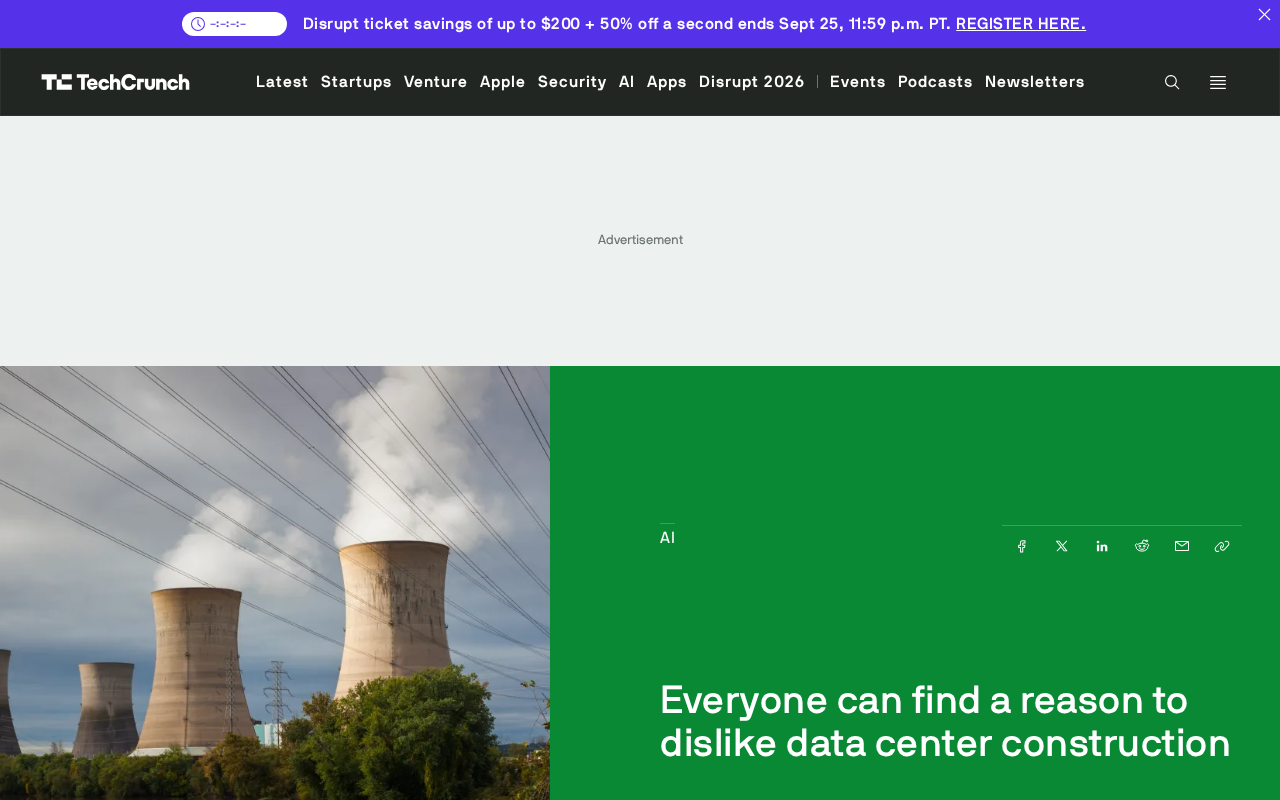
The race for AI computing power is thrusting data centers into the spotlight. A report focused on Pennsylvania reveals a recurring phenomenon: no matter which angle you take, almost everyone can find a reason to oppose data center construction.
The story centers on "two years of contentious AI data center debate," painting a picture of the persistent friction these infrastructure projects face at the local level. This isn't resistance from any single group — it's a complex struggle involving residents, environmentalists, local governments, and more.
"Everyone can find a reason to dislike data center construction."
This headline-worthy verdict precisely captures the social resistance behind AI infrastructure expansion — a resistance that often goes unacknowledged.
Why the Controversy Is So Widespread
The widespread discontent surrounding data centers stems from a deeply uneven distribution of costs and benefits. They consume enormous amounts of electricity and water, occupy land, and generate noise — yet typically create only a limited number of local jobs. For surrounding communities, it's a deal where the burdens are local and the benefits are distant.
Pennsylvania sits right at the center of this tension. As a traditional energy and industrial hub, the state has the electrical infrastructure to host compute facilities, but also a public deeply sensitive to environmental and community impacts. When these two forces collide, every new project risks becoming a years-long public debate.
This resistance has broader significance. As major tech companies scramble to expand computing capacity for training and running AI models, similar controversies are playing out across the United States and around the world.
The job creation benefits of data centers are often overstated. A large facility costing billions of dollars to build may only sustain a few dozen to a few hundred permanent operational roles — most of them highly specialized technical positions that offer little absorption for the local general workforce. Meanwhile, the pressure of rising electricity prices from grid upgrades and transmission line expansions during construction, plus ongoing noise, light pollution, and traffic loads, are borne continuously by all nearby residents. This structure — where employment benefits concentrate among a few while environmental and infrastructure costs are dispersed across everyone — is what economists call the internalization failure of negative externalities. Market prices don't reflect true social costs, so the problem can't self-correct through ordinary commercial negotiation; it requires regulatory or policy intervention.
The Hidden Price of AI Compute Expansion
The generative AI explosion has transformed data centers from behind-the-scenes "invisible infrastructure" into a focal point of public debate. Training a large model demands staggering amounts of energy and cooling water, and all of that consumption ultimately lands on specific plots of land and power grids.
From an industry perspective, computing power is the core resource in the AI competition, giving tech giants powerful incentives to build infrastructure fast. But from a community perspective, local residents bear the environmental pressure, the risk of rising utility bills, and the anxiety of declining quality of life. This tension is unlikely to ease anytime soon.
Two years of debate in Pennsylvania show that building data centers is no longer a purely commercial or technical decision — it has become a public governance challenge involving energy policy, environmental justice, and community self-determination.
To put concrete numbers to this: training a large language model at the scale of GPT-4 is estimated to consume over 50 gigawatt-hours (GWh) of electricity — equivalent to the annual power consumption of thousands of American households. The water demands of cooling systems are equally striking: a mid-sized data center can consume millions of liters of water per day, primarily for evaporative cooling towers. In drought-prone regions or water-stressed watersheds, this directly competes with agricultural and municipal water use. At the same time, the cumulative energy consumption of the AI inference stage — the phase after a model goes live, responding to every user query — is rapidly approaching or even surpassing that of training. This means data centers will sustain high operational loads over the long term, not just deliver a one-time impact. These figures make the "hidden costs" quite tangible, and explain why grid operators and state energy regulators are finding it increasingly difficult to sidestep the issue.
Lessons for the Industry
This controversy serves as a warning to the entire AI industry: expanding compute capacity can't be evaluated solely through a technical or economic lens. Even if project developers have the funding and the power supply, ignoring the real concerns of local communities can trap them in years of drawn-out permitting battles and public protests.
Viable paths forward might include greater transparency in disclosures, meaningful community benefit agreements, investment in renewable energy and water recycling, and robust engagement with local stakeholders starting at the site selection phase. Only by ensuring that local communities receive tangible, real benefits can the "everyone has a reason to object" impasse be broken.
As AI continues to penetrate every sector of the economy, the social costs of data centers will only grow more visible. Pennsylvania's two years of debate may well be the growing pains that global compute infrastructure must endure before it can truly mature.
Related articles

WorkBuddy Agent in Action: From AI Q&A to Automated Office Work
WorkBuddy is Tencent's AI agent desktop workbench that reads local files, operates office software, executes multi-step tasks, and runs on schedules. This article explains its core features, key differences from traditional AI tools, and use cases.

Anthropic Research: LLMs Make Formal Software Verification at Scale Possible
Anthropic Frontier Red Team research shows LLMs can generate formal proofs at the RISC-V assembly level for over 100 real open-source libraries, covering 123 OSS-Fuzz libraries and 239 entry points, totaling about 180 million lines of Rocq proofs and finding hundreds of bugs. The article analyzes specification generation, the proof pipeline, trust boundaries, and cost reduction paths.

Prompt Engineering for Beginners: From Writing Prompts to Building AI Collaboration Skills
From the four functions of prompts to the six-step prompt engineering process, this article systematically covers core concepts, business value, and three layers of limitations to help beginners build a complete cognitive framework for prompt engineering.