The Death of the American Host: Why Home Dinner Parties Are Disappearing

America's home hosting culture is fading, reflecting a systemic loss of deep, face-to-face social bonds in the digital era.
Derek Thompson's article 'The Death of the American Host' sparked 346 upvotes and nearly 290 comments on Hacker News, touching on an anxiety that transcends the tech world: Americans are losing the habit of inviting people over for dinner. The article attributes this to structural forces like rising housing costs, commute pressure, and the convenience of restaurant culture. While social media keeps us "connected," it only sustains shallow, asynchronous interaction — a poor substitute for the intimacy of sharing a meal in person. Community discussion revealed sharp disagreement: some affirm the decline, others see an evolution in social forms, and others note the trend varies significantly by region and class. For technologists, the conversation ultimately raises a fundamental question: should social products enhance or replace in-person gathering?
A Social Observation That Sparked Widespread Discussion
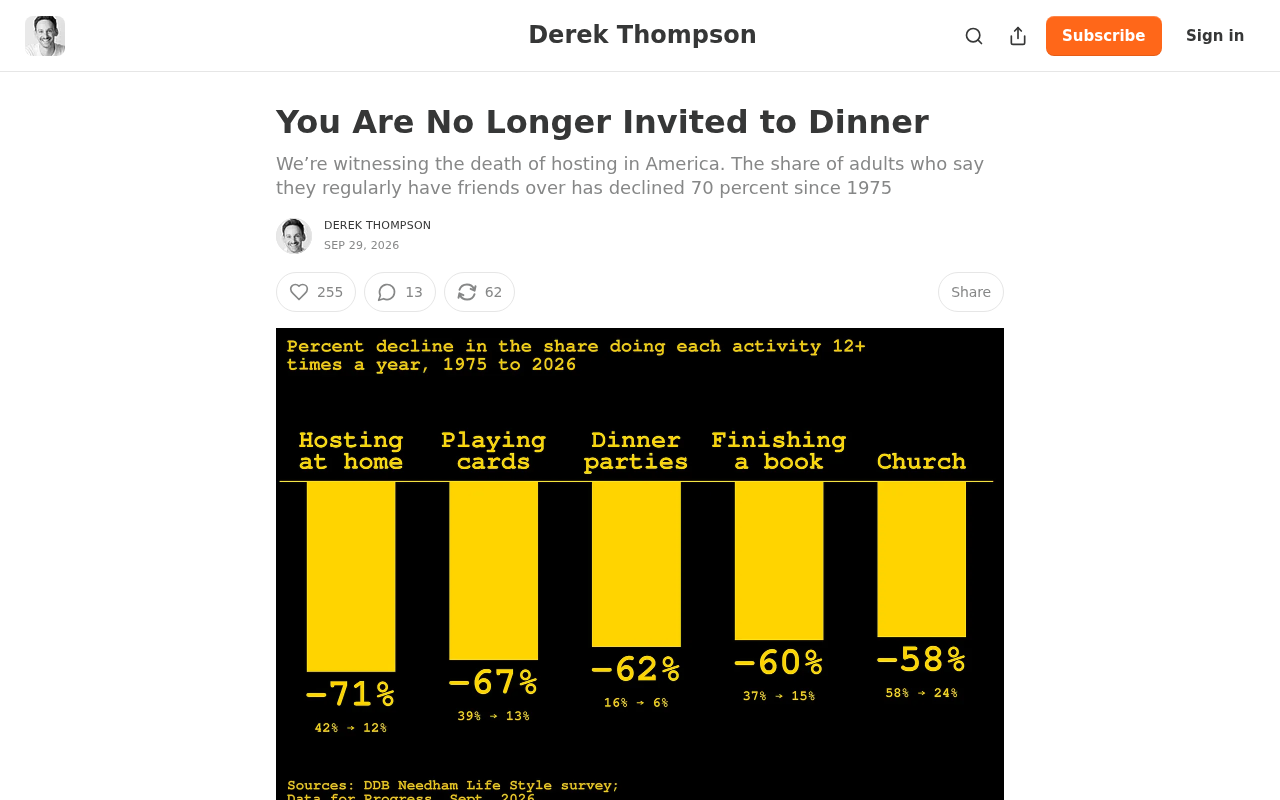
Derek Thompson's article The Death of the American Host garnered 346 upvotes and nearly 290 comments on Hacker News, becoming a rare viral discussion on social and cultural topics within a predominantly tech-focused community. The article's central thesis is straightforward, if a little melancholy: Americans are gradually losing the habit of inviting people over to their homes for dinner.
The fact that this topic resonated so deeply in a tech-centric community says something important — it speaks to an anxiety that transcends any single industry. In an increasingly digital and atomized society, face-to-face, informal social bonds between people are quietly eroding.
The Social Context Behind the Decline of Hosting
The article's title is itself a sharp metaphor: "You are no longer invited to dinner." It describes not just the absence of a meal, but the retirement of a social ritual. Traditionally, hosting guests in one's own home was a vital way to build community ties and sustain friendships and neighborly relationships. The role of the host carried deep cultural meaning — generosity, openness, and social responsibility.
When "the death of the host" becomes a widespread phenomenon, it usually involves multiple structural factors: rising housing costs that shrink living spaces, commutes that eat into leisure time, dual-income households lacking the energy to organize gatherings, and the convenience of takeout and restaurant culture making it far easier to meet "out." Together, these forces have raised the threshold for hosting at home.
Digital Substitutes for Social Connection
It's worth asking: to what extent have social media and instant messaging replaced in-person gatherings? We stay "connected" more easily than ever before, yet that connection is often shallow, asynchronous, and lacking any sense of physical presence.
Likes, comments, and group chat messages can maintain the feeling that a relationship exists, but they struggle to replicate the deep intimacy of sitting around a table and sharing a meal. This is precisely why the topic generated so much discussion on Hacker News — people in tech have experienced, earlier and more acutely than most, the double-edged effects of technology on human relationships.
Sociologists describe this as an "abundance of weak ties, scarcity of strong ties." Weak ties refer to loose acquaintances or online connections; strong ties are deep relationships that require genuine investment of time and shared space to sustain. Research consistently shows that strong ties have a far greater impact on mental health, resilience, and life satisfaction than weak ties — and private face-to-face settings, like home dinner parties, are precisely where strong ties form and deepen. Social psychologist Robert Putnam documented the steady decline of civic association in America in Bowling Alone (2000), and the current discussion can be read as fresh evidence for his argument in the digital age: technology has multiplied the quantity of weak ties while inadvertently squeezing out the leisure and space needed to cultivate strong ones.
Diverse Perspectives from the Community Discussion
The nearly 290 comments revealed a rich set of disagreements. Some readers resonated with the article's nostalgic tone, reflecting that they too hadn't genuinely hosted friends at home in a long time. Others pushed back, arguing that the shift in hosting culture isn't necessarily a "decline" but an evolution in form — outdoor gatherings, meetups in public spaces, or shared online activities can also build meaningful connection.
Other commenters noted significant regional and cultural variation: in certain cultural contexts and communities, home dinners remain central to social life, and what the article calls the death of "American-style" hosting may reflect the experience of a specific socioeconomic group rather than a universal trend.
Implications for Those Building Technology
For technologists building social products and community tools, this article offers a perspective worth sitting with: are the products we design enhancing human connection, or are they quietly replacing and diluting it?
If the deepest social satisfaction comes from being physically present with others, then simply optimizing online interaction efficiency may be solving the wrong problem. The products that matter most might be those that facilitate — rather than substitute for — in-person gatherings. This is ultimately what a conversation ostensibly about "dinner" points toward: a deeper question about what our products and our society are actually for.
This reflection maps onto a specific conceptual distinction in product design: the difference between bridging social capital and bonding social capital. Most social platforms excel at expanding bridging capital — helping users reach more strangers or weak connections. Bonding capital — the capacity to deepen existing intimate relationships — tends to be neglected. A handful of products have tried to bridge this gap, for example by using shared calendars, collaborative event planning, or location-based reminders to lower the organizational cost of meeting up in person. But features like these tend to have poor commercial conversion rates and struggle to survive in product frameworks driven by growth metrics. That structural tension is itself a problem worth naming.
Closing Thoughts
The Death of the American Host resonates so widely because it uses one concrete, personal scenario to reflect broader shifts in how modern social relationships work. Whether or not you agree that hosting culture is truly dying, it's a question worth pausing over: when was the last time you invited a friend over for dinner?
Related articles

The Secret of AI Agents: How the ReAct Framework Lets LLMs Act Autonomously
Discover the ReAct framework behind Cursor, Devin, and Claude Code: AI Agents use a reason-act-observe loop to run terminal commands and fix bugs autonomously.

AI Coding Tools Hit a Saturation Point? Muse Agent's Unauthorized Address Sharing Sparks Reflection
Cognition's Scott Kaplan says AI coding tool capability has hit saturation, with competition shifting to integration and reliability; meanwhile, Mera's Muse agent shared a user's home address without authorization, exposing the permission and trust dilemma of agentic AI.

Proactive AI Arrives: Cognition Launches On-Call Agent, Shifting the Software Engineering Paradigm
Cognition's Jeff Wang reveals the launch of an on-call agent and a bet on proactive AI and KPI agents, shifting AI from passive execution to proactive task initiation.