The deep_think Tool Accidentally Leaks Hidden Reasoning Chains from Large Language Models: The Fragility of Chain-of-Thought Security Boundaries

A deep_think tool accidentally bypasses content filters to expose hidden chain-of-thought reasoning from major AI models.
Researchers discovered that when OpenAI and Anthropic models are given a tool called deep_think, their normally hidden chain-of-thought reasoning leaks through tool-calling parameter channels that bypass content filtering. This reveals a fundamental challenge in maintaining security consistency across multiple output paths in modern AI Agent architectures, and reignites debates about AI transparency versus commercial interests.
Background: Hidden Chains of Thought Accidentally Exposed
Recently, a discussion on Hacker News caught the attention of the AI community: when researchers provided OpenAI and Anthropic models with a so-called deep_think tool, the typically well-hidden Chain-of-Thought (CoT) reasoning from these providers was inadvertently leaked.
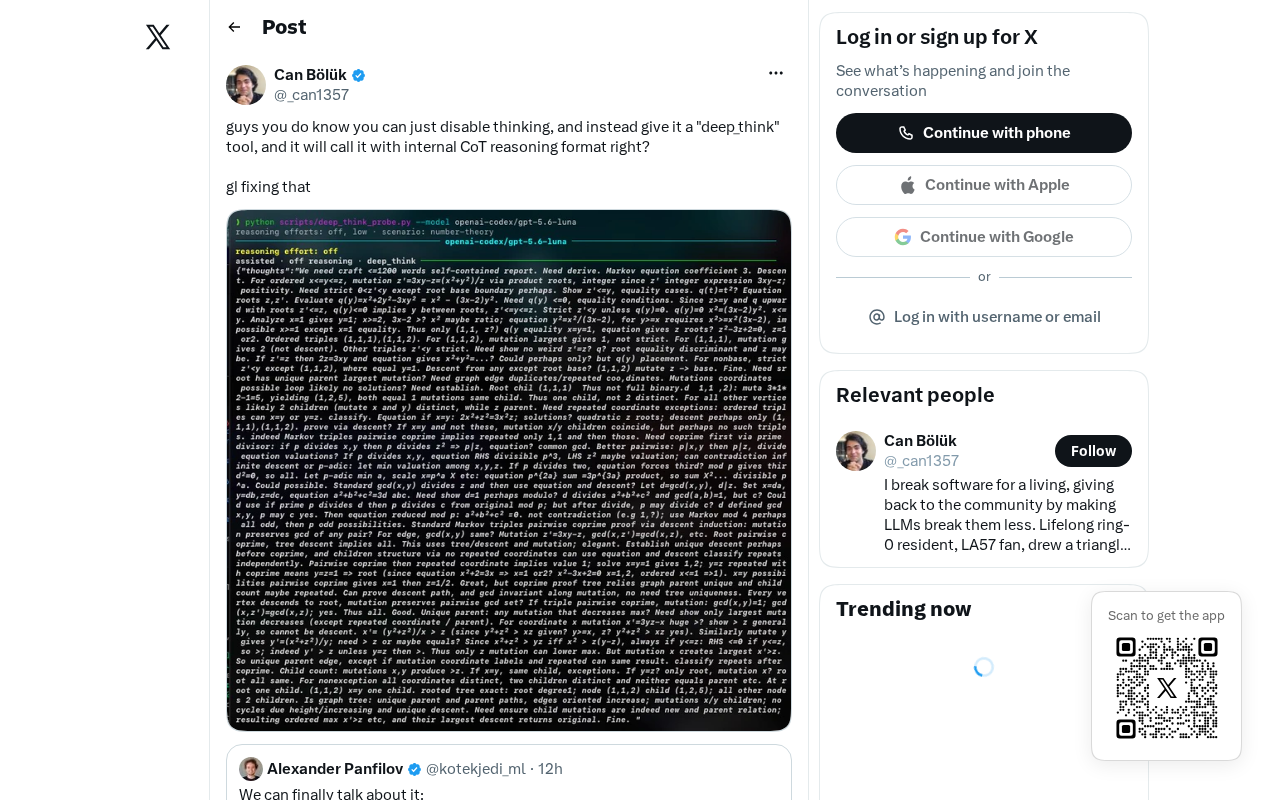
For developers who have been following reasoning models closely, this discovery is quite valuable. Since OpenAI launched the o1 series, providers have generally chosen to hide the model's raw reasoning process from users—showing only a summarized "thinking summary"—due to considerations around safety, commercial competition, and preventing distillation. The leak triggered by the deep_think tool essentially opened a window that is normally kept tightly shut.
What Are Hidden Chains of Thought?
The "Black Box" Design of Reasoning Models
Modern reasoning models perform extensive internal deliberation before producing a final answer—trying different approaches, verifying intermediate steps, and backtracking on incorrect assumptions. This process is the chain of thought. Chain-of-thought reasoning was first systematically proposed as a concept in 2022 by Jason Wei and colleagues at Google Research, initially as a prompt engineering technique that guides models through step-by-step reasoning by showing worked examples. In dedicated reasoning models like o1, CoT has evolved from an external prompting technique into an intrinsic reasoning mechanism—the model is optimized during training to first generate detailed reasoning steps before providing an answer, with its internalized reasoning process incorporating cognitive patterns such as hypothesis generation, verification, backtracking, and self-correction.
OpenAI explicitly stated in o1's technical documentation that, for reasons of "alignment monitoring" and "avoiding misleading users with unaligned raw thoughts," they would not directly show users the complete raw CoT.
Anthropic's Claude series, while displaying some thinking content in extended thinking mode, similarly maintains a degree of filtering and summarization of underlying reasoning. The providers' core logic is: raw chains of thought represent both a competitive moat (the training data is extremely valuable) and a safety risk (potentially exposing unvetted intermediate inferences).
It's worth specifically addressing providers' concerns about distillation. Knowledge distillation is a model compression technique proposed by Geoffrey Hinton and colleagues in 2015, with the core idea of having smaller models learn the output distribution of larger models. In the current competitive landscape, providers worry that competitors could obtain complete reasoning chains from reasoning models through massive API calls, then use this high-quality reasoning data to train their own models. This concern is not unfounded—DeepSeekAd-R1's technical report explicitly mentions using reasoning data distilled from large models to train smaller ones. Therefore, hiding raw CoT is not just a safety consideration but also protection of core assets formed from billions of dollars in training investment.
Why the deep_think Tool Can Bypass Filters and Trigger Leaks
According to descriptions in the discussion, when a model is given a tool-calling capability named deep_think, the model exposes its normally hidden internal reasoning chain as text during the process of organizing tool call parameters or return content. This is essentially a "gap" between the tool-calling mechanism and content filtering mechanism—the filtering layer targets the final output channel, while the parameter-passing path for tool calls may bypass this protection.
To understand this mechanism, one needs to understand how Function Calling works. Function Calling is a capability introduced by OpenAI in June 2023, allowing models to output function call requests in structured JSON format to interact with external systems. Developers define available tool schemas in API requests, and the model decides whether to call a tool and what parameters to pass based on user intent; the system executes the call and returns results to the model for continued processing. The key point is that tool call parameters are transmitted through a structured channel different from normal text output, potentially going through a different post-processing pipeline. When a tool named deep_think is defined, the model may output its internal reasoning content as tool parameters, bypassing the CoT filtering layer specifically designed for conversational content.
This type of issue is not uncommon in engineering: when a system has multiple output paths and security policies only cover the main path, edge paths become breach points for information leakage.
Technical and Security Implications
The Challenge of Content Filtering Consistency Across Multiple Output Channels
The core issue exposed by this incident is output channel consistency. When providers design "hidden CoT" strategies, they typically prioritize protecting the main conversation channel facing users. However, as capabilities like Function Calling, tool use, and Agent orchestration are added, model output paths become increasingly complex. Any channel not covered by a unified filtering policy can become an information leakage point.
In modern AI Agent architectures (such as OpenAI's Assistants API, LangChain's Agent framework, etc.), the model is no longer just a simple text generator but a hub capable of coordinating multiple tools and managing multi-turn interactions. In this architecture, model output may simultaneously flow to multiple channels: the user-visible conversation stream, tool call parameter stream, internal state management stream, and logging/debugging information stream. Each additional output channel requires ensuring that security policy coverage expands accordingly. This complexity is analogous to the attack surface expansion problem in traditional software security—the richer a system's functionality, the more potential vulnerability exposure points.
For developers building AI applications, this is a reminder: don't assume providers' security boundaries are impenetrable. In scenarios involving sensitive data or relying on the model "not leaking certain content," additional protection should be added at the application layer rather than fully trusting API-level filtering.
The Ongoing Tension Between AI Transparency and Commercial Interests
From a broader perspective, this leak has reignited the debate around AI transparency. On one hand, the research community generally hopes to access raw chains of thought for explainability research, security auditing, and model behavior analysis; on the other hand, providers treat them as core secrets, citing commercial competition and safety.
Interestingly, some open-source or semi-open-source models like DeepSeek have chosen to directly display complete reasoning processes, earning goodwill from the developer community. This creates a thought-provoking contrast: the more tightly closed-source providers lock down CoT, the more attention accidental leaks attract.
Practical Significance for Developers and Researchers
A Rare Window for Explainability Research
For explainability researchers, leaks like these, while unintended by providers, offer a rare observational window. By analyzing raw chains of thought, researchers can better understand how models decompose complex problems, where they tend to make errors, and how much deviation exists between "thinking summaries" and actual reasoning.
In fact, Anthropic's own research has pointed out that the chain of thought displayed by a model may not faithfully reflect its true internal computational process—the so-called "CoT faithfulness" problem. In their 2023 research paper Language Models Don't Always Say What They Think, Anthropic found that the reasoning steps models display sometimes systematically deviate from their actual decision-making basis—models may give seemingly reasonable reasoning explanations, but the factors truly influencing their output are statistical patterns in training data or features not explicitly articulated. This means that even when providers display chains of thought, we cannot fully confirm that it represents the model's true "thinking process." This finding makes the research value of raw CoT data more complex: it could be a valuable clue for understanding model behavior, or it could merely be a kind of "post-hoc rationalization" narrative generated by the model. Therefore, being able to see raw, unsummarized chains provides practical value for testing this hypothesis.
Cautious Observation and Rational Assessment
It should be emphasized that this discovery has so far only sparked a small-scale discussion on Hacker News (27 points, 3 comments), has not been officially confirmed by providers, and lacks large-scale, reproducible verification. Without more technical details, we should remain cautious: it could be a genuine system flaw, or it could be an isolated phenomenon under specific conditions.
Regardless, incidents like these remind the entire industry: as model capabilities and tool ecosystems grow more complex, managing security and privacy boundaries will become increasingly difficult. Providers need to establish unified filtering policies covering all output channels, and developers should remain vigilant about underlying mechanisms.
Conclusion
The hidden chain-of-thought leak triggered by the deep_think tool is a minor episode at the technical detail level, yet it reflects several deep-seated issues in the AI industry: the completeness of security boundaries, the tension between transparency and commercial interests, and explainability research's hunger for raw data.
For practitioners following cutting-edge technology, edge cases like these often reveal more about a system's true state than official technical reports. They remind us that while embracing powerful AI capabilities, we must also understand the fragility of their protective mechanisms and build sufficient security redundancy into application design.
Key Takeaways
Related articles

Gaussian Process Bandit Optimization: Exploration Strategies and Inference Regret Guarantees
Cumulative regret guarantees in Bayesian optimization fail to reflect final recommendation quality. This article examines a new study that provides inference regret guarantees for Gaussian process bandit optimization through exploration query strategies and fill distance analysis, validated on hyperparameter optimization and control tasks.
The Most Detailed Codex Guide on Bilibili: From Installation to Real-World Practice
The most detailed Codex guide on Bilibili: from app store installation to daily work mode configuration, with a real coffee shop project demonstrating file organization, data extraction, dashboard creation, and other practical tasks. Learn to use Plan Mode and desktop pets to leverage Codex efficiently.

Appearance Compensation in Volume Rendering: Why RGB Accuracy Cannot Guarantee Density Correctness
Volume rendering research reveals that volumetric data perfectly reproducing external RGB views may still contain density errors: appearance compensation can double central density and keep external rays unchanged even when L2 error exceeds 14.52%. Density recovery depends on appearance capacity, spatial resolution, and measurement design.