The Deeper Logic Behind Qwen Models Claiming the Top 4 Spots on HuggingFace's Popularity Chart

Qwen's rapid climb to HuggingFace's all-time top 4 signals a shift in global open-source LLM competition.
Alibaba's Qwen series has surged to the top 4 on HuggingFace's all-time most-liked models leaderboard, sparking heated Reddit discussion. This article analyzes the driving factors — including aggressive open-source licensing, practical medium-parameter models ideal for consumer GPUs, and rapid iteration — while examining what this phenomenon reveals about shifting power dynamics in the global open-source LLM landscape.
A Community Post That Sparked Heated Discussion
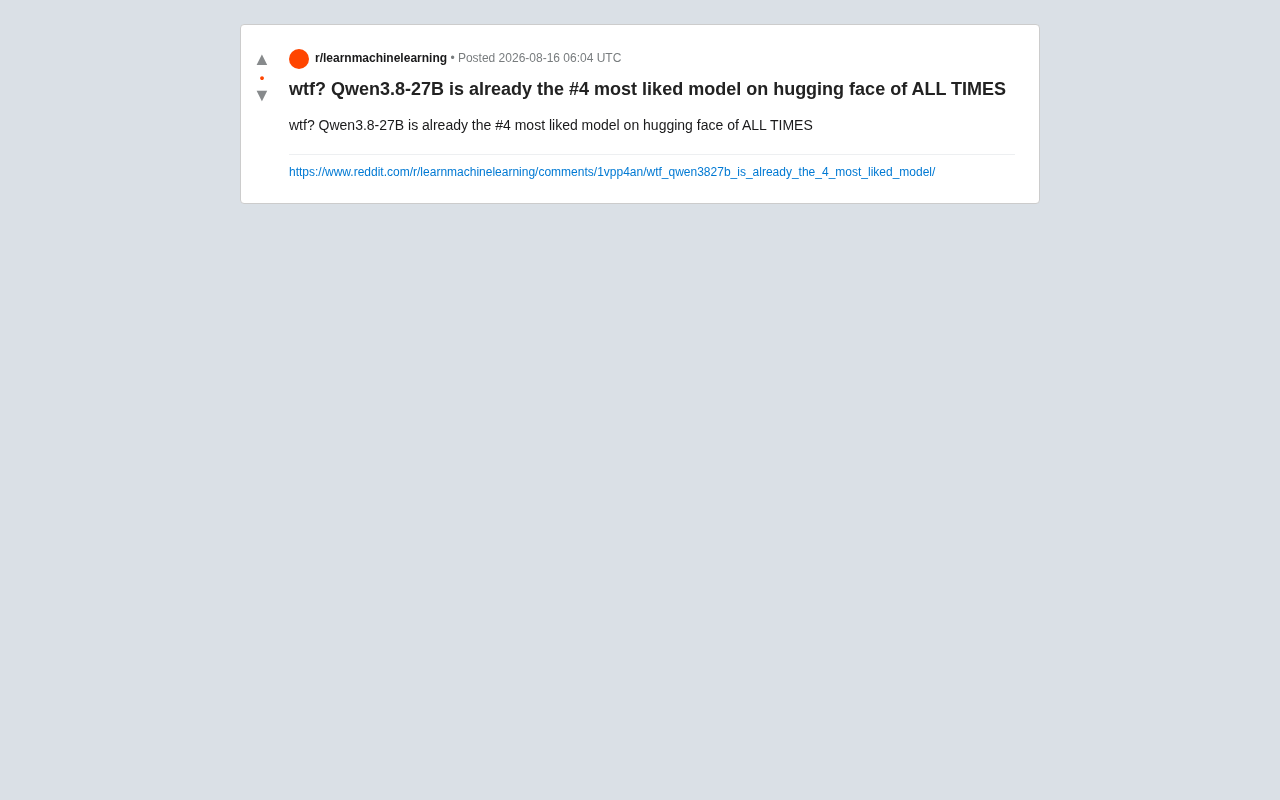
Recently, a Reddit post titled "wtf? Qwen3.8-27B is already the #4 most liked model on hugging face of ALL TIMES" sparked widespread discussion in the AI community. The poster was astonished to discover that Alibaba's Qwen series models had climbed to the fourth position on HuggingFace's "all-time" most popular models leaderboard in an remarkably short period.
For those familiar with the open-source LLM ecosystem, this phenomenon is both surprising and entirely logical. As the world's largest open-source model hosting platform, HuggingFace's "likes" leaderboard aggregates community approval for all models since the platform's inception. Founded in 2016, HuggingFace started as a company focused on chatbots before pivoting to become an open-source machine learning model hosting and collaboration platform — now widely regarded as the "GitHub of AI." As of 2024, the platform hosts over 500,000 models, 100,000 datasets, and more than 200,000 demo applications. Its like mechanism is similar to GitHub Stars — registered users can like any public model, and these numbers accumulate over time, serving as an important metric for measuring community approval. Unlike download counts, likes represent deliberate endorsement actions by developers, making them a more reliable signal of a model's actual reputation.
Breaking into the top four means Qwen has distinguished itself in long-term competition against star models like Meta's Llama series, Mistral, and Stable Diffusion.
Core Reasons Behind Qwen's Rapid Rise in Popularity
A Comprehensive Victory for Open-Source Strategy
Chinese AI teams' investment in the open-source route in recent years is paying dividends. Unlike some vendors that choose closed-source or limited access approaches, Alibaba's Qwen (Tongyi Qianwen) has consistently released model weights across multiple parameter scales under permissive licenses, covering the full spectrum from small-scale edge deployment to large-scale server inference. This "full suite" open-source strategy has dramatically lowered the barrier to entry for developers.
Since its first open-source release in August 2023, Qwen has undergone rapid iteration. Through the evolution from Qwen 1.0, 1.5, 2.0, 2.5, to 3.0, the models have continuously improved in multilingual capabilities, code generation, mathematical reasoning, and tool calling. The series uses permissive licenses such as Apache 2.0, allowing commercial use — a stark contrast to Meta's Llama series, which uses a community license that restricts companies with over 700 million monthly active users. The Qwen team has also simultaneously open-sourced specialized variants including the vision-language model Qwen-VL, the code model Qwen-Coder, and the math model Qwen-Math, forming a complete model matrix that covers developers' diverse needs across different task scenarios.
For researchers and engineers worldwide, a high-performing, commercially usable, and continuously iterating open-source model holds inherently strong appeal. The rapid accumulation of likes is essentially the community voting with its feet — developers are genuinely downloading, fine-tuning, and deploying these models.
Precise Balance Between Performance and Practicality
While the specific model name mentioned in the post contains a typo (commonly discussed Qwen model sizes include 32B, 72B, etc.), the core message is clear: medium-parameter models are becoming the community's preferred choice. These models can run on single or dual consumer/professional-grade GPUs while retaining reasoning capabilities approaching top-tier models, precisely hitting the practical pain points of individual developers and small-to-medium teams.
A key technical factor behind the popularity of medium-parameter models is the maturing of quantization inference technology. Through quantization methods like GPTQ, AWQ, and GGUF, models that originally required tens of gigabytes of VRAM can significantly reduce resource requirements. For example, a 27B parameter model requires approximately 54GB of VRAM at FP16 precision, but only about 14-16GB after 4-bit quantization — perfectly fitting high-end consumer GPUs like the RTX 4090. Meanwhile, the proliferation of inference frameworks like llama.cpp, vLLM, and Ollama has further lowered the technical barrier for local deployment, enabling individual developers to run and fine-tune these models on their own workstations without relying on expensive cloud computing resources. This "run it at home" accessibility has directly fueled community enthusiasm for medium-scale models.
Industry Signals Behind the Leaderboard Phenomenon
Shifting Competitive Landscape in Open-Source LLMs
Qwen's rise to the top of HuggingFace's popularity chart reflects a subtle shift in the global open-source LLM competitive landscape. For a long time, the leaderboard's top positions were almost exclusively occupied by models from Western teams. Now, a Chinese model's ability to claim a high position on a leaderboard driven purely by organic community approval demonstrates that its technical capabilities and ecosystem influence have gained substantive recognition from the international developer community.
The current major competitors in the open-source LLM space include: Meta's Llama series (from Llama 1 to Llama 3.1, with parameter scales ranging from 8B to 405B), French team Mistral AI's Mistral/Mixtral series (known for their Mixture of Experts architecture), Google's Gemma series, and from China, DeepSeek, Qwen, and 01.AI's Yi series. While Stable Diffusion is an image generation model rather than a language model, its pioneering open-source contributions to AI art have earned it substantial historical likes on HuggingFace. These models each have advantages on different benchmarks, but community popularity often depends on the combined performance of actual usability, documentation quality, and ecosystem completeness — precisely the areas where the Qwen series has been focusing its recent efforts.
Here's a notable detail: HuggingFace's likes leaderboard is "all-time cumulative" rather than "recent trending." This means that for a new model to make the list, it must accumulate enough popularity in a short period to surpass classic models that have been building their numbers for years — this explosive growth rate is compelling in itself.
Model Naming Confusion and the Cost of Rapid Iteration
This post also exposes a common problem in the rapidly iterating AI field: chaotic model naming. The "Qwen3.8-27B" in the title is likely a memory error or typo regarding the specific version number. As vendors release new versions and specifications at a dizzying pace, even practitioners — let alone casual users — find it increasingly difficult to accurately remember each model's exact name. This indirectly reflects the current pace of open-source model releases — the Qwen series alone has gone through five major version iterations in less than two years, with each version containing multiple parameter scales and task variants. The complexity of version numbering has begun to create additional friction in community information dissemination.
Practical Implications for Developer Model Selection
For developers currently evaluating model choices, this leaderboard phenomenon offers several reference points:
Community popularity is an important reference but not the sole criterion. High like counts typically mean more comprehensive community documentation, more fine-tuned derivative versions, and more active issue feedback — all of which can significantly reduce actual usage costs. In the HuggingFace ecosystem, popular models tend to spawn numerous community contributions — including quantized versions optimized for different hardware, fine-tuned models for specific vertical domains, and detailed performance benchmarks. These derivative resources themselves constitute important reasons for choosing that model.
Medium-scale open-source models are becoming the best value proposition. Before pursuing ultimate performance, evaluating your actual compute budget and task requirements often leads to more pragmatic solutions. For most application scenarios, a well-fine-tuned 27B-32B model's performance on real tasks may already be sufficient for production environments, at a fraction — roughly one-tenth — of the running cost of 400B+ scale models.
A thriving open-source ecosystem brings greater freedom. Whether it's Qwen, Llama, or other series, developers now have unprecedented choice in building their AI applications. The advantage of open-source models lies not just in being free to use, but in complete controllability — developers can audit model behavior, customize safety policies, and deploy in local environments to meet data privacy requirements. These are flexibilities that closed-source APIs simply cannot provide.
Conclusion
The astonishment expressed in a single Reddit post reflects the profound transformation of the open-source LLM ecosystem. Qwen series breaking into HuggingFace's all-time top four is not merely a technical achievement for Alibaba's Tongyi team — it represents the global open-source community's collective endorsement of high-quality, accessible models. In this silent open-source race, the ultimate winners are all the developers who can freely use these powerful tools.
Related articles
AI Beginner's Guide: Three Stages to Building Your Own Personal AI Assistant from Scratch
No tech background? No problem. This beginner's guide maps out a 3-stage path to building a personal AI assistant — from prompt engineering to no-code automation to API calls.
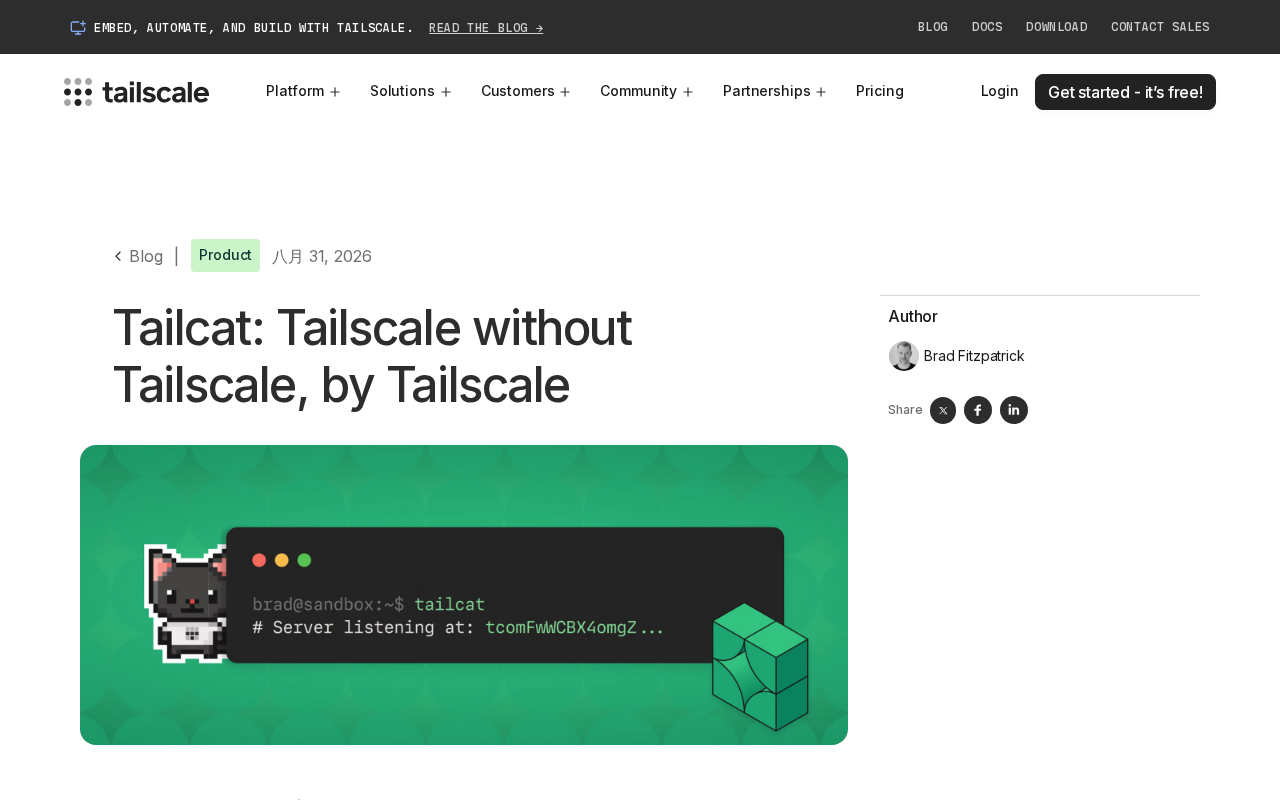
Tailcat: Tailscale's Official Decentralized Minimalist Networking Solution
Tailcat is Tailscale's official decentralized networking project that strips control plane dependencies, offering self-hosting users a more autonomous, privacy-focused WireGuard mesh experience.
Configuring OpenTelemetry Logs in Rails: From Integration to Production
Learn how to configure OpenTelemetry logs in Rails, covering OTel SDK setup, trace context injection, structured log export, and performance optimization for seamless log-trace correlation.