The Delayed Label Dilemma: How to Evaluate a Buying Signal Agent That Reads Messy Web Text

Evaluating a buying-signal Agent is harder than building one — delayed labels, sample bias, and confident model errors all compound.
This article examines a real engineering challenge: an AI Agent extracts buying signals from unstructured web text, but evaluating its output is far harder than building it. Models misread "nice-to-have" as purchase intent, treat habitual CEO statements as imminent deals, and struggle with forum sarcasm. The deeper problem is that true purchase labels arrive months late or never, and manual spot-checks only validate extraction faithfulness, not predictive validity. The article proposes separating these two evaluation goals, using proxy labels to shorten feedback cycles, avoiding LLM-as-judge self-grading traps, and calibrating model confidence — framing this as a weak-supervision, delayed-feedback, sample-bias challenge.
A Real Engineering Problem: When Labels Don't Show Up Until Months Later
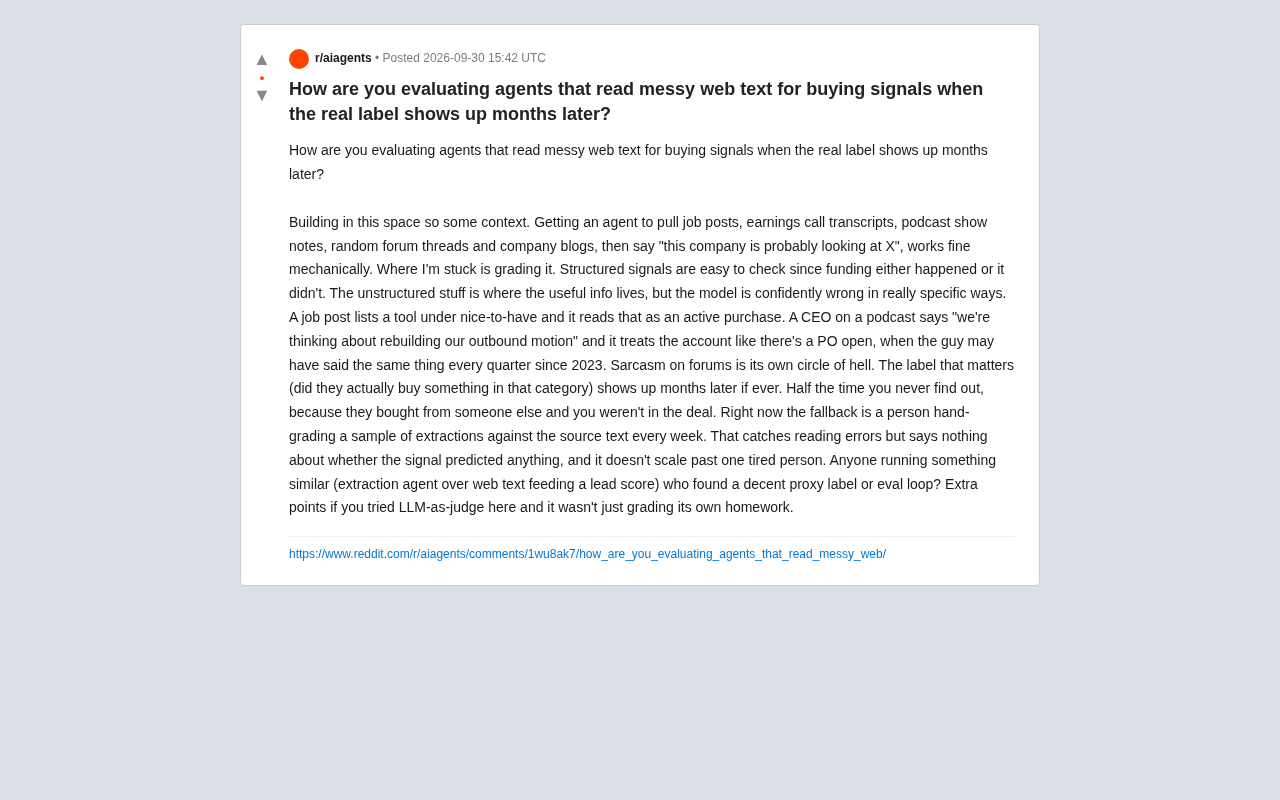
A developer building a sales intelligence system posted a remarkably representative question on Reddit: when you have an AI Agent extracting "buying signals" from job postings, earnings call transcripts, podcast notes, forum threads, and company blogs, the mechanical work isn't particularly hard — the real challenge is figuring out how to score the Agent's output.
The core issue is a broken feedback loop. Structured signals (like whether a company completed a funding round) are easy to verify — something either happened or it didn't. But the most valuable intelligence hides in unstructured text, which is precisely where models tend to fail confidently. Worse still, the labels that actually matter — "did this company actually make a purchase in this category?" — often don't surface for months, if ever.
How Models "Fail Confidently"
The original poster shared several very specific failure cases that anyone doing text extraction should take seriously.
Misreading "Nice-to-Have" as "Purchase Intent"
A job listing mentioned a certain tool under the "nice-to-have" section, but the model interpreted it as the company "actively looking to buy." This is a classic semantic intensity miscalibration — a weak signal in the text gets amplified into a strong one.
Misreading "Repeated Mentions" as "Imminent Action"
A CEO said on a podcast, "We're thinking about rebuilding our outbound system," and the model treated this as the company having already issued a purchase order (PO). In reality, that CEO might have been saying the same thing every quarter for years. Without temporal context, the model can't distinguish between "long-term talk" and "about to act."
Sarcasm and Irony: The Extraction Hell
The original poster bluntly called sarcastic tone on forums "a circle of hell." Irony, venting, and in-jokes are hard enough for humans to parse with full context — for a model that lacks community background knowledge, they're nearly insurmountable.
Why Existing Evaluation Methods Fall Short
The author's current fallback is having one person manually sample outputs each week, comparing extraction results against the raw source text line by line. This catches "misreading" errors but has two fatal flaws.
First, it only validates extraction faithfulness — it says nothing about predictive validity. Did this signal actually predict anything correctly? Second, it doesn't scale at all; the bottleneck is "one exhausted human."
The deeper contradiction: in half of all cases, you'll never know the outcome. If the target company bought from someone else, you never entered that deal and never get the ground-truth label. This means the dataset is fundamentally biased and incomplete — you can only observe outcomes from deals you won or clearly lost, while a large volume of "silent samples" remains permanently missing.
The problem of "never knowing the outcome in half of cases" is known in machine learning as selection bias or survivorship bias — a data trap shared by recommendation systems, ad targeting, medical diagnosis, and many other domains. In a sales intelligence context specifically: the system can only observe outcomes from "deals it participated in," and for target companies that never entered the sales funnel, there's no feedback signal regardless of whether the extraction was right or wrong. This skews both training and evaluation sets toward "companies that overlapped with your sales activity," so what the model actually learns is "companies similar to existing customers are more likely to buy" — not "companies showing buying signals are more likely to buy." Those sound similar but are quite different. Counterfactual estimation and inverse propensity weighting are the mainstream academic approaches to this kind of bias, but they're difficult to implement in practice. A more actionable starting point is to establish regular manual sampling of companies that never entered the funnel at all, to estimate the scale of missed signals.
Potential Ways Forward
Although the original post was asking for help, the problem itself points toward several evaluation approaches worth exploring.
Separate the Two Evaluation Objectives
Treat "did the extraction faithfully represent the source?" and "does the signal have predictive power?" as two independent evaluation dimensions. The former can be monitored continuously with LLM-as-judge or manual spot-checks — it's a short feedback loop. The latter requires long-cycle attribution using delayed labels — it's a long feedback loop. Conflating the two makes it impossible to measure either accurately.
Find Proxy Labels
Since true purchase labels are delayed and sparse, look for earlier intermediate signals as proxies. Did the target company open an email? Did they schedule a demo? Did they advance to the next stage of the sales funnel? These proxy labels are imperfect, but they can compress the feedback cycle from "months" down to "days or weeks."
Proxy labels are a classic machine learning strategy for dealing with sparse or delayed ground truth — the core idea is using "observable intermediate outcomes" in place of "final outcomes that are hard to obtain in time" as training or evaluation signals. Classic examples include using click-through rate as a proxy for content relevance, video completion rate as a proxy for user satisfaction, and credit card applications as a proxy for ad conversion. Introducing proxy labels inevitably brings label noise — the proxy metric correlates with but is not equivalent to the true target, which statisticians call "target shift." In the sales context, "email open" appears earlier and more frequently than "final purchase," but it's also far noisier (automated email client previews, sales rep misclicks, etc.). When building a proxy label system, document the historical correlation coefficient between each proxy metric and the true label, and continuously monitor whether the two drift apart during model iteration — otherwise you risk a system that quietly optimizes the proxy while drifting away from the actual business goal.
Be Skeptical of LLM-as-Judge
The original post specifically noted: "If you've tried LLM-as-judge and it's not just grading its own homework, bonus points." This is a crucial point. Using a model from the same family to score itself can easily create a self-reinforcing loop. To make a judge model genuinely useful, at minimum ensure the judge and the evaluated model are architecturally different, evaluation criteria are anchored by human experts, and human annotations are used for regular calibration.
LLM-as-judge is a recently popular method that uses a large language model to replace human evaluators for output quality assessment. The core idea: have a high-capability model (e.g., GPT-4) act as a "judge," scoring another model's outputs against given criteria or ranking preferences. This approach costs far less than human annotation, is fast, and scales well — it's already widely used in RLHF data filtering, RAG system evaluation, and Agent trajectory scoring.
However, several systematic biases have been documented in research: self-enhancement bias (models in the same family tend to rate stylistically similar outputs higher), position bias (answers listed first are more likely to be selected), and verbosity bias (longer answers are often rated better). In specialized domains like sales intelligence, the judge model may also lack the domain knowledge needed to reliably distinguish subtle semantic differences like "nice-to-have vs. purchase intent." This is why "judge and evaluated model must be architecturally distinct, with human-anchored evaluation criteria" isn't an optional optimization — it's a baseline requirement for valid evaluation.
Calibrate Confidence Instead of Just Tracking Hit Rate
The fact that models "fail confidently" means their confidence scores aren't properly calibrated. Rather than only tracking signal hit rates, also evaluate whether the model's confidence distribution matches its actual accuracy rate — then use this to down-weight high-risk signals in downstream scoring.
Closing Thoughts
What makes this problem so hard is that it's fundamentally a machine learning evaluation challenge with three compounding difficulties: weak supervision + delayed feedback + sample bias — not simply a prompt engineering problem. In scenarios where ground-truth labels arrive late or never, rather than chasing a perfect closed evaluation loop, it's more practical to build a layered evaluation system anchored by proxy labels and calibrated periodically with human annotation. This is also the "last mile" problem that Agent deployments in commercial settings consistently run into — being able to run the pipeline doesn't mean you can measure its value.
Related articles

When Did Paid Childcare Become the Norm? Working Mothers and the Evolution of Childcare
When did paid childcare become the norm? This article traces the evolution from the rise of childcare centers in the 1970s–80s and the 1990s linking of federal subsidies to work requirements, to declining stigma and rising costs, and explores advocates' 25-year effort to catch up with other countries on childcare and paid parental leave.

Red Flags for Product-Market Fit: A Practical Guide from Top VCs and the Superhuman Founder
Investors from Iconiq and Sapphire Ventures and Superhuman founder Rahul Vohra share PMF red flags and practical methods, including the 40% disappointment rule, retention curves, and acquisition costs.

What Task Should AI Agents Take Over Most? Heated Reddit Discussion
Reddit discussion: Which task do you most want AI agents to take over completely? Cross-app data migration, CRM updates, and report generation top the list, but insufficient reliability and the trust gap are the biggest obstacles to automation adoption.