The Doctoral Student's Method Research Dilemma: When Even the Advisor Has No Answers

How an unguided PhD student can self-train method research skills in small-data healthcare ML
Starting from a healthcare ML PhD student's Reddit help post, the article analyzes the structural dilemma of missing method research guidance. The advisor's examples of Transformer and their own incremental paper expose the blurry boundary between method research and incremental improvement, while small-data conditions limit the foundation-model path. It proposes self-training paths like reverse-engineering exemplary papers, building out-of-lab feedback networks, and extracting problems from reproduction failure cases, and suggests turning aggressive feedback into structured dialogue about hypothesis conditions and evidence needs. The core conclusion: a doctoral research question is not the starting point but a result that gradually converges through continuous practice and feedback.
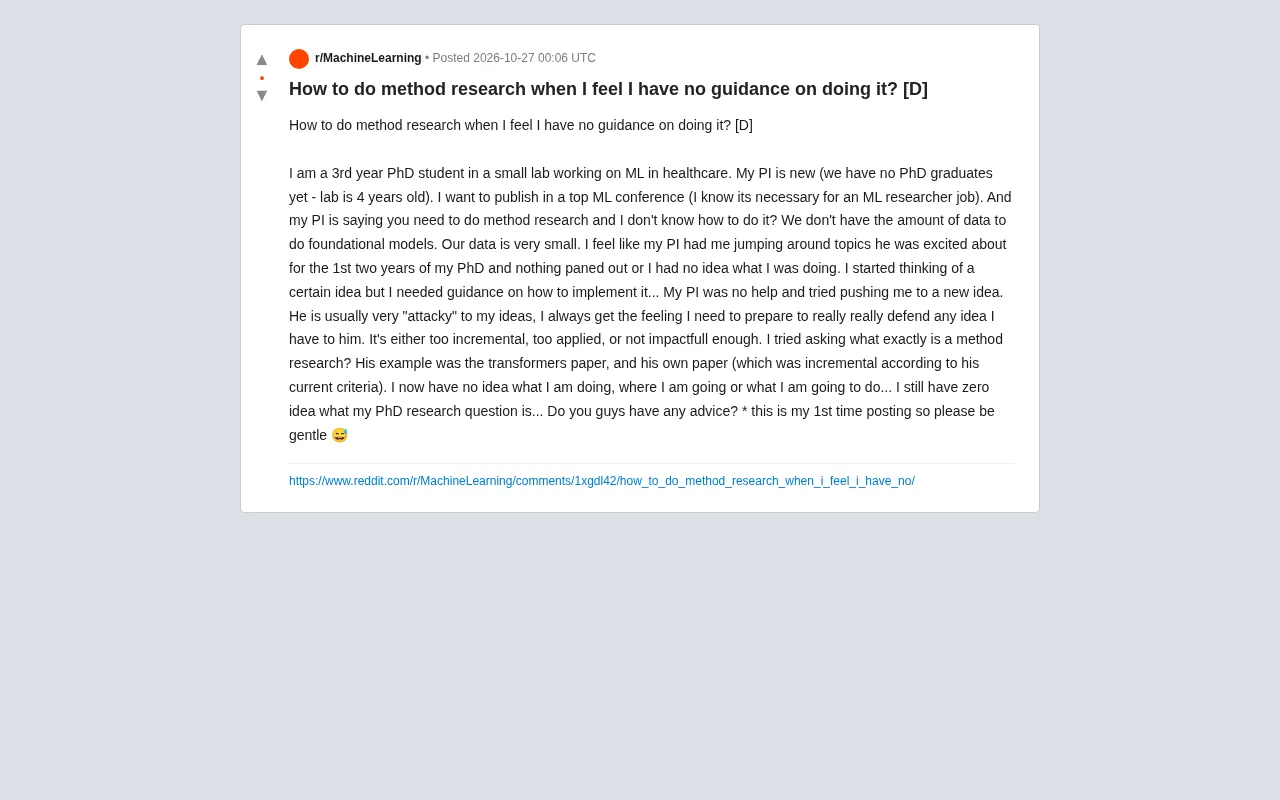
A third-year PhD student in machine learning for healthcare posted on Reddit, describing their experience of becoming lost in method research. The lab was founded only four years ago, the advisor is new, and no doctoral student has yet graduated. The advisor repeatedly emphasizes "doing method research" but cannot give a clear definition, citing the Transformer paper and their own work—which by their current standards would be considered "incremental"—as examples. Over two years, the student has followed the advisor's shifting interests across multiple topics without producing results, and still does not know what their doctoral research question is.
This is not an isolated case. Many doctoral students face a lack of guidance in method research, especially when the advisor themselves lacks mentoring experience. The dilemma in the post points to a core question: how exactly should the ability to do method research be acquired?
The Blurry Boundary of Method Research
The advisor cites the Transformer paper as a model of method research, yet also uses their own paper—which they call "incremental"—as another example. This contradiction leaves the student at a loss. The line between method research and incremental improvement is inherently blurry. Transformer proposed an entirely new attention mechanism architecture, a typical paradigm innovation; yet many papers labeled "method research" are actually module swaps or loss function tweaks on existing frameworks.
The problem is that when the advisor dismisses a student's idea as "not impactful enough," the student can hardly extract an actionable standard from that evaluation. According to the poster, the advisor takes an "aggressive" attitude toward any idea, and the student must be prepared to defend it fully—ideas are either too incremental, too applied, or insufficiently impactful. This feedback pattern offers no constructive path and instead intensifies the loss of direction.
The Mismatch Between Data Scale and Method Innovation
The post mentions a key constraint: the lab does not have enough data to build foundation models, and the data scale is very small. This directly limits the space of explorable methods. In healthcare ML, method research under small-data conditions often focuses on inductive bias design, few-shot learning, domain adaptation, or interpretability modules, rather than large-scale pretraining.
The advisor suggests doing method research but does not give specific directions that account for the lab's data conditions. The student once had an idea that needed guidance to implement; the advisor did not help, but instead pushed for a switch to a new idea. This pattern repeated for two years, resulting in a lack of continuity in the research topic. For doctoral students in small labs, rather than chasing whatever topic excites the advisor at the moment, it is better to first systematically map the methodological gaps in small-data healthcare ML—for example, the failure modes of existing methods in specific clinical scenarios—and derive research questions from there.
Inductive bias refers to the preferences or constraints a model imposes on the hypothesis space during learning, enabling it to prioritize certain types of solutions. When data is limited, a reasonable inductive bias (such as the locality of convolutions, adjacency relations in graph structures, or anatomical priors in medical imaging) can significantly improve generalization without relying on massive data. Few-shot learning focuses on how a model can quickly adapt to new classes given only a small number of labeled samples; common paradigms include meta-learning, metric learning, and prompt tuning. Domain adaptation studies how to transfer a model trained on a source domain to a target domain with a different distribution—in healthcare, this often means transfer across hospitals, devices, or populations. Interpretability modules use attention visualization, concept activation vectors, or post-hoc attribution to align model decisions with clinical knowledge. Together, these directions constitute the methodological space of small-data healthcare ML, and their research questions often arise from the failure modes of existing methods under specific clinical constraints.
How to Train Yourself Without Guidance
The ability to do method research does not have to be transmitted only by an advisor. The following paths are worth considering:
Reverse-engineer exemplary papers. The advisor mentioned Transformer; you can ask: what specific defect in prior methods did it solve? What assumptions underlie its design choices? If the data conditions were different, which assumptions would fail? By dissecting the methods sections of top-tier conference papers, you gradually build judgment about "what counts as a good methodological contribution."
Build a substitute feedback network. The advisor's feedback style is hard to change, but you can seek diverse opinions on research ideas from peers outside the lab, online communities, or collaborators. The poster's choice to ask Reddit is itself an attempt. Continuous exposure to constructive feedback helps calibrate your own judgment of "incremental" versus "innovative."
From reproduction to improvement. With limited data, pick a baseline method that matches the lab's data, fully reproduce it, and analyze its failure cases. Failure modes often point to researchable methodological problems. This approach does not require large-scale data and can train intuition for method design.
Reproduction is the foundational training of method research: rerun the baseline under the same data and evaluation protocol, confirm the results are reproducible, and then systematically change a single variable (such as the loss function, data augmentation, or network depth) to observe changes in performance and failure cases. This process cultivates sensitivity to "which design choices actually matter." Failure case analysis requires grouping and attributing samples the model predicts incorrectly, identifying whether errors come from data bias, label noise, or insufficient model capacity, thereby turning phenomena into testable methodological hypotheses. Compared with chasing new ideas directly, reproduction and failure analysis provide a low-data-dependency, verifiable starting point for research.
Communication Strategies with the Advisor
The advisor's "aggressive" feedback pattern needs to be confronted. Students can try shifting the conversation from "is this idea good?" to "under what conditions does this idea hold, and what evidence is needed?" Specific practices include: breaking the idea into testable hypotheses and discussing it with preliminary experiments or literature support rather than conceptual statements alone. When the advisor dismisses it, ask "if this is to become a methodological contribution, which piece is missing?"—turning the evaluation into directional information.
At the same time, manage expectations about the advisor's guidance. A new advisor with no graduates yet and a lab only four years old has limited mentoring experience. Students can proactively make specific requests for help, such as "I need help designing the control group for this experiment," rather than asking vaguely "how do I do method research?"
The poster's dilemma reflects a structural gap in doctoral training: the methodology of method research itself is rarely taught explicitly. It is usually transmitted implicitly through apprenticeship, but when the advisor also lacks experience, students need to actively build their own learning system. This includes dissecting exemplars, finding alternative feedback, extracting problems from reproduction, and adjusting how they collaborate with the advisor. Determining a doctoral research question is often not the starting point but a result that gradually converges through continuous practice and feedback.
Turning vague evaluations into actionable information can be aided by a "hypothesis–evidence–criterion" framework: state the idea as "if a certain design is adopted, it should outperform the baseline on a certain metric, with an expected effect size of X," accompanied by small-scale pilot experiments or supporting evidence from the literature. When the advisor dismisses it, ask about the specific missing link (such as theoretical basis, experimental controls, or clinical significance) rather than arguing about whether the idea itself is good. This structured communication can reduce the aggressiveness of the conversation while translating the advisor's intuition into executable research decisions.
One-line Summary
How an unguided doctoral student can self-train method research skills in small-data healthcare ML
Paragraph Summary
Starting from a Reddit help post by a doctoral student in healthcare ML, this article analyzes the structural dilemma of missing guidance in method research. The advisor's examples of Transformer and their own incremental paper expose the blurry boundary between method research and incremental improvement; small-data conditions further limit the foundation-model path. The article proposes self-training paths such as reverse-engineering exemplary papers, building an out-of-lab feedback network, and extracting problems from reproduction failure cases, and suggests turning the advisor's aggressive feedback into structured dialogue about hypothesis conditions and evidence needs. The core conclusion: a doctoral research question is not the starting point but a result that gradually converges through continuous practice and feedback.
Related articles

What Improves During Pretraining? Temporal Variability Score Reveals Knowledge Learning Dynamics
Researchers propose the Temporal Variability Score (TVS) using point-in-time models to track knowledge learning dynamics during pretraining. High-TVS entries improve faster later on and ultimately perform better in 34/36 settings, with an average advantage of 7.3 percentage points.

The AI Compute Hunger Behind the RTX 5090 Price Surge
A Reddit discussion reveals the truth behind the RTX 5090 price surge: in the German market, prices rose from 3,000 to 9,000 euros as consumer GPUs are reconfigured for server farms.

A New Evaluation Method for Audio-Language Models: Same-Class Controls Reveal the True Impact of Local Audio Evidence
A new study proposes a matched same-class control protocol to distinguish whether audio-language model answer changes stem from event categories or waveform rewrites. Experiments show different-class replacements cause 49.7-60.9 percentage points more answer changes, while same-class accuracy remains stable.