The End of .name Domains: Why Personal Brand Digital Assets Are So Fragile

The demise of .name domains exposes the fragility of personal digital identity and brand assets.
Developer Neil Fraser's blog post about .name domain termination went viral on Hacker News, highlighting the vulnerability of digital assets. For years, developers built identities on .name domains, but the TLD's impending shutdown threatens links, SEO authority, and email continuity. The incident reveals domains are rentals, not ownership, and underscores the need for stable infrastructure over trendy choices.
The Story: A Domain Heading Toward Extinction
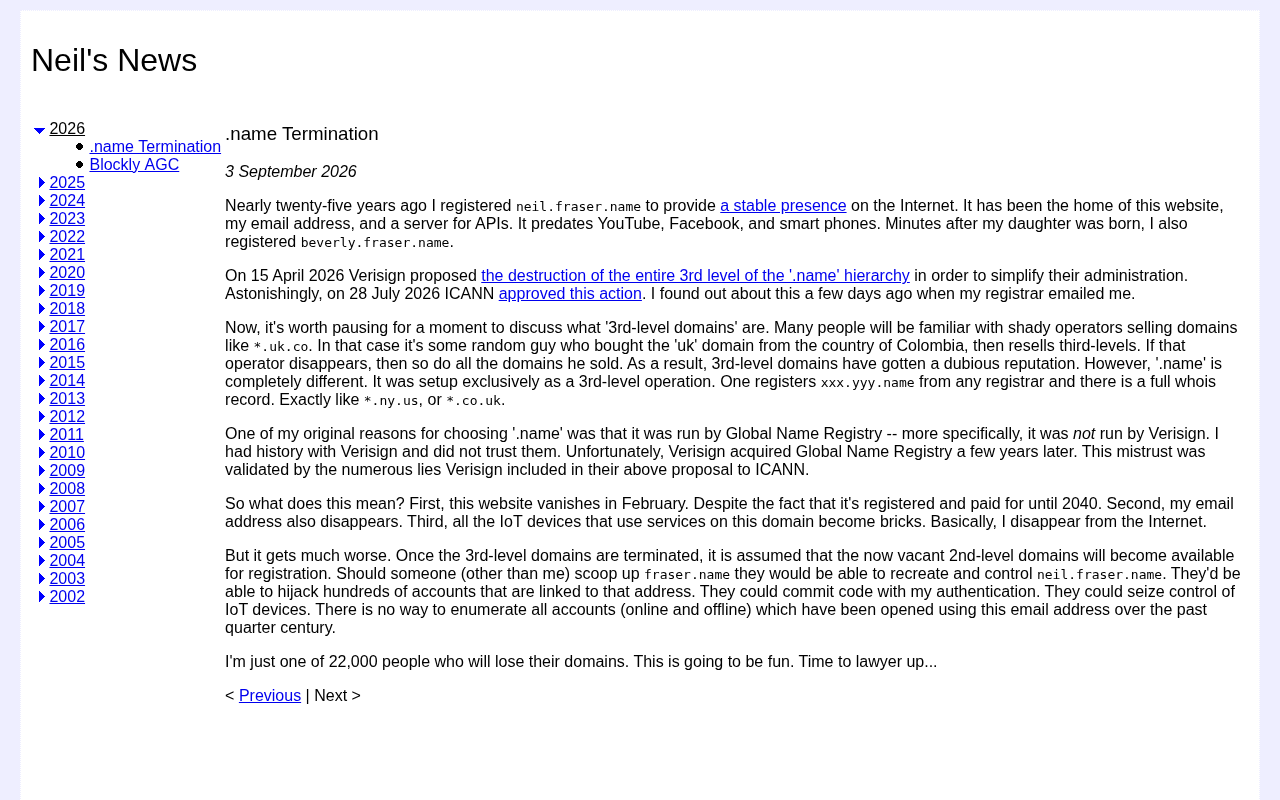
Recently, a blog post by developer Neil Fraser sparked heated discussion on Hacker News, quickly garnering over 1,456 upvotes and 395 comments. The title is succinct yet dramatic—".name Termination"—chronicling the demise of the .name top-level domain.
For many developers, creators, and tech professionals who built their online identities around their personal names, .name domains were once an appealing choice. Launched in the early 2000s and designed specifically for personal branding, they allowed people to register highly distinctive addresses like firstname.lastname.name. Neil Fraser's blog is hosted at neil.fraser.name, making his discussion of the domain's termination particularly poignant.
The History and Positioning of .name Domains
A Top-Level Domain Built for Individuals
.name is one of the earlier generic top-level domains (gTLDs) in internet history, officially approved and launched in 2001. Unlike .com or .org, which target businesses and organizations, .name was designed from the outset with a clear personal focus.
The Birth and Evolution of Generic Top-Level Domains (gTLDs): Generic top-level domains (gTLDs) are among the highest-level categories in the Domain Name System (DNS). The earliest gTLDs—including .com (commercial), .org (organization), and .net (network)—emerged in the 1980s during the early commercialization of the internet. After 2000, ICANN (the Internet Corporation for Assigned Names and Numbers) began approving more new gTLDs, attempting to break .com's monopoly and meet the diverse needs of different groups. .name was custom-tailored for individual users in this context, reflecting the internet's attempt to shift from commercial dominance toward more diverse identity expression. However, the adoption of new gTLDs has always faced challenges from user habits, brand recognition, and commercial ecosystems.
Its unique feature was support for third-level domain structures—users could register not just name.name, but also firstname.lastname.name. This design concept was quite forward-thinking at the time, attempting to provide every internet user with a permanent digital address based on their own name—an idea that aligns with today's emphasis on "personal branding" and "digital identity."
The Gap Between Ideal and Reality
However, .name domains never gained widespread mainstream acceptance. Under the near-monopolistic mindshare of .com, the vast majority of users and businesses still prioritize .com, while personal bloggers tend to favor later entrants like .io, .dev, or .me.
.name gradually became a niche choice with persistently low registration numbers. When a top-level domain's commercial value can no longer sustain its operational costs, its fate is already sealed.
What Domain Termination Means for Personal Brands
Digital Assets Are Far More Fragile Than Imagined
This incident made it to the top of Hacker News and sparked extensive discussion because it touches on a long-standing pain point in the tech community: How fragile are the identities and assets we build on the internet?
When someone spends years or even decades tying their blog, email, and professional identity to a particular domain, and that domain's top-level suffix disappears, the ripple effects are enormous:
- All external links pointing to that domain become broken
- Years of accumulated search engine authority vanish
- Email communications established through that domain are completely severed
- Personal brand assets face irreversible loss
On the Deep Impact of Search Engine Authority: Domain authority in search engine optimization (SEO) is built over time. Search engines like Google assign authority scores based on a domain's history, backlink quality, content update frequency, and other factors—directly affecting search rankings. When a domain is forced to migrate, even with 301 redirects (permanent redirects), weight transfer is not 100%, and it takes months or longer for search engines to recrawl and reassess. Worse still, if the old domain becomes completely defunct and redirects can't be set up, all external links turn into dead links (404 errors), and years of SEO value are essentially reset to zero. For blogs and personal sites that rely on search traffic, this means a cliff-edge drop in audience and influence.
This isn't just a matter of technical migration costs—it's the unexpected collapse of a personal digital identity.
A Warning for Developers and Creators
For tech professionals, this incident is a wake-up call. It reminds us that when choosing infrastructure to carry our core personal or professional identity, stability and long-term sustainability should be the top priorities.
Those seemingly cheap, unique, or trendy niche domain extensions often hide risks of operator bankruptcy, policy changes, or extension obsolescence. By contrast, traditional domains with long histories, large registration volumes, and strong commercial backing may lack personality but excel in reliability.
Deeper Reflection: Can We Truly "Own" Domains?
The "Rental" Nature of Domains
This incident forces us to reexamine the nature of domain names. We often speak of "buying" or "owning" a domain, but from legal and technical perspectives, domains are never truly owned—they're closer to periodic rentals. Users pay annual fees to obtain usage rights from registrars, and all of this is predicated on the continuous operation of the top-level domain registry.
The Multi-Layered Architecture of Domain Registration: Domain registration is not a simple transaction but a complex ecosystem involving multiple parties. At the top is ICANN, responsible for global domain policy and root server management; below that are registries (like Verisign, which operates .name), responsible for running specific top-level domains; further down are registrars (like GoDaddy or Namecheap), which sell domains directly to end users. The annual fees users pay are distributed across these layers. This multi-tiered structure normally ensures stability, but when a registry shuts down due to poor performance or strategic shifts, all domains under that TLD are affected, and users have virtually no bargaining power or alternatives.
When the registry itself disappears, no matter how much users have paid or how many years they've renewed, their usage rights evaporate. This "ownership" built on layers of trust and commercial contracts shows its fragility laid bare in the .name termination event.
Insights from Decentralized Identity
In recent years, explorations around decentralized identity (DID) and blockchain domains (like ENS) are, to some extent, responses to the fragility of traditional domain systems. People hope to find a digital identity solution that doesn't depend on a single centralized authority and is truly controlled by users.
Technical Implementation of Decentralized Identity: Decentralized Identity (DID) is an identity verification system that doesn't rely on a single centralized authority—users control their identity credentials through cryptographic key pairs. ENS (Ethereum Name Service) is one of the most prominent implementations, recording domain names on the Ethereum blockchain. Users who hold the corresponding NFT own control of that domain, without going through traditional registrars. Theoretically, as long as the blockchain network continues to operate, these domains won't disappear because a company goes bankrupt. However, DID and blockchain domains currently face numerous challenges: limited native browser support, high gas fees, steep learning curves for ordinary users, and insufficient ecosystem applications. They're seen more as an exploratory direction than a mature alternative.
While these emerging technologies still face many challenges in usability and ecosystem maturity, the demise of .name validates the value of such exploration—as we migrate more of our lives and careers online, a stable, enduring, and self-controlled digital identity is becoming more important than ever.
Conclusion: Choosing Reliability Over Chasing Trends
The termination of .name domains is, on the surface, just the curtain call for a niche extension in internet history, but the widespread discussion it triggered reflects the tech community's collective anxiety about the sustainability of digital assets. For every creator and developer building a personal brand online, this is a case worth pondering: while pursuing personalization and uniqueness, we should pay even more attention to whether the infrastructure carrying our identity is solid enough.
After all, in the digital world, what endures is often not what's trendiest, but what's most reliable.
Related articles

REA: Reverse Engineer Any App with AI, No Coding Required
REA is a viral open-source AI reverse-engineering tool that lets Claude, Codex, and other AI agents analyze any app and generate functional clones—no coding required. This article covers how it works, installation, a hands-on test, and legal risks.

2026 AI Coding Tools Comparison: Claude, ChatGPT, Gemini — Which Is the Best?
A 2026 comparison of five mainstream AI coding tools — Claude Code, ChatGPT Codex, Gemini, DeepSeek, and GitHub Copilot — on real projects, pricing, and code quality, to help you decide where that $20/month should go.

ChatGPT Codex Can Clone Any Software? Testing the Risks and the Truth
YouTube shorts claim ChatGPT Codex or Claude Code can clone Adobe, Excel, and Figma for lifelong free use. We break down the feasibility, legal risks, and DM-funnel tactics—and explain what AI coding tools are truly good for.