The Essential Difference Between AI Agents and ChatGPT: From Answering to Executing

ChatGPT gives answers; AI Agents complete tasks—the difference is whether the LLM is placed in an execution loop.
The article uses ThinkTech's analogy to explain the essential difference between ChatGPT and AI Agents: the former is like an encyclopedia, with output staying at the information level; the latter is like a personal assistant, with output pointing to task results. An Agent's work loop includes planning, calling tools, checking results, and deciding the next step, running repeatedly until the task is complete. The "checking" step is the most easily overlooked yet determines whether an Agent can be accountable for execution results. The key insight is that an Agent is not a new model—it's still an LLM from the same lineage as ChatGPT, and the difference is that the LLM is placed in a loop and called repeatedly. Therefore, use conversational tools when you need to quickly obtain information; only when tasks involve multiple steps, require operating external tools, and need result verification is it appropriate to hand them to an Agent. The two are diverging into an information interface and an execution layer.
A Simple Analogy That Explains the Difference
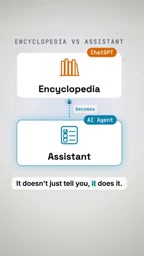
According to a short video from the YouTube channel ThinkTech, the difference between ChatGPT and an AI Agent can be understood through a simple analogy: ChatGPT is like an encyclopedia—you ask a question, and it gives you an answer; an AI Agent is like a personal assistant—it doesn't just tell you what to do, it actually goes and gets it done.
This analogy captures the core: ChatGPT's output stays at the "information" level, while an AI Agent's output points to "results." The former is a one-off Q&A interaction; the latter is an execution process that continues until the task is complete.

The AI Agent's Work Loop: Plan, Call, Check, Decide
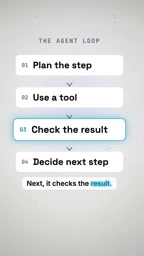
ThinkTech breaks down how an Agent works into several key steps. The first is Planning—when faced with a task, the Agent first breaks down what needs to be done and in what order. The second is calling tools, such as search engines, calendars, or other external services, turning "thinking" into "doing."
The third step is checking results, determining whether the current action achieved the expected outcome. The fourth is deciding the next step, adjusting strategy based on the check results and continuing to push forward until the task is truly complete. This loop runs repeatedly, with the user only confirming the result at the final stage.
One detail worth noting: the most easily overlooked part of this process is the "checking" step. Traditional chatbots don't need to verify what they've said, but an Agent must be accountable for execution results—whether search results are relevant, whether a calendar event was successfully created—all of which directly affect subsequent decisions.
Tool Calling / Function Calling is the key mechanism that moves LLMs from "saying" to "doing." The model itself cannot access the internet, read calendars, or send emails, but it can be trained and prompted to output a structured instruction—for example, specifying the function name and parameters to call. An external program parses this instruction, actually executes the corresponding operation, and sends the result back to the model as new context. In this way, search, database queries, code execution, and third-party APIs are all abstracted into tools the model can "name." The reliability of tool calling depends on two things: whether the model can correctly determine when to call and what parameters to pass, and whether the external system can return clearly parseable results. The "checking results" step emphasized in the article is largely about verifying whether the tool's return value meets expectations, thereby deciding whether to retry, switch tools, or continue.
ReAct (Reasoning + Acting) is the classic paradigm for understanding the Agent work loop, consisting of alternating Reasoning and Acting: the model first outputs a thought explaining what should be done now; then executes an action (usually a tool call); after observing the returned result, continues reasoning—and so on in a loop. This aligns closely with the plan–call–check–decide cycle described in the article. The value of ReAct lies in explicitly interweaving "thinking" and "doing," enabling the model to dynamically adjust strategy based on environmental feedback rather than generating a complete plan in one shot. Many subsequent Agent frameworks—including those introducing reflection, memory, and subtask decomposition—can be seen as extensions of this loop. It also explains why Agent performance is particularly sensitive to prompt design and tool description quality: any deviation at one step in the loop gets amplified by subsequent steps.
The Same LLM Underneath—The Difference Is the "Loop"
One commonly misunderstood point: an AI Agent is not some entirely new kind of model. ThinkTech explicitly states that what runs inside an Agent is still an LLM, the same lineage as ChatGPT. The real difference is in how it runs—the LLM is placed in a loop, called repeatedly, with each call's output serving as input for the next step.
This explains why an Agent can handle multi-step tasks while single-turn ChatGPT cannot. The model's capabilities haven't undergone a qualitative change—the architecture and interaction paradigm have. In other words, an Agent turns the LLM from a "one-time exam" into "continuous, iterative project management."

LLM (Large Language Model) is the shared computational core of both ChatGPT and AI Agents—essentially a neural network trained on massive text data that generates content by predicting the next word. It is inherently stateless: each call is an independent inference, the model doesn't automatically remember what happened in the previous round, and it has no ability to proactively execute actions. What we call "conversation" is actually the result of an external program concatenating historical messages into the input and feeding them to the model. Understanding this is crucial—the LLM is only responsible for generating text (or structured tool-call instructions) based on the given context, while the loop, tool interfaces, and state management—the "scaffolding"—are all provided by engineering systems outside the LLM. Precisely because of this, the same model can serve as a chatbot or be packaged as an Agent; the capability ceiling is the same, and the difference lies entirely in external orchestration.
When to Use Which
At the end of the video, ThinkTech poses a choice to viewers: next time, do you need "an answer" or "something to get done"? This question itself is the criterion.
When you need to quickly obtain information, explain concepts, or generate text, conversational tools like ChatGPT are more direct and efficient. When a task involves multiple steps, requires operating external tools, and needs result verification, that's when an Agent's value truly shines. Mixing the two—for example, using a single-turn conversation to complete a task requiring multi-step execution—is often both inefficient and error-prone.
Looking at industry trends, the boundary between conversational AI and Agents is becoming clearer: the former is an information interface, the latter is an execution layer. Understanding this layering helps you choose the right tool in practical work and also helps you judge the real substance behind the word "Agent" in various AI product marketing.
One-line Summary
ChatGPT gives answers; AI Agents complete tasks—the difference lies in whether the LLM is placed in an execution loop.
Paragraph Summary
The article uses ThinkTech's analogy to explain the essential difference between ChatGPT and AI Agents: the former is like an encyclopedia, with output staying at the information level; the latter is like a personal assistant, with output pointing to task results. An Agent's work loop includes planning, calling tools, checking results, and deciding the next step, running repeatedly until the task is complete. The "checking" step is the most easily overlooked yet determines whether an Agent can be accountable for execution results. The key insight is that an Agent is not a new model—it's still an LLM from the same lineage as ChatGPT, and the difference is that the LLM is placed in a loop and called repeatedly. Therefore, use conversational tools when you need to quickly obtain information; only when tasks involve multiple steps, require operating external tools, and need result verification is it appropriate to hand them to an Agent. The two are diverging into an information interface and an execution layer.
Related articles

AI Tools Quietly Altering Settings: Postman Silently Installs Plugin, Codex Sharing Option Auto-Resets
AI Daily reports: Postman silently installs a Mac plugin and self-approves startup hooks, logged as auto-existing upgrade; Hacker News developers say Codex data-sharing opt-out flips back. Plus Simon Willison's raw float weight experiment with QEN 3.8-27B.

AI Learns to Rewrite AI: MIT's "Weightspace Programming" Redraws the Path to Recursive Self-Improvement
MIT team proposes weightspace programming: GPT-6 Astra reads and edits AI model weights directly. Math scores jump several-fold, hand-written networks beat trained models. Eight experiments analyzed, plus Anthropic's same-day warning and the real boundaries of recursive self-improvement.

Running Qwen 3.8 on a Laptop to Read Raw Weights: 46 Minutes Per Answer
Simon Willison reproduced weight space programming with Qwen 3.8 27B on a laptop: a 17GB model file, 46 minutes per answer, 43,506 reasoning tokens, Pong over an hour, Freeway failed. Suited for interpretability researchers.