The Fastest-Growing Market in Tech Isn't AI — It's Data Infrastructure
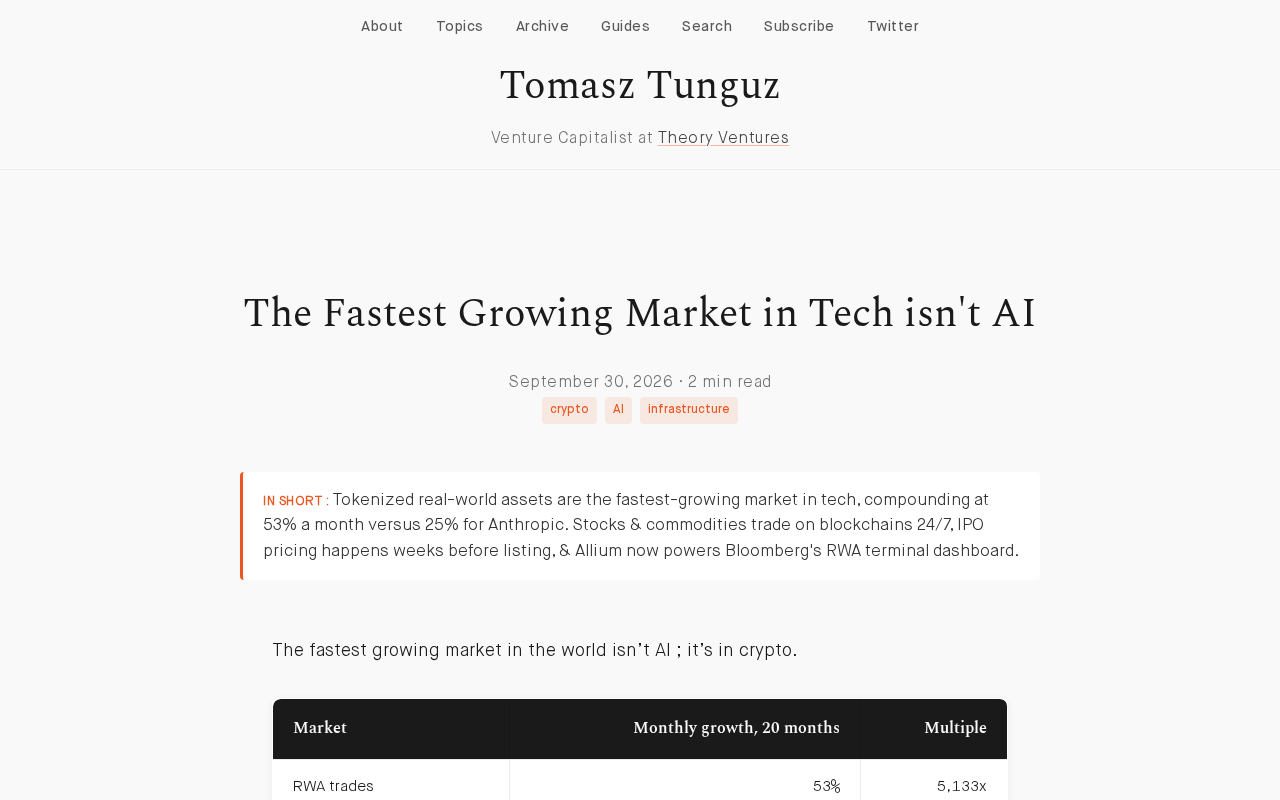
Tunguz argues data infrastructure — not AI apps — is the fastest-growing market, following classic pick-and-shovel logic.
Venture capitalist Tomasz Tunguz offers a counterintuitive take: in the current AI boom, the fastest-growing market isn't AI applications but the data and infrastructure layer underneath them. The core logic mirrors the classic gold rush pick-and-shovel argument — regardless of which model or app wins, demand for data collection, storage, cleaning, vectorization, and orchestration will persist. Compared to the application layer, infrastructure offers higher demand certainty, greater switching costs, and compounding growth tied to expanding data volumes — making it a more durable and structurally sound market for both founders and investors.
A Counterintuitive Take
At a time when artificial intelligence dominates nearly every conversation in tech, prominent venture capitalist Tomasz Tunguz has put forward a thought-provoking view: the fastest-growing market in tech may not be AI itself, but rather the underlying data and infrastructure that makes AI work.
What makes this observation compelling is precisely that it challenges the prevailing narrative. Markets, media, and capital are all chasing foundation models, generative applications, and AI Agents — yet Tunguz redirects attention toward the less glamorous, but genuinely foundational, layers that support the entire AI wave.
Note: This article is based on a title and discussion thread circulating on Hacker News. The original post has limited information (6 upvotes, no comments at the time of writing). Readers interested in the full argument are encouraged to consult Tomasz Tunguz's original blog post directly.
Why AI Isn't the Fastest-Growing Market
On the surface, AI looks like the most explosive growth sector by any measure — funding rounds, valuations, and user numbers are all skyrocketing. But investors like Tunguz, who have spent years focused on SaaS and data markets, tend to draw a clear distinction between "hype" and "sustainable market growth."
Behind the impressive growth numbers at the AI application layer lies a practical reality: model training and inference require massive amounts of data, storage, compute, and pipeline tooling. Every successful AI product is built on a foundation of data collection, cleaning, labeling, vectorization, retrieval, and more. In other words, the AI boom translates directly into structural demand for data infrastructure.
The Pick-and-Shovel Logic
This is the classic "selling shovels during a gold rush" argument. When everyone rushes to mine gold, the ones reliably making money are often those supplying the tools and infrastructure. Data warehouses, vector databases, data orchestration platforms, and observability tools are all experiencing unprecedented growth momentum driven by the AI explosion.
These markets don't attract the same public attention as consumer-facing AI products — but their revenue growth, customer retention, and expansion velocity may be far healthier and more durable than many high-profile AI applications.
In the current AI cycle, the "shovels" cover a remarkably wide range. Vector databases (such as Pinecone, Weaviate, and Milvus) store and retrieve high-dimensional embedding vectors, serving as a core component of RAG (Retrieval-Augmented Generation) architectures. Data orchestration tools (such as Airflow, Prefect, and dbt) schedule and transform the data flowing into model training and inference pipelines. Observability platforms (such as Arize and WhyLabs) monitor model drift and data quality in production environments. Adjacent segments — data labeling services, feature stores, and model registries — are also expanding in lockstep with AI adoption. Many of these tools operate on usage-based pricing (billed by storage volume, query count, or data processed), meaning that as customers scale and deepen their usage, revenue naturally increases. This creates a growth curve that is inherently correlated with the rate of AI adoption.
Structural Advantages of the Infrastructure Layer
Compared to the application layer, infrastructure has several structural advantages worth noting.
First, demand certainty. Regardless of which foundation model ultimately wins or which application becomes the breakout hit, the underlying need for data processing and compute will persist. This puts infrastructure vendors in a position to benefit regardless of how the market shakes out.
Second, high switching costs. Once an enterprise has built out its data pipelines, warehouses, and tooling, migration is extremely costly — creating strong customer lock-in and high renewal rates.
Third, compounding growth. Data volumes are continuously expanding, and AI usage further accelerates data generation and consumption, creating a positive feedback loop. Infrastructure market size rises with the expansion of the entire ecosystem.
This logic was already validated during the previous wave of cloud computing. During the mobile internet boom of the 2010s, infrastructure and tooling companies like AWS, Twilio, and Stripe delivered market cap growth that consistently outpaced most application-layer darlings — precisely because of these three structural advantages. No matter which app won, the need for servers, payment rails, and SMS APIs remained constant. In the current AI cycle, data platforms like Snowflake and Databricks are already benefiting: AI workloads have significantly increased data processing volumes for their enterprise customers, reflected in earnings reports as persistently high Net Revenue Retention (NRR).
Implications for Founders and Investors
For founders, this perspective points toward a less crowded path. Rather than competing head-on with countless teams and tech giants at the application layer, it's worth examining the "pick-and-shovel" opportunities that the AI wave is creating — data management, tooling, operations, and security often offer cleaner competitive landscapes and more solid business models.
For investors, Tunguz's view serves as a reminder not to be swept up in surface-level narratives. Real growth is sometimes hidden in unglamorous pipes and plumbing, not in the spotlight-grabbing products of the moment.
That said, this perspective isn't without its counterarguments. The AI application layer could still produce winners of extraordinary scale, and infrastructure markets carry their own risks of commoditization and price wars. The rational approach is to evaluate opportunities at both layers together, rather than making a binary choice between "AI" and "non-AI."
Conclusion
At its core, Tomasz Tunguz's observation is a reminder to return to business fundamentals: the fastest-growing market is not always the loudest one. Beneath the AI hype, the data and infrastructure supporting this wave are quietly becoming one of the most important growth engines worth watching.
Given the limited information available in the original source, readers interested in this topic are encouraged to consult Tunguz's original post and any supporting data for a more complete and rigorous analysis.
Related articles

CSS Anchor Positioning: A New UI Positioning Approach Without JavaScript
A deep dive into CSS Anchor Positioning: from anchor-name and position-anchor to the anchor() function, position-area shorthand, position-try-fallbacks, anchor-size, and upcoming anchor queries.

New AI Chart Interaction: Continuous Follow-up Questions and Visualization in Conversation
Explore a new AI interaction method for continuously generating charts in conversation. Use the /visualize command to ask follow-up questions and visualize answers in the same chat window, improving data analysis efficiency.

Cursor Merges Into X Subscription: Paid Plans Share Unified Usage Pool, Grok Model Coding Usage Doubled
Cursor joins The X Subscription with a unified usage pool and doubled Grok coding quota. Third-party models shift to API pricing. Existing users can keep or migrate plans.