The GAI Framework: A Formal Theory Unifying Iterated Policy Improvement and Recursive Self-Improvement
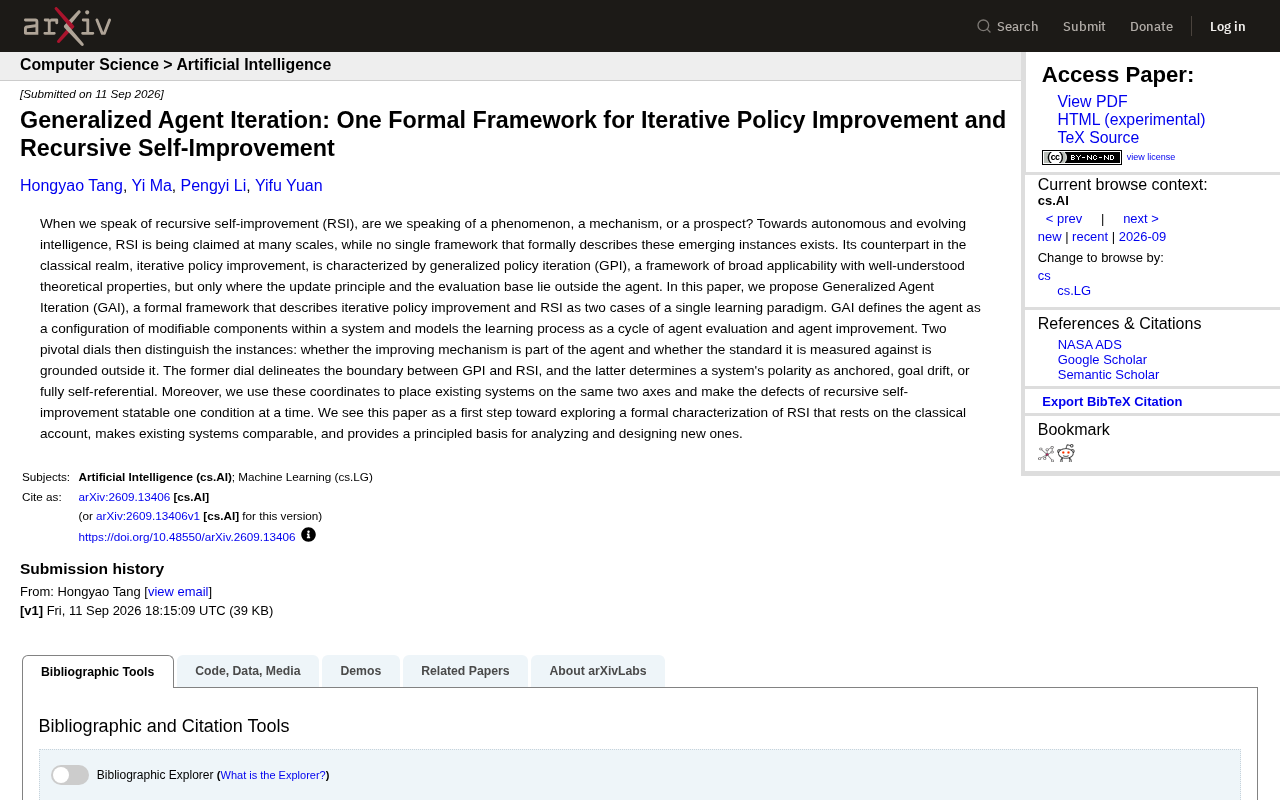
GAI framework uses two formal dials to unify RL policy iteration and recursive self-improvement for AI safety analysis.
A new arXiv paper proposes the Generalized Agent Iteration (GAI) framework to formally ground the widely cited but loosely defined concept of Recursive Self-Improvement (RSI). The framework unifies classical Generalized Policy Iteration (GPI) and RSI as two special cases of the same learning paradigm, centered on two key dials: whether the improvement mechanism belongs to the agent, and whether the evaluation standard is external. The second dial further classifies systems as anchored, goal-drifting, or fully self-referential — mapping directly onto the most concerning AI alignment failure scenarios. The framework's practical value lies in enabling cross-system comparison on a shared coordinate space and making RSI failure modes statable one condition at a time, rather than vaguely "out of control."
What Exactly Is Recursive Self-Improvement?
When we talk about Recursive Self-Improvement (RSI), are we describing a phenomenon, a mechanism, or a possibility? This seemingly philosophical question is precisely what a newly published arXiv paper (arXiv:2609.13406v1) sets out to clarify.
On the path toward autonomously evolving intelligence, RSI is widely invoked — from models fine-tuning themselves to agents autonomously rewriting their own code. Systems of all scales claim to have achieved some form of self-improvement. The problem is that the field still lacks a unified framework capable of formally describing these emerging cases. In other words, everyone is using the same term to mean very different things.
The Generalized Agent Iteration (GAI) framework proposed in this paper aims to fill exactly that gap. Its ambition: to bring classical iterated policy improvement from reinforcement learning and cutting-edge recursive self-improvement under the same learning paradigm.
From GPI to GAI: Extending a Classical Paradigm
To appreciate what GAI offers, we need to revisit its classical counterpart — Generalized Policy Iteration (GPI).
GPI is a widely used, theoretically well-understood framework in reinforcement learning that characterizes policy learning as an alternating cycle of "policy evaluation" and "policy improvement." But GPI carries an implicit assumption: both the update principle and the evaluation base lie outside the agent. That is, the mechanism that improves the agent, and the standard by which it is judged, are externally fixed and given.
This is precisely why GPI cannot capture RSI. The defining feature of recursive self-improvement is that the agent begins to modify those originally external mechanisms — it is not just optimizing a policy, but optimizing the very process of "how to optimize a policy."
GAI addresses this by redefining the agent as a configuration of modifiable components within a system, and modeling the learning process as a cycle of "agent evaluation" and "agent improvement." This elevation in abstraction level allows GPI and RSI to be treated as two special cases of the same learning paradigm.
Two Key Dials: Distinguishing GPI from RSI
The elegance of the GAI framework lies in its use of two key "dials" to distinguish different instances — the most operationally useful contribution of the paper.
First Dial: Does the Improvement Mechanism Belong to the Agent?
The first dimension asks: is the mechanism responsible for improvement actually part of the agent itself?
- If the improvement mechanism lies outside the agent (e.g., a fixed optimizer designed by humans), this falls within the scope of GPI.
- If the improvement mechanism is itself a modifiable component of the agent, the system crosses into RSI territory.
This dial draws a clear boundary between GPI and RSI, turning a long-standing conceptual blur into a condition that can be explicitly determined.
Second Dial: Is the Evaluation Standard External?
The second dimension determines the system's "polarity" — whether the standard used to evaluate the agent is grounded outside the agent itself. Based on this dial, systems can be classified into three types:
- Anchored: the evaluation standard is entirely external; the system remains aligned to an outside objective.
- Goal drift: the standard is partially internalized; the system's goals may shift as improvement progresses.
- Fully self-referential: the standard is defined entirely by the system itself — the agent is both athlete and referee.
These three polarities are highly valuable for understanding AI safety concerns. "Goal drift" and "fully self-referential" correspond directly to the scenarios most worrying in alignment research.
Making RSI Failure Modes "Statable One Condition at a Time"
The real practical value of the GAI framework lies in placing different systems on the same coordinate system.
Using the two-dial coordinate space, researchers can locate existing systems — whether traditional RL agents or frontier systems claiming self-improvement capabilities — on the same two axes for comparison. This means that the previously disconnected claims about RSI finally have a shared vocabulary for cross-system analysis.
More importantly, the paper argues that this coordinate system makes recursive self-improvement failure modes "statable one condition at a time." Rather than the vague worry that a self-improving system "might go out of control," specific risks can now be decomposed into discrete, individually analyzable conditions. This provides a solid foothold for formally analyzing the risks of RSI.
Significance and Limitations
The authors position this paper as a "first step" — an initial attempt to formally characterize RSI grounded in classical theory. Its three goals are clear: build on classical policy iteration theory, make existing systems comparable, and provide a principled foundation for analyzing and designing new systems.
In terms of research value, GAI's contribution is not a specific algorithm but rather the establishment of a shared conceptual coordinate system. At a time when the RSI concept is heavily overloaded and lacks rigorous definition, the work of "getting the language right first" is often rarer and more important than yet another new model.
Of course, as a theoretical framework paper, its real-world impact remains to be seen. Whether GAI's abstract definitions will be widely adopted as a common community language, and whether they can genuinely guide the design and evaluation of empirical systems, will require follow-up work to validate. But at minimum, it provides a formal starting point — one that deserves serious consideration — for a concept that has long been both imaginative and frustratingly vague.
Related articles
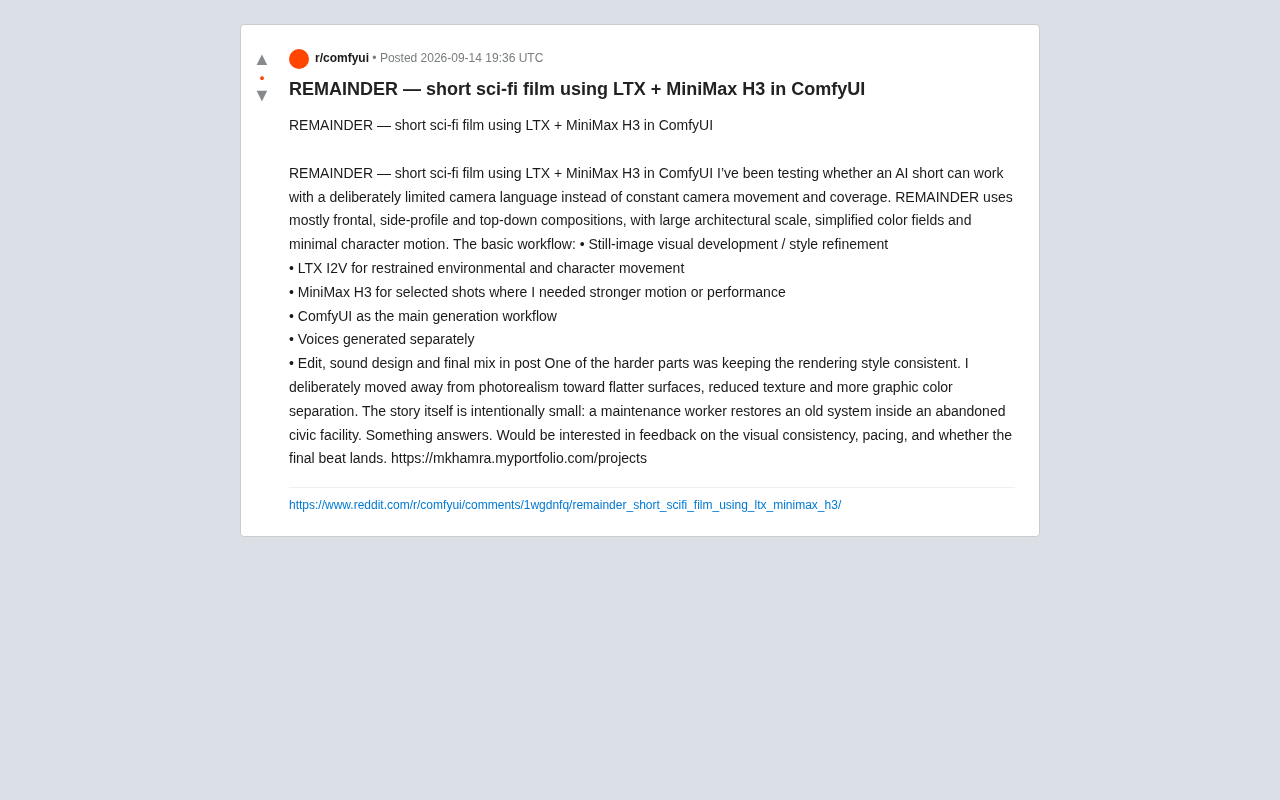
Building an AI Sci-Fi Short with LTX + MiniMax H3: Restrained Cinematography in ComfyUI
Sci-fi short REMAINDER uses LTX, MiniMax H3, and ComfyUI with restrained cinematography and flat aesthetics to solve visual consistency in AI filmmaking.
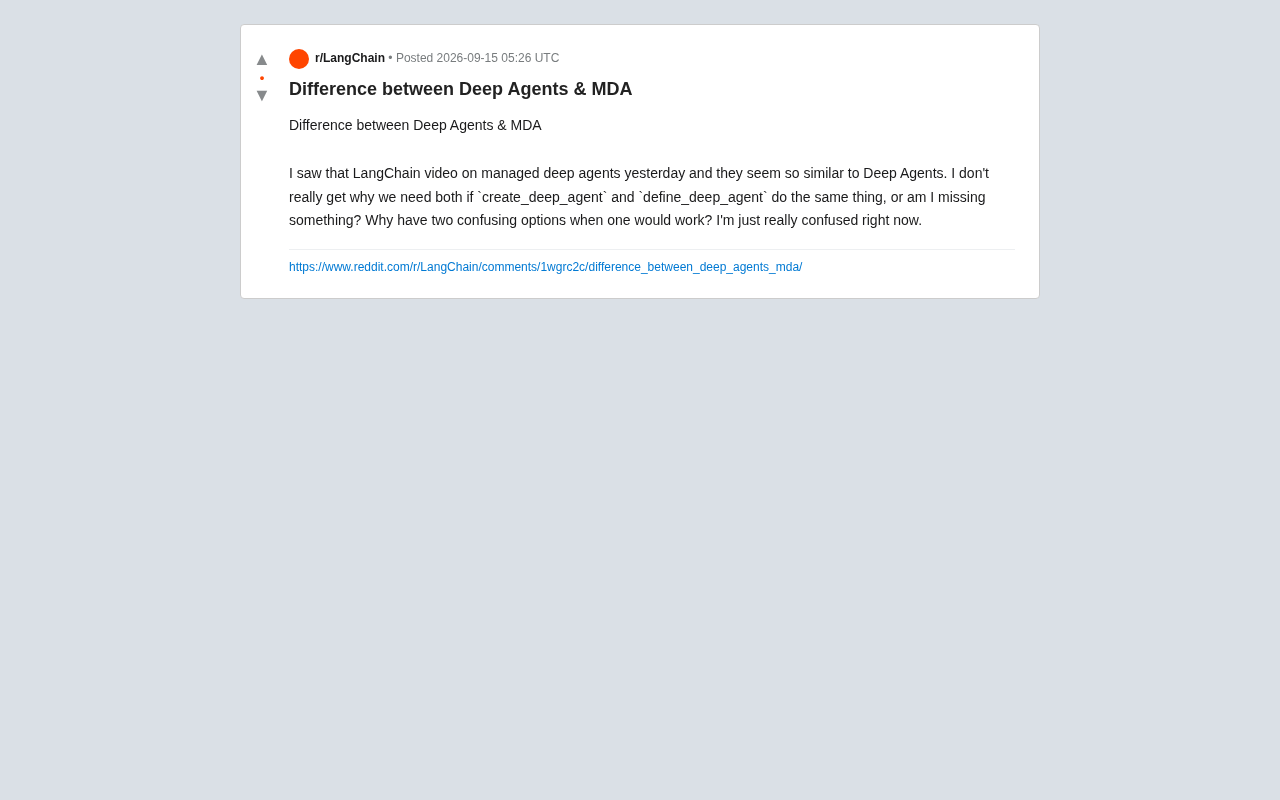
LangChain Deep Agents vs. MDA: Clearing Up the Confusion for Developers
What's the difference between LangChain's Deep Agents and MDA (Managed Deep Agents)? We break down create_deep_agent vs. define_deep_agent and help developers choose.

Why Is AI Agent Development So Fragmented? The Real Causes and How to Work Around Them
Why does AI Agent development feel so fragmented? Logic scattered across prompts, configs, and frameworks makes portability nearly impossible. Here's why — and how to cope.