The Game of Life and the Algorithmic Lens: How Computation Explains Natural Complexity

The Game of Life is a universal Turing machine, and computational limits profoundly shape natural explanation and model selection.
The article reinterprets Conway's Game of Life through the eyes of a theoretical computer scientist on the Lex Fridman podcast, noting that minimal rules can yield universal computation. The interviewee proposes an "algorithmic lens" that extends computation from computers to the natural world, using computational complexity to constrain natural modeling. The computational difficulty of Nash equilibrium undermines its credibility as a universal explanation of human strategic behavior; Kamal Jain's remark that "if my laptop can't find it, the market can't find it either" highlights the importance of computational feasibility. Ultimately, computational limits determine our choice of coordinate systems and granularity in describing the world, and interpretability and computability are structural constraints for understanding complex systems.
Conway's Game of Life is often treated as a fun cellular automaton toy, but the theoretical computer scientist featured in the Lex Fridman podcast offers a deeper reading: the Game of Life is a universal Turing machine, and on top of minimal rules you can "cook up" any behavior you want. This leads to a larger proposition—computation belongs not only to laptops but to the natural world itself.
How Minimal Rules Give Rise to Complex Behavior
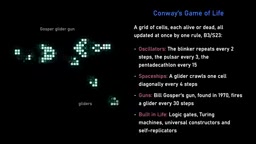
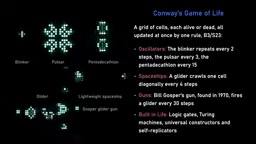
The appeal of the Game of Life lies in how shockingly few rules there are. The researcher admits that "how small the rules need to be to get these bizarre behaviors" is itself surprising. Three simple local update rules can support gliders, oscillators, and even universal computation.
Behind this is an epistemological shift: complexity does not necessarily require complex underlying specifications. When we see the myriad patterns in nature—flocks of birds, snowflakes, neurons firing—the Game of Life provides an operational thought model: tiny differences in micro-level rules can be amplified at the macro level into radically different structures.
A universal Turing machine is a core concept in computation theory, referring to a Turing machine capable of simulating any other Turing machine. In 1936, Turing proved that as long as a machine has the ability to read and write on an infinite tape, move the read/write head, and perform finite state transitions, it can implement any computable function. The Game of Life is called a universal Turing machine because researchers have shown that by carefully arranging structures such as gliders, one can construct logic gates and even a complete computer. This means the Game of Life is computationally equivalent to your laptop, only encoded in a completely different way. This conclusion elevates the Game of Life from a "fun pattern generator" to an example of computational completeness, and it also shows that computational power does not depend on a specific physical substrate—silicon chips, cellular automata, or even natural processes can all carry computation.
The Algorithmic Lens: Computation Doesn't Only Happen in Computers
As a theoretical computer scientist, the interviewee regards the "algorithmic lens" as one of the most important outputs of the field. The object of computation is no longer limited to "a well-defined problem plus a laptop" but extends to the natural world: can the operating rules of nature themselves be understood as some kind of computational process?
The value of this lens lies in its bidirectionality. On the one hand, we can use computational complexity to constrain modeling of natural phenomena; on the other hand, nature's "implementation methods" in turn inspire new computational models. The Game of Life is precisely the intersection of the two—it is both an artificially constructed computational system and a conceptual tool for understanding natural emergent phenomena.
Computational complexity studies how the resources required to solve a problem (usually time and space) grow with the size of the problem. Concepts such as P vs NP and NP-completeness characterize the intrinsic difficulty of a problem rather than the efficiency of a particular algorithm. When the interviewee says "use computational complexity to constrain modeling of natural phenomena," it means: if a natural process requires exponential time to simulate, then whether that process itself really operates in this way in reality is questionable. This provides a tool for reverse inference—starting from computational feasibility and ruling out certain theoretical models. At the same time, lower-bound results in complexity theory tell us which problems are fundamentally impossible to solve efficiently, thereby delineating computational boundaries for explanations of natural and social phenomena.
What the Computational Difficulty of Nash Equilibrium Means
Another example raised in the interview is Nash equilibrium in game theory. Nash equilibrium is an elegant solution concept, but computing Nash equilibrium is difficult in general. This computational fact directly undermines its explanatory power: if even a machine struggles to compute the equilibrium point, can it still serve as a universal mechanism for explaining human strategic behavior?

The interviewee quotes a line from Kamal Jain to express this tension: "If my laptop can't find it, then the market can't find it either." This statement embeds computational feasibility directly into discussions of markets and rational behavior—if a theoretically existing solution cannot be computed by any agent within feasible time, its practical guiding significance must be discounted.
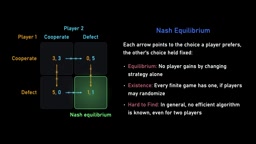
Nash equilibrium is a solution concept in game theory proposed by John Nash: in a multiplayer game, if every participant's strategy is a best response to the strategies of the others, then that strategy profile constitutes a Nash equilibrium. Nash proved that any finite game has at least one mixed-strategy Nash equilibrium. However, computing this equilibrium is PPAD-complete in general, meaning there is currently no known polynomial-time algorithm. This computational difficulty has profound implications: if the equilibrium point cannot be computed efficiently, then the assumption that real market participants can "find" the equilibrium lacks an algorithmic basis. Kamal Jain's line "If my laptop can't find it, then the market can't find it either" precisely emphasizes that theoretical existence does not equal real-world reachability, and computational feasibility should become a necessary dimension for evaluating the explanatory power of solution concepts.
Computational Limits Shape How We Describe the World
The interview's final point is quite philosophical: the limits imposed by computation in turn determine "what a good coordinate system should look like." In other words, the variables and granularity we choose to describe a system are not purely a matter of aesthetics but are constrained by computational feasibility.
This offers a pragmatic reminder for AI and complex systems research: model interpretability and computability are not after-the-fact decorations but structural constraints in understanding natural and social phenomena. This is precisely where the significance of the Game of Life lies—with the smallest possible rules, it places two questions on the same table: "how does simplicity generate complexity" and "how is complexity computed."
Coordinate system here is a metaphor referring to the set of variables and granularity chosen when describing a system. For example, when describing a gas, using macroscopic quantities such as temperature and pressure is more feasible than tracking the position and velocity of every molecule, because the latter requires enormous computation. Computational limits tell us that a good description must enable key computations to be completed within feasible resources. This resonates with the idea of "causal states" in computational mechanics: the most effective models are those coarse-grained descriptions that capture the causal structure of a system while minimizing computational complexity. Therefore, model selection is not only a matter of goodness of fit but also a matter of computational feasibility—interpretability and computability thus become structural constraints on modeling rather than after-the-fact embellishments.
One-line Summary
The Game of Life is a universal Turing machine, and computational limits profoundly shape natural explanation and model selection.
Paragraph Summary
From the perspective of a theoretical computer scientist on the Lex Fridman podcast, the article reinterprets Conway's Game of Life, pointing out that minimal rules can give rise to universal computation. The interviewee proposes an "algorithmic lens" that extends computation from computers to the natural world, using computational complexity to constrain natural modeling. The computational difficulty of Nash equilibrium undermines its credibility as a universal explanation of human strategic behavior, and Kamal Jain's remark that "if my laptop can't find it, the market can't find it either" highlights the importance of computational feasibility. Ultimately, the article emphasizes that computational limits determine the choice of coordinate systems and granularity in describing the world, and that interpretability and computability are structural constraints for understanding complex systems.
Related articles

Qwen 3.8 Beats Opus at Coding—But Can Your Mac Run It?
Open-source Qwen 3.8 beats Opus 4.6 at coding at just 18GB, but how much Mac memory do you need? 24GB crashes; 32GB is the sweet spot. Full config guide inside.

Claude Code + Agent: Building a Fully Automated AI Testing Loop
Bilibili course breakdown: how test developers can use Claude Code terminal-based Agents to build a fully automated AI testing loop. Compares permission boundaries of terminal vs. device Agents, explains why enterprise projects choose Claude Code over Open Claude-type tools, and outlines the Node.js environment setup and DeepSeek model integration path.

Working with AI Agents Requires Nerves of Steel
The more autonomous AI agents become, the heavier the user's psychological burden. Drawing from a Hacker News discussion, this article analyzes black-box anxiety, behavior drift, and monitoring fatigue in agent collaboration, and offers practical approaches like sandbox isolation, permission control, and task granularity management to reduce cognitive load.