The Hidden Concerns of Campus Surveillance: How We Learned to Live With It
How campus surveillance quietly erodes academic freedom under the guise of safety and convenience.
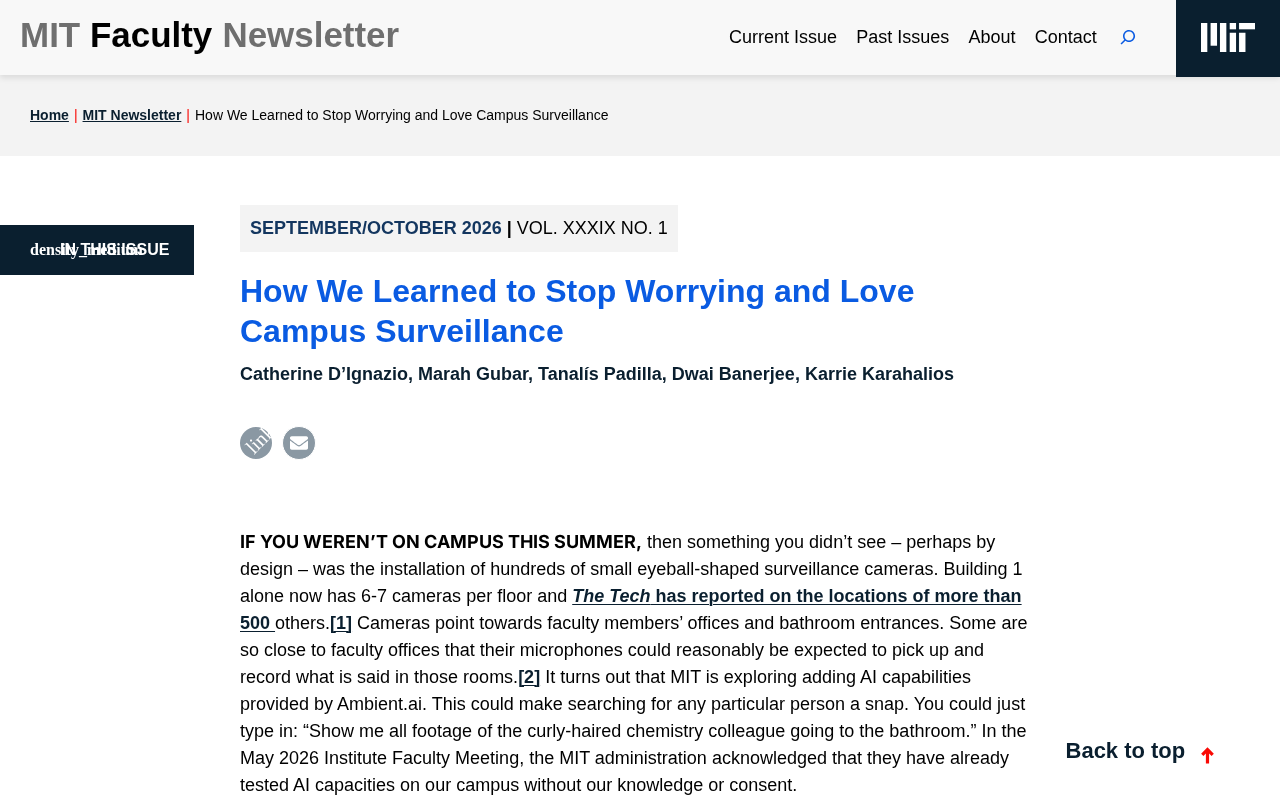
An MIT Faculty Newsletter article titled *How We Learned to Stop Worrying and Love Campus Surveillance* sparked heated discussion on Hacker News. It argues that campus surveillance has crept in not through overt policy, but via infrastructure like door-access systems, Wi-Fi logs, LMS platforms, and student success analytics — all framed around safety and efficiency. This implicit privacy-for-convenience trade lacks genuine informed consent, produces chilling effects on intellectual inquiry, and risks entrenching educational inequality through biased algorithms. The piece calls on universities to adopt transparent data governance, independent ethics review, data minimization, and meaningful opt-out options.
Campus should be a place for free inquiry and the collision of ideas — yet as surveillance technology proliferates, universities are quietly becoming arenas for data collection and behavioral tracking. An article published in the MIT Faculty Newsletter, titled How We Learned to Stop Worrying and Love Campus Surveillance, has sparked widespread discussion in the Hacker News community, amassing 217 upvotes and 125 comments in a short time — a clear signal of the academic world's deep concern about this issue.
The Quiet Expansion of Campus Surveillance
Surveillance technology didn't enter campuses overnight. It has seeped into daily operations gradually and gently — from door-access card swipes and Wi-Fi connection logs, to classroom cameras and behavioral data within Learning Management Systems (LMS), to the recently proliferating "student success analytics" platforms. The campus digital infrastructure itself has become a finely woven surveillance network.
The article's title borrows the classic subtitle structure from the film Dr. Strangelove, and the irony is unmistakable: we didn't actively choose to embrace surveillance. Rather, through rhetoric centered on convenience, safety, and administrative efficiency, we slowly let our guard down. Every system upgrade advances under the banner of "for your own good" — ensuring campus safety, improving teaching quality, optimizing resource allocation — while the boundaries of privacy silently and steadily retreat.
Privacy Surrendered in the Name of Convenience
The core logic driving surveillance expansion is an implicit bargain: privacy traded for convenience. For students, seamless campus card payments, automated attendance tracking, and personalized learning recommendations offer tangible benefits. For administrators, data translates into higher operational efficiency and risk management capability.
The problem is that this transaction rarely involves genuine informed consent. Students and faculty are seldom explicitly told which data is being collected, who holds it, what it's used for, or how long it's retained. When surveillance is embedded at the infrastructure level, "opting out" effectively means forgoing campus services entirely — rendering so-called "consent" a mere formality.
The deeper concern is that academic freedom and intellectual exploration require a space free from constant observation. When students realize that every library book they borrow, every search they run, every remark they make in class could be recorded and analyzed, a chilling self-censorship quietly takes hold. This stands in direct contradiction to the university's essential nature as a sanctuary for free thought.
The "Chilling Effect" is a classic concept in law and communications, originally used to describe how overly broad legal provisions indirectly suppress freedom of expression — even without actual punishment, the mere risk of it is enough to make people voluntarily restrain themselves. In the context of surveillance, this effect has been confirmed by multiple empirical studies: a 2015 PEN America survey found that following the Snowden/PRISM revelations, a significant proportion of writers began avoiding certain topics in online searches or communications. The chilling effect is especially concerning on campuses, where students are in the formative stages of developing their worldview and critical thinking — and are more sensitive to the prospect of being judged. When students anticipate that their academic explorations might be recorded and interpreted, they tend to gravitate toward "safe" topics and "mainstream" views, quietly narrowing the boundaries of intellectual inquiry through self-censorship.
Missing Data Governance and the Challenge of Tech Ethics
From the Hacker News discussion, the tech community's concern extends beyond surveillance itself to the absence of data governance mechanisms. The vast amounts of data collected on campus often lack transparent management frameworks: data may be outsourced to third-party vendors, shared with law enforcement, or exposed in data breaches.
The introduction of algorithmic decision-making amplifies these risks further. When "student success prediction" models profile and categorize students based on historical data, the biases embedded within can entrench and even exacerbate educational inequality. A student flagged as "high risk" by an algorithm may be treated differently as a result — yet the basis and logic of that judgment are often opaque and unappealable to the individual concerned.
Technology itself is neutral, but the institutional choices surrounding its deployment carry value judgments. At its core, the campus surveillance debate is about finding balance — between efficiency and freedom, safety and privacy, administrative convenience and individual dignity.
"Student success analytics" platforms are a category of EdTech products that have expanded rapidly across European and American universities in recent years. Representative systems include Civitas Learning, EAB Navigate, and Hobsons Starfish. These platforms integrate multi-dimensional behavioral data — course enrollment records, attendance, library usage, LMS login frequency, even meal card spending — to build predictive models that score students on "attrition risk" and push intervention recommendations to advisors or faculty. Proponents argue this helps with early identification of students who need support; critics point out that the training data for these models carries historical structural inequalities baked in — students from certain ethnic or socioeconomic backgrounds may be systematically overestimated as high-risk, subjecting them to heightened "attention" and producing labeling and discriminatory effects. Moreover, these platforms are typically operated by commercial companies, giving universities very limited control over their algorithmic logic and data flows — a significant data sovereignty concern.
How Should Universities Respond?
In the face of normalized surveillance, passive acceptance is not the only option. The article and community discussion point to several directions worth considering:
Establish transparent data governance frameworks. Universities should publicly disclose the scope, purpose, and retention period of data collection, and grant faculty and students genuine rights to query and delete their data.
Introduce independent ethics review. Before deploying any new surveillance or analytics system, an interdisciplinary ethics committee should conduct an assessment — rather than leaving the decision solely to IT or administrative departments.
Uphold the principle of data minimization. Data collection should follow a "collect only what's needed" principle, avoiding the over-accumulation of data on the grounds that it might be useful someday.
Restore meaningful informed consent. Make "opting out" a genuinely viable option rather than a token gesture.
Conclusion: Beware the Slow Boil
The greatest value of this MIT Faculty Newsletter article lies in how it exposes the insidious nature of surveillance expansion — it doesn't arrive overnight through some shocking policy, but accumulates through countless individually reasonable-seeming small steps. By the time we've "learned to love surveillance," we've often already forgotten what kind of privacy we once had.
For universities whose mission is to cultivate independent thinkers, the question of how to embrace technological convenience while preserving space for free inquiry is one that cannot be avoided. The significance of this conversation may lie precisely in transforming silent acquiescence back into a conscious, deliberate choice.
Related articles

WorkBuddy Full Tutorial: Build an AI Office Automation Agent from Scratch
A complete WorkBuddy tutorial: installation, three working modes, multimodal picture book video practice, expert team agent building, and workflow configuration for low-cost AI office automation.

WorkBuddy Agent Complete Guide: From Beginner to Automation in 7 Days
Based on Bilibili's 256-episode WorkBuddy masterclass, this systematically breaks down Tencent's AI office workbench core capabilities: Agent principles, Skill encapsulation, cross-platform connectors, scheduled automation, knowledge bases, and zero-code development, with learning path recommendations.

8 AI Accounts, 7 Failed: An Honest Review of Using AI to Get Work Done
Only 1 of 8 AI-run Bilibili accounts succeeded. We break down the real difference between "performing AI" and "using AI to get work done."