The Hidden Cost of Inference Latency: Are You Overlooking Model Load Time?

Model load time can be 10x slower than inference — a hidden latency cost most teams overlook.
A developer testing an inference server found the same model took 13.9 seconds on the first request but only 1.6 seconds when warm — a nearly 10x gap that exposes the often-conflated concepts of inference latency and model availability latency. The full loading chain includes weight download, deserialization, warmup, and worker startup. The article examines why model state observability matters, and outlines three production strategies for handling cold starts: keeping all models warm, loading on demand, and using a model router with dedicated workers.
The Overlooked Inference Cost: Model Loading vs. Inference Itself
When we talk about inference service performance, the conversation usually centers on "inference latency" — how many milliseconds a model takes to process a request. But a developer on Reddit, while testing an inference server, discovered that the real time sink might not be inference at all. It's the long-underestimated step of "getting the model ready."
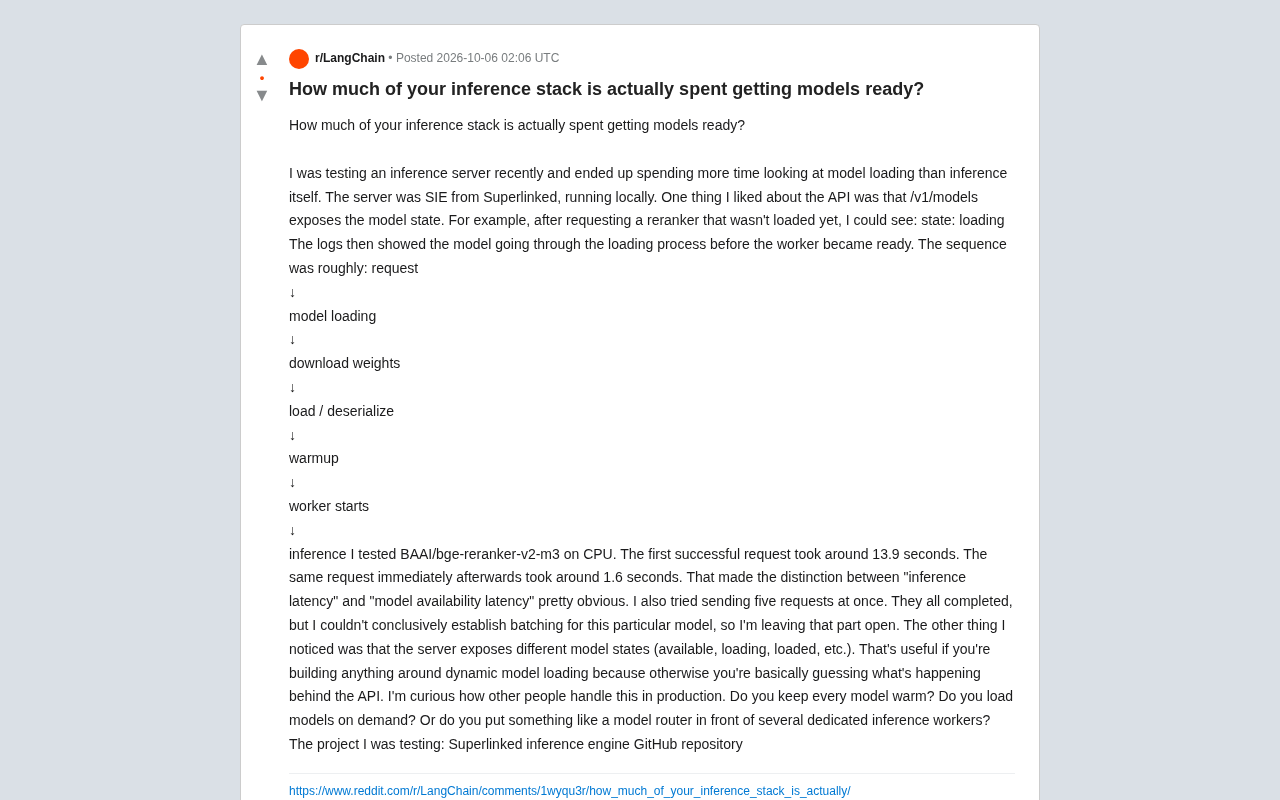
This developer ran Superlinked's SIE (Superlinked Inference Engine) locally and deliberately observed the model loading process. The results were eye-opening: when testing the BAAI/bge-reranker-v2-m3 reranker model on CPU, the first successful request took approximately 13.9 seconds, while the immediately following identical request took only about 1.6 seconds. This nearly 10x gap clearly exposes two concepts that are often conflated: inference latency and model availability latency.
The Full Chain from Request to Ready
Most developers treat inference APIs as black boxes: send a request, get a result. But this server exposed model state through a /v1/models endpoint, making the entire "preparation" process transparent. When requesting a reranker that hasn't been loaded yet, the API returns state: loading, and logs show the model working through a complete loading pipeline.
The chain looks roughly like this:
Request
 ↓
Model Loading
 ↓
Weight Download
 ↓
Load / Deserialization
 ↓
Warmup
 ↓
Worker Startup
 ↓
Inference
Every step consumes time: weight downloads are constrained by network and storage speeds, deserialization depends on model size and format, and the warmup phase handles memory allocation, operator initialization, and even the first computation graph build. All of this is where those 13.9 seconds actually go. Once the model is "hot" and resident in memory, subsequent requests return to the true inference cost of around 1.6 seconds.
Deserialization is an often-overlooked bottleneck in the loading chain. Model weights are typically stored on disk in formats like SafeTensors, PyTorch .pt/.bin, or GGUF, and loading requires parsing that binary data and mapping it into tensor structures in GPU/CPU memory. For large models, this step alone can take several seconds. SafeTensors, with its zero-copy memory-mapping design, deserializes faster and more safely than the traditional PyTorch pickle format — which is one reason why inference frameworks have broadly migrated to it in recent years.
Warmup is equally significant. In PyTorch, for example, the first inference requires JIT compilation of CUDA operators (or loading them from cache), auto-tuning of cuDNN convolution algorithms, and computation graph construction and optimization. These operations only happen on the first execution; subsequent requests can reuse the already-compiled kernels. This is the underlying reason for the dramatic latency gap between cold and warm requests.
The Value of Model State Observability
The most noteworthy design choice in this test was the server explicitly exposing different model states (available, loading, loaded, etc.). This might seem like a minor feature, but it's enormously significant for anyone building systems with dynamic model loading.
If an API doesn't tell you the current state of a model, you're essentially guessing what's happening in the background — is the request stalled due to queuing, downloading, or warmup? There's no way to tell. With state observability, you can design smarter scheduling logic: for instance, returning a clear wait signal to clients when a model is loading, or triggering preloading in advance to avoid cold starts.
The developer also honestly flagged one unresolved question: he tried sending five concurrent requests and while all completed successfully, he couldn't definitively verify whether the model performed batching. This remains an open item, reminding us that when evaluating inference engines, batching capability is another variable you can't just assume.
Three Strategies for Production Environments
This test surfaces a very practical production deployment question: how do you balance resource consumption against cold start latency? Community discussion has converged on three main approaches, each with its own trade-offs.
Keep All Models Warm
Load every potentially needed model into memory and keep it hot. The benefit is zero cold start latency for any request, delivering the best user experience. The cost is high memory overhead — when you have many large models, this approach is nearly unsustainable.
Load on Demand
Only load a model when a request arrives. This maximizes resource efficiency but passes that "13+ second" first-request penalty directly to the first user — exactly what was observed in this test. It's suitable for low-frequency access patterns where first-request latency isn't critical.
Model Router + Dedicated Workers
Place a model router in front of multiple dedicated inference workers, routing traffic to the worker that already has the requested model loaded. This is an engineering compromise between latency and cost, and the approach taken by many mature inference platforms — though it introduces additional scheduling complexity.
Beyond these three strategies, the industry has also developed Predictive Preloading and model quantization as complementary techniques. Predictive preloading analyzes historical access patterns to trigger model loading before it's actually requested, removing cold start costs from user-perceived latency. Quantization compresses weights from FP32/FP16 to INT8 or INT4 precision, dramatically reducing model size and simultaneously cutting download time, deserialization overhead, and memory footprint — a practical tool for balancing load speed with resident cost in resource-constrained environments. In serverless inference scenarios (such as AWS Lambda or Google Cloud Run), where instances are frequently recycled and rebuilt, cold starts are especially painful. The standard mitigation is pre-caching model weights in object storage or local SSD co-located with compute nodes, avoiding network download overhead on every cold start.
Implications for Inference Architecture Design
What looks like a casual local test actually touches on a core principle of inference service design: the latency a user perceives is not the same as the model's computational latency. Cold starts, weight downloads, deserialization, warmup — these "preparation costs" can be amortized to negligibility in high-frequency, stable workloads, but in scenarios with frequent model switching, dynamic loading, or serverless-style deployment, they become the dominant factor shaping performance.
For teams building inference stacks, here are a few immediately actionable takeaways: prioritize inference engines that expose model state so your system is observable rather than opaque; choose between warm, on-demand, or routed strategies based on your model access patterns; and treat "model availability latency" as a distinct metric in your monitoring, rather than folding it into a single end-to-end latency number.
After all, when a significant portion of your inference stack's time is actually spent "getting the model ready" rather than doing real inference, the right optimization target may be completely different from what you originally assumed.
Related articles

Amphibious Transforming Drone: Beyond 100x Power Savings, What Are the Real Needs?
Is the amphibious transforming drone just a gimmick? Starting from the 100x power difference of the M4 Morphobot, explore real application scenarios and thesis topic ideas, analyzing boundary conditions where pure drones and pure ground robots both fail.

Warhound Raises $200 Million: Genetically Engineered "War Dogs" Paired with Anduril Gear
Warhound raises $200M, backed by Ben Lamm and Palmer Luckey, to genetically engineer dogs for military and law enforcement use and equip them with Anduril gear. This article analyzes its technology direction, funding logic, and ethical controversy.

Claude API Comes to Google Cloud: IAM Integration and SDK Access Guide
Anthropic hosts the full Claude API on Google Cloud with IAM-controlled permissions and unified billing. This guide covers the Vertex AI and Anthropic-hosted entry points, IAM role configuration, and SDK access.