The Hidden Token Tax of MCP: One Server Burns 18,000 Tokens Before Doing Any Real Work

MCP preloads tool schemas that silently consume thousands of tokens before any reasoning begins.
Model Context Protocol (MCP) was designed to standardize tool access for AI agents, but its mechanism of preloading tool descriptions and JSON Schemas can consume massive tokens before the model begins reasoning — a single Chrome DevTools server burns roughly 18,000. Larger tool catalogs amplify this hidden cost while shrinking reasoning space and degrading tool selection accuracy. The recommended approach: measure each server's full prompt cost, prune unnecessary tools, then apply lazy loading, scoped exposure, tool search, and hybrid patterns to keep overhead manageable and let MCP fulfill its original promise.
MCP Was Supposed to Simplify Tool Calling — Instead, It's Become a New Bottleneck
Model Context Protocol (MCP) was designed to make it easier for AI agents to connect to tools and data. In practice, however, a single Chrome DevTools server can burn through roughly 18,000 tokens before executing its first meaningful action.
The root cause lies in how tools are loaded. Many MCP implementations preload all tool descriptions and JSON Schemas before any real work begins. This means the context window is already packed with metadata before the model has done any reasoning. In other words, MCP itself can become a performance bottleneck before the model's intelligence even kicks in.
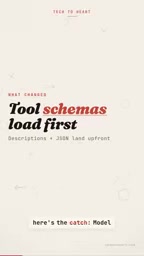
This is a cost that's easy to overlook. Developers tend to focus on the model's capabilities and response quality, while ignoring the silent budget drain happening at the integration layer. Once this overhead is quantified, many are surprised to find how much has been spent before anything useful happens.
MCP (Model Context Protocol) is an open standard released by Anthropic in late 2024, designed to provide large language models with a unified interface for accessing tools and data. Its design philosophy resembles USB-C: through a standardized protocol layer, different AI applications no longer need to build custom integrations for each external tool. An MCP server acts as a middleware layer that exposes a tool catalog to the model — each tool comes with a name, description, and parameter definitions in JSON Schema format. At inference time, the model reads these descriptions to decide which tool to call and what arguments to pass. This "tool manual" is injected into the context at the start of every conversation, constituting the hidden token overhead described in this article. JSON Schema itself is a specification for describing and validating JSON data structures. While critical for accurate tool calling, its detailed field descriptions, type constraints, and examples can consume a significant amount of token space.
The Bigger the Tool Catalog, the Higher the Price
As more tools are connected, the hidden costs of MCP scale linearly. A larger tool catalog means three compounding penalties: higher input costs, less space for reasoning, and lower tool selection accuracy.

There's a counterintuitive trade-off at play here. Intuitively, giving an agent access to more tools should make it more capable. But in practice, when tool descriptions flood the context window and crowd out space for actual reasoning, the model becomes more likely to pick the wrong tool from a sea of similar options. More tools doesn't equal a smarter agent — sometimes it's the opposite.
The growth in input costs is also not trivial. Every single call must carry these tool descriptions along with it. In high-frequency use cases, this "token tax" accumulates with each invocation, becoming an invisible but steadily growing line item in operating costs.
Measure First, Then Prune
Since the costs originate in the setup phase, the first step toward a solution is measurement — quantifying the full prompt cost of every server. Only by making hidden overhead explicit can you determine which tools are actually worth keeping.

After measurement comes pruning: removing high-cost tools that a specific agent task simply doesn't need. Different agent tasks have very different tool requirements. An agent focused on data analysis has no reason to carry around a full set of browser debugging tool descriptions. Trimming the tool catalog to match the task at hand is the most direct and effective way to reduce the token tax.
This mindset treats the tool catalog like a "dependency" to be managed — just as you wouldn't pull in a bunch of unused third-party libraries into a project, an agent's toolset should stay lean and purposeful.
Optimize with Lazy Loading, Scoped Exposure, and Hybrid Patterns
Beyond pruning, a set of more fine-grained optimization strategies are worth adopting:
Lazy Loading and Scoped Exposure
- Lazy loading: Instead of loading all tool descriptions at startup, load them on demand to avoid upfront overhead.
- Scoped exposure: Only expose the relevant subset of tools for the current task, rather than the entire catalog.
- Tool search: Let the agent retrieve tools when needed, rather than stuffing all options into the context upfront.
Hybrid Patterns Let Code Do the Heavy Lifting
A key architectural pattern is the hybrid pattern: have code handle the heavy lifting and return only concise outputs to the model.

The idea is to avoid having the model directly consume verbose raw data or full tool interaction details. Instead, deterministic code handles the heavy processing logic, and only the refined, distilled result is handed off to the model for reasoning. This saves tokens while also improving the reliability of outputs.
Lazy loading is a concept rooted in the delayed initialization pattern in software engineering — the core idea being "load when needed, not before." In an MCP context, lazy loading means the agent registers only minimal metadata at startup (such as tool names), and full Schema descriptions are only injected into the context just before a tool is actually invoked. Scoped exposure goes a step further: based on the current task phase or user intent, it dynamically filters and presents a relevant subset of tools to the model — similar to how role-based access control (RBAC) works, applied at the tool level. Tool search is typically implemented using vector embedding techniques: tool descriptions are vectorized and stored, and at inference time the most relevant tools are retrieved via semantic similarity and injected into the context, rather than loading the full catalog. The shared goal of all three strategies is to shift the tool descriptions in context from "fully static" to "dynamically on-demand," keeping token consumption manageable even as the tool catalog grows.
Manage Your Tool Catalog Like a Dependency
Before connecting an agent to yet another server, two disciplines are worth establishing:
First, set per-agent token budgets — define a clear spending cap for the integration layer to prevent costs from spiraling out of control.
Second, scrutinize the tool catalog the same way you scrutinize any other dependency. Every new tool or server added should be evaluated: does the benefit it brings justify its token cost? Don't integrate blindly.
The value of MCP is undeniable, but its hidden costs remind us: optimizing agent architecture goes beyond model selection and prompt design. Engineering discipline at the integration layer is equally decisive for a system's efficiency and economics. Measure first, prune next, and make good use of lazy loading and hybrid patterns — that's how MCP gets back to its original promise of simplifying tool calling, rather than becoming the new bottleneck.
Related articles

DeepSeek's New Model + Inference Engine Tested: Open-Source AI Nears the Frontier
DeepSeek releases open-source C.E Flash 1017 and inference engine DeepInfer. Tests show coding and research near GPT-5.6, frog-finding beats closed models, all for $6. DeepInfer reveals 96% cache hit rate, 80% gross margin, and Huawei Ascend support.

Hands-On with the Gemini 4 Argon API: Thinking Levels and Background Mode Explained
A Free Code Camp crash course on the Gemini 4 Argon API: from getting a key and sending your first request to controlling reasoning costs with thinking levels, enabling multi-turn chat with previous_interaction_id, and generating a Breakout game in background mode—plus a Google engineer's take on the model's capabilities.

Reinforcement Learning Takes On Getting Over It: Distributed Training Strategies Behind 63% Progress
A developer uses deep reinforcement learning to tackle Getting Over It. The agent climbs from the bottom to 63% progress but gets stuck at the anvil. The project is open-sourced, using divide-and-conquer training and CPU-only training, seeking community collaboration to break the bottleneck.