The History of AI Is the History of an Ideology: No More Excuses, Anyone Can Create

The history of AI is not a technological but an ideological history, centered on removing barriers between ideas and existence.
Drawing on a tweet's perspective, the article argues that the history of AI should be understood as an ideological history whose core tenet is that "nothing should stand between an idea and its existence." Traditional barriers such as skills, experience, money, connections, time, and approvals are being compressed by AI, as evidenced by non-technical creators delivering work independently with AI coding tools. The author also offers a calm analysis: "AI ends excuses" is motivational, but structural constraints like compute costs, data, and distribution channels remain. The democratization narrative holds for front-end entry rights, but the back-end reward structure remains concentrated. The article concludes with three insights for creators: prioritize shortening the idea-to-prototype distance in tool selection, shift capability from "knowing how to implement" to "knowing how to define the problem," and actively document the full process from idea to launch.
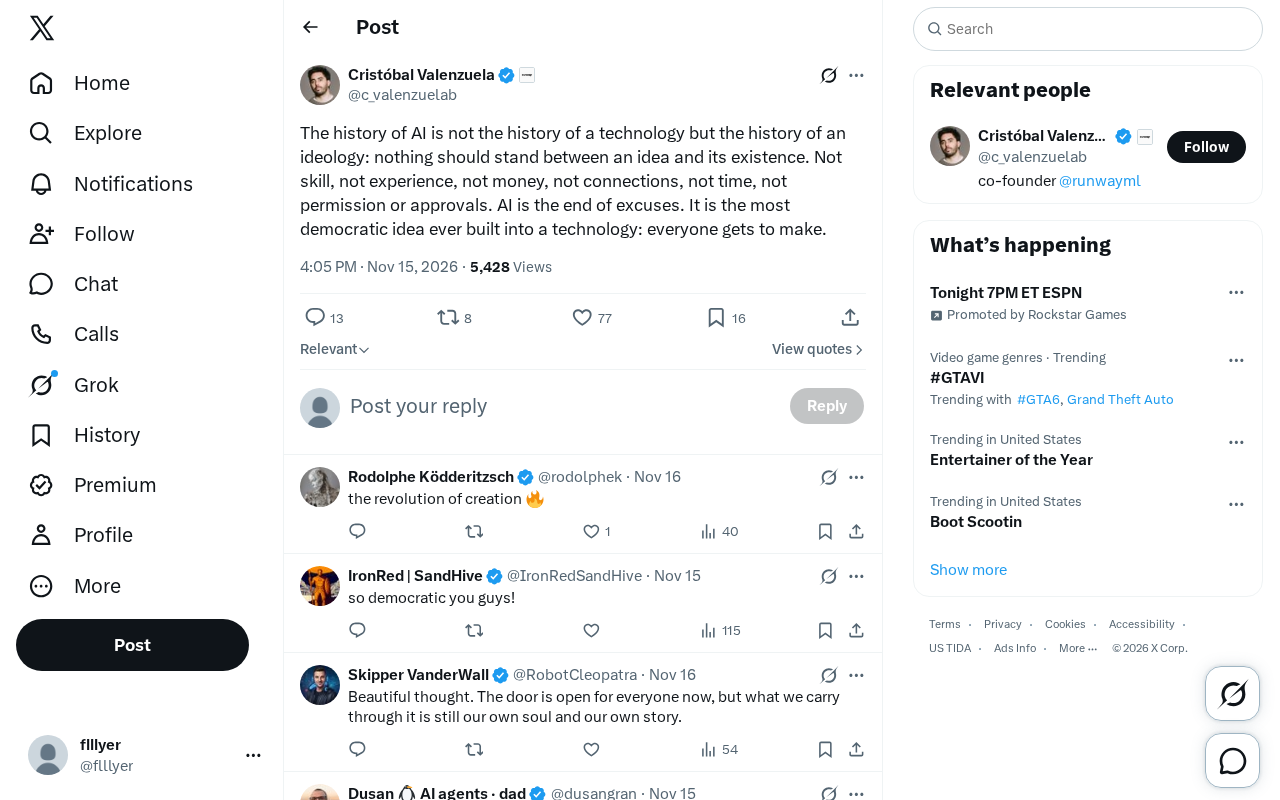
The history of AI is often told as a story of technological evolution: from symbolic logic to deep learning, from stacked compute to exploding parameter counts. But a tweet on Twitter offers a sharper perspective: the history of AI is not the history of a technology but the history of an ideology—one whose core claim is that "nothing should stand between an idea and its existence." Skills, experience, money, connections, time, permissions, and approvals—these traditional barriers are being dismantled by AI one by one.
Tearing Down the Barriers: From Skill Gatekeeping to "Anyone Can Build"
The author defines AI as "the most democratic technological idea in history": everyone can create. The force of this statement lies in how it pulls the AI discussion away from model performance and back to the level of social distribution. In the past, turning an idea into something runnable required crossing a series of barriers: knowing how to code, understanding design, having startup capital, finding the right people, waiting through approval cycles. What AI does, at its core, is compress the thickness of these barriers.
This judgment resonates with the firsthand experience of many frontline developers. On platforms like Bilibili and YouTube, a large number of non-technical creators are using AI coding tools to build usable web pages, small utilities, and automation scripts. Among them are designers, operations staff, teachers, and even people with no programming experience at all. This is not an isolated case but a spreading mode of creation. The tweet's author emphasizes ideology rather than the tools themselves, which cross-validates these observations: the lowering of barriers is not just a transfer of technical capability but a rewriting of the very idea of "who is qualified to create."
AI coding tools (such as Cursor, GitHub Copilot, Replit Agent, etc.) are code generation and assisted development environments based on large language models. They can generate functions from natural language descriptions, debug errors, explain code logic, and even build runnable application prototypes from scratch. Unlike traditional IDEs, these tools shift the operational focus of "writing code" from typing syntax line by line to describing intent and constraints in natural language. For non-technical creators, their significance lies in compressing programming from a craft requiring long-term training into a collaborative process communicable in everyday language—precisely the technical vehicle for what the original text calls "compressing the thickness of barriers."
The Ideological Core: The Shortest Path Between Idea and Existence
"Nothing should stand between an idea and its existence" is the tweet's key insight. It connects the history of AI to earlier Enlightenment ideals: knowledge should liberate people, not become a new privilege. The author goes further to say that AI is the entity that "ends excuses"—when tools are powerful enough, the reason for failing to make something is no longer external but only internal.
This view carries an obvious motivational tone, but it also deserves calm scrutiny. On one hand, it captures a real psychological shift: AI turns "I can't" from an objective limitation into a subjective choice. On the other hand, reducing all obstacles to excuses may obscure structural problems. For example, access to compute and high-quality models is not entirely free, and data and distribution channels remain constrained by platform rules. The tweet's stance is closer to a manifesto than an analysis, but it offers a useful coordinate: the measure of AI's value may not just be benchmarks, but how many people who were previously locked out have now walked through the door.
Knowledge liberation in the Enlightenment ideal refers to a belief dating back to the 18th-century Enlightenment: knowledge should not be monopolized by a privileged few but should serve as the foundation for everyone's self-realization and rational action. This tradition treats "barriers to accessing knowledge" as social shackles to be dismantled rather than a natural order. The original text juxtaposes AI with this ideal because the two share the same set of value judgments—the barriers themselves are suspect. Understanding this background helps clarify: calling AI a "democratic technology" is not describing a specific feature but continuing an ancient debate about the relationship between knowledge, qualification, and human potential.
The Boundaries of the Democratization Narrative: Who Really Benefits?
Calling AI "the most democratic technology" is a strong claim. Different sources hold subtly different views on this point. Optimists see the collapse of creative barriers: one person plus one computer can now deliver work that previously required a small team. Cautious observers point out that tool proliferation does not equal equal outcomes—distribution, attention, and commercialization capabilities remain concentrated, and AI may only lower the barriers at the front end while intensifying competition at the back end.
These two views are not irreconcilable. The tweet talks about "the possibility of creation"; critics talk about "distribution after creation." They correspond to different levels: the former is a revolution in the right of entry, the latter a continuation of the reward structure. Acknowledging the latter does not negate the significance of the former. On the contrary, only when the right of entry is truly universalized will discussions about distribution structures have a broader set of participants.
Technological democratization is a frequently cited concept referring to a technology that was once expensive or specialized gradually becoming cheap, accessible, and masterable by ordinary people. But it typically describes only the decline of "entry costs" without guaranteeing equal "distribution of benefits." Distribution channels, the attention economy, and commercialization capabilities often remain highly concentrated, so technological democratization frequently coexists with "outcome inequality." The original text's distinction between "the possibility of creation" and "distribution after creation" touches precisely on this internal tension: the universalization of entry rights can be real, and the continuation of reward structures can also be real at the same time—the two do not disprove each other.
Practical Implications for Creators and Developers
If one accepts the framework that "the history of AI is the history of an ideology," the practical implications become clear. First, tool selection should be guided by the principle of "shortening the distance from idea to prototype," not by chasing parameter leaderboards. Second, the definition of capability is shifting from "knowing how to implement" to "knowing how to define the problem"—when implementation becomes cheap, judging what is worth doing becomes more expensive. Third, creators should actively document the complete process from idea to launch, which in itself is the best validation of the claim that "the barriers have been torn down."
The tweet closes with "everyone can create," which is more an ongoing promise than a completed conclusion. Whether the history of AI will truly become a history of democratization depends on things beyond the tools: pricing, openness, educational access, and whether society is willing to acknowledge that creation is no longer a license held by the few. Technology provides the possibility, ideology determines the direction, and it is at the intersection of the two that the history of AI is truly being written.
One-line Summary
The history of AI is not a technological history but an ideological one, centered on tearing down the barriers between ideas and existence.
Paragraph Summary
Drawing on the perspective of a tweet, the article argues that the history of AI should be understood as a history of ideology, whose core tenet is that "nothing should stand between an idea and its existence." Traditional barriers such as skills, experience, money, connections, time, and approvals are being compressed by AI one by one, as evidenced by non-technical creators independently delivering work with the help of AI coding tools. The author also offers a calm analysis: "AI ends excuses" has a motivational tone, but structural constraints such as compute costs, data, and distribution channels still exist. The democratization narrative holds for front-end entry rights, while the back-end reward structure remains concentrated. Based on this, the article offers three insights for creators: make shortening the distance from idea to prototype the principle for tool selection, shift the focus of capability from "knowing how to implement" to "knowing how to define the problem," and actively document the complete process from idea to launch.
Related articles

ChatGPT Plus Subscription Pitfall Guide: Go/Plus/Pro Tier Comparison and Quick Activation
A complete ChatGPT Plus subscription guide based on a Bilibili tutorial: from registering an account, comparing Go/Plus/Pro tiers, to the practical steps for quickly completing your subscription.

GPT-6.2 Sol/Astra Released! A Step-by-Step ChatGPT Plus Subscription Guide and Tier Comparison
GPT-6.2 Sol/Astra is out—here's a ChatGPT Plus subscription guide: register an account, compare Go/Plus/Pro tiers, and subscribe in a minute.

Comparing Three Channels for Subscribing to GPT Plus in China: Is Website Top-Up the Easiest?
How to subscribe to GPT Plus in China? This article compares website top-up, credit card, and mobile top-up channels—process, cost, and risk—with steps and tips to help you choose wisely.