The Inside Story of OpenAI Cutting Off Cursor: The Model Wars Triggered by SpaceX's Acquisition
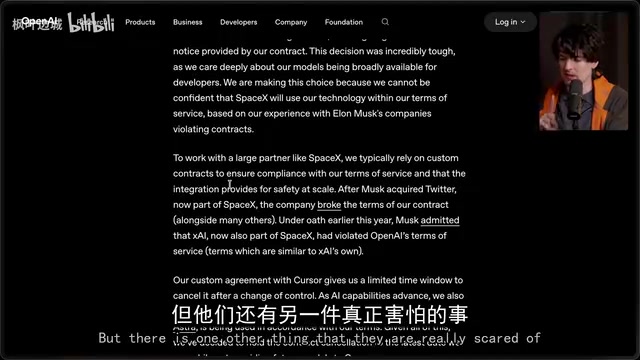
After SpaceX acquired Cursor, OpenAI cut off model access on Nov 12 to prevent distillation — and developers are caught in the crossfire.
After SpaceX completed its acquisition of AI coding tool Cursor, OpenAI announced it would terminate Cursor users' direct access to its models by November 12th. Beyond the contract dispute, the real driver is OpenAI's fear that Elon Musk's company will use paid API calls to distill training data — especially with the powerful new Astra model on the horizon. Anthropic has made similar moves against XAI and Windsurf. A public spat over whether OpenAI accounts for 5% or more of Cursor traffic has further inflamed tensions, and developers are now being pushed toward direct lab subscriptions or open-source tooling as the AI supply chain power struggle escalates.
The AI coding tool community just experienced a major shockwave. OpenAI has announced it is terminating its partnership with Cursor, with plans to cut off Cursor users' direct access to OpenAI models on November 12th. The triggering factor: SpaceX's acquisition of Cursor, and the deep-seated tensions that have long been building between Elon Musk and OpenAI. This isn't just an ordinary business breakup — it's a microcosm of the supply chain power struggles playing out in the age of large AI models.
What Happened: SpaceX Acquires Cursor, OpenAI Immediately Cuts Supply
According to an urgent breakdown by prominent overseas developer blogger Theo (founder of T3), the full picture of events is becoming clear. SpaceX had originally planned a joint collaboration with Cursor, with two possible arrangements: either SpaceX AI would pay Cursor $10 billion in exchange for data and RL (reinforcement learning) engineering capabilities to improve the Grok model, or it would acquire Cursor outright for $60 billion by year's end. Ultimately, SpaceX chose not to wait and completed the acquisition directly.
Theo himself disclosed that he had been an early investor in Cursor, and that with the acquisition complete, his financial ties to Cursor had essentially ended — which is why he felt he could comment more objectively on the matter. He also emphasized that he has no financial relationship with OpenAI, and is actually a heavy paying user, with Anthropic being the company he spends the most money on.
OpenAI's official position: due to past experience with Elon Musk's companies "violating contracts," they decided to terminate the agreement to provide OpenAI models, with a shutdown date of November 12th — the maximum notice period allowed under the contract. On the surface it looks like an amicable split, but the real reasons run deeper.
The Real Reason for the Cutoff: Distillation, Data, and the Upcoming Astra
OpenAI cited a key reason in its statement: based on past experience with Elon Musk's companies "violating contracts," they could not be confident that SpaceX would use their technology within the bounds of the terms of service.
The core concern here is model distillation. Elon himself has acknowledged on the record that XAI distills data from OpenAI models to improve its own. And Cursor, as an AI coding tool, has accumulated a massive volume of real-world programming data over time — precisely the data that makes Cursor's proprietary Composer model perform so well. Now that this data belongs to SpaceX, it effectively belongs to Elon. OpenAI clearly doesn't want a competitor using paid API calls to its models as a backdoor way to acquire training data.
Even more critically, OpenAI is about to release a new model called Astra. Theo points out that what OpenAI is really worried about is competitors distilling the leading capabilities of Astra. The statement explicitly mentions "new accountability requirements for our upcoming model Astra as AI capabilities advance." In other words, the timing of this cutoff is closely tied to Astra's release schedule.
Theo also noted the underlying business logic: Cursor didn't receive the massive 80%–95% subsidy that individual subscribers get — its API pricing discount was roughly in the 20%–30% range. If Cursor paid to call OpenAI models and then retained the resulting data for training, it would amount to "double-dipping" — charging customers while freely harvesting training material (assuming users hadn't opted out of data usage).
Model Distillation is a technique for transferring the "knowledge" of a large, high-performance model into a smaller one. Traditional distillation has the smaller model (the student) mimic the output distribution of the larger model (the teacher), thereby approximating the larger model's capabilities without direct access to the original training data. In the context of AI competition, "distillation" has taken on an extended meaning: by making large volumes of API calls to a model and collecting its input-output pairs, you can then fine-tune or train your own model on that data — essentially "buying" training data through paid API calls. This practice is explicitly prohibited by most model providers' terms of service, but is extremely difficult to prove in practice. The vast real-world programming data Cursor has accumulated is especially valuable, because it reflects how professional developers actually write code, debug, and solve problems in their day-to-day work — high-quality signal that's nearly impossible to find in general-purpose corpora, and directly useful for improving code generation models.
Historical Precedent: Anthropic Has Done This Before
This kind of "cut supply to prevent distillation" move isn't new. Theo outlined several precedents:
- When Windsurf was rumored to be acquired by OpenAI, Anthropic blocked its access to Claude models within Windsurf, citing the same concern about distillation.
- Earlier this year, XAI was already banned from using Anthropic models through Cursor, on the grounds that XAI might use the data for RL training.
- Anthropic also revoked OpenAI's access to the Claude API, reportedly because OpenAI was using it for benchmark comparisons. This reportedly explains why Anthropic models rarely appear in OpenAI's own benchmarks.
Interestingly, while Anthropic and XAI are nominally competitors, Anthropic is heavily dependent on SpaceX for compute — and both share a mutual antagonism toward OpenAI — which has forged an unlikely alliance between them. Anthropic's head of compute even publicly signaled goodwill toward SpaceX during this episode, stating they would continue adding compute support for Cursor, even as Claude Code usage quotas were simultaneously reduced by around 17%.
Theo's take on the broader ecosystem is pointed: everyone is distilling, Elon admitted it, and that shouldn't be such a big deal. Data is data. OpenAI and Anthropic themselves scraped the internet en masse back when it was still largely unguarded, giving them a first-mover advantage. Now they're aggressively defending against others acquiring data through paid access — and "that's not good for the ecosystem."
Reinforcement Learning (RL) in this context refers specifically to RLHF (Reinforcement Learning from Human Feedback) and its variants — an indispensable stage in training today's top large language models for alignment and capability improvement. In simple terms: the model generates multiple responses, which are then scored by humans or a "reward model," and through repeated iteration the model learns to produce higher-scoring outputs. Real user data from actual scenarios — like Cursor users' genuine programming requests — reflects what a "good answer" looks like far better than manually annotated data, making it extremely valuable for RL training. What Anthropic and OpenAI fear is that competitors, by making paid API calls, can gather large volumes of real input-output pairs and use them as positive training samples or reward signals for RL — dramatically improving their own models in specialized domains like coding at minimal cost.
The PR War: The Battle Over That 5% Traffic Figure
As the story spread, the public sparring between executives on both sides made things uglier. Cursor's Michael posted that OpenAI models account for only about 5% of Cursor user traffic, in an apparent attempt to downplay the impact. But Theo found that number "a bit much."
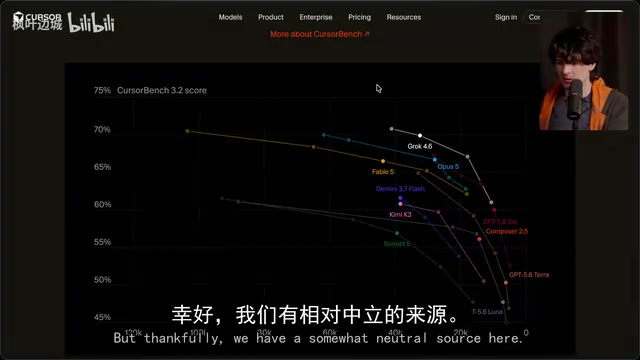
The crux of the issue is token efficiency. OpenAI models are far more token-efficient than competitors, so if you measure usage share purely by token count, OpenAI models will naturally "look small." Theo cited data from Artificial Analysis and Cursor's own benchmarks: GPT-5.6 Sol completes tasks using roughly 17k–28k tokens, while Anthropic's Fable requires 36k or even 103k tokens — more than a 3x difference. This means that 5% measured in tokens could translate to something closer to 15% when measured in actual requests or value.
OpenAI's Thibaut fired back, stating that "tokens are not a proxy for revenue or value, and OpenAI models are at the frontier of token efficiency" — a comment Theo acknowledged as technically correct, but unnecessarily combative. He quipped that senior executives publicly beefing "affects the users," while Thibaut and Michael themselves won't see their livelihoods threatened by this dispute — making the whole argument "childish and unnecessary."
A token is the basic unit of text that large language models process — roughly 1–1.5 tokens per English word, and about 1–2 tokens per Chinese character. API costs and usage are typically measured in tokens. Token efficiency refers to how many tokens a model consumes to complete a task of equivalent quality — the more efficient the model, the fewer tokens it needs. Different models can vary by several multiples in token efficiency: the same coding task might require 20k tokens from a highly efficient model, but 60k or more from a less efficient one. This means that measuring "usage share" purely by token consumption will systematically underestimate the most efficient models — their actual business value and request volume far exceed what the token numbers suggest. This is the technical root of the controversy surrounding Cursor's reported 5% figure.
What Should Users Do?
For developers who rely on Cursor as an all-in-one multi-model platform, Theo's advice is straightforward: if you want one subscription to cover all models, that's basically not going to work anymore.
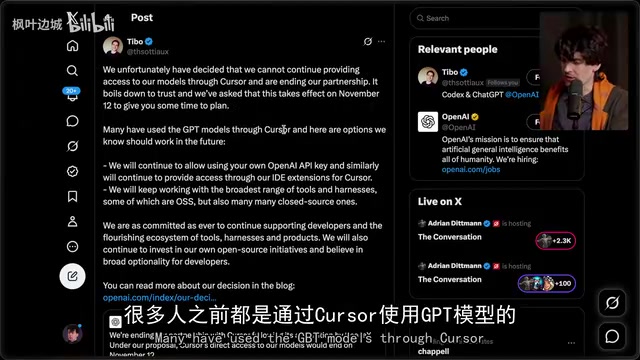
The reality is that subscribing directly to model providers (such as a $200/month Claude Code or Codex subscription) gets you far better quotas and subsidies than any aggregator can offer. Aggregation platforms simply cannot match lab-level subsidies — the same prompt might cost $2 on T3Chat but only $0.20 on ChatGPT. There's no competing with that.
Viable transition options include:
- Continuing to use your own OpenAI API key within Cursor;
- Calling OpenAI through its IDE extension (e.g., the Codex plugin) inside Cursor;
- Switching to direct subscriptions with official labs.
If you're open to Grok, the Cursor + XAI ecosystem still works. Theo admits Grok 4.5 and 4.6 can handle a fair amount of real coding work, but aren't quite Frontier-tier — people used to Fable and Sol will feel like they're "going back to the Stone Age."
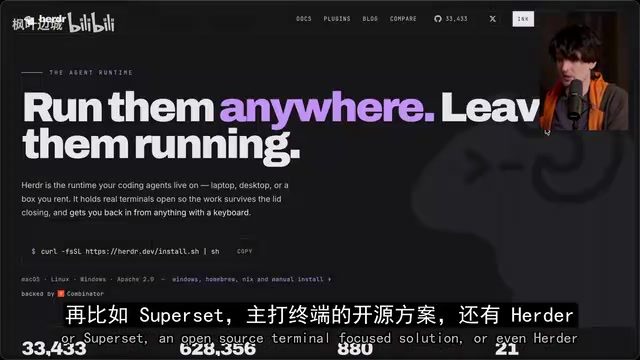
He also recommended several open-source terminal/panel tools as unified interfaces, including Gene, Superset, and the newly emerging Herder. Theo particularly emphasized the advantage of open-source tools: "they're much less likely to get banned." He used this as a call for developers to "own your tools and have a direct relationship with the products you depend on, rather than going through an intermediary layer."
Theo also took a swipe at Google — not the worst models, but the most aggressive account suspension policies and a terrible desktop app (Antigravity) make it impossible to safely integrate their subscription.
This Is Just the Beginning
Theo's broader assessment is worth taking seriously: this won't be a one-time event — it's more likely "the beginning of the end." As model capability competition intensifies, Anthropic, OpenAI, and even Google and SpaceX may all pull similar cutoff moves. For developers, this means the golden age of "one-stop multi-model platforms" is fading, and the political battles of AI supply chains will increasingly be felt by end users.
For those who write code in Cursor every day using GPT-5.6 Sol, after November they'll lose access to all OpenAI models in Cursor — including the upcoming Astra. In this "parents fighting" saga, it's ultimately the users who pay the price.
Related articles

LynnReal-Omni: 32B Unified Video Diffusion Model Goes Open Source with Multi-Task Coverage in Four Steps
LynnReal-Omni is a 32B unified video diffusion model on MiniMax H3, covering text-to-video, pose guidance, style transfer, restoration in 4 steps. Flash version generates 540p video in 377ms on one H100.

Anthropic Co-Founder: AI 'Kill Switch' May Need to Be Mandatory by Law
Anthropic's co-founder tells the BBC that AI 'kill switches' may need to be legally mandated. We analyze the industry logic, technical challenges, and the tension between regulation and innovation.

The AI Data Center Boom Is Colliding With Cities Scarred by Heavy Industry
The AI data center boom is clashing with post-industrial communities. Philadelphia's case reveals structural conflicts between AI growth, energy use, water, and environmental justice.