The JPEG XL Debate: Why Technical Superiority Struggles Against Ecosystem Reality
The JPEG XL Debate: Why Technical Supe…
JPEG XL's technical edge couldn't survive Chrome's withdrawal — a lesson in how ecosystems trump engineering.
JPEG XL is a next-generation image format purpose-built for still images, offering superior compression, lossless JPEG migration, progressive decoding, and HDR support — once considered the most elegant universal image format solution. Yet Google Chrome dropped support citing "insufficient ecosystem interest," a move critics saw as clearing the way for Google-backed AVIF. The battle between these two formats reveals a brutal truth: ecosystem inertia, browser gatekeepers, and commercial interests consistently outweigh technical merit in determining a format's fate.
The JPEG XL Debate: Why Technical Superiority Struggles Against Ecosystem Reality
JPEG XL is widely regarded by image compression experts as a strong candidate for the next-generation image format, boasting impressive technical advantages including high compression efficiency, lossless JPEG recompression, and progressive decoding. Yet controversy has never been far behind — a post titled The Case Against JPEG XL sparked a heated debate on Hacker News about the format's future. What this controversy reflects goes far beyond technical trade-offs; it exposes the complex interplay of browser ecosystems, standards battles, and commercial interests.
JPEG XL's Technical Promise
JPEG XL (JXL) was designed from the ground up to serve as a universal replacement for JPEG, PNG, and even many GIF use cases. Its core selling points include: lossless, smaller-footprint recompression of existing JPEG files — meaning massive libraries of legacy images can migrate seamlessly — along with excellent high-fidelity compression efficiency, wide color gamut support, high dynamic range (HDR), and a unified encoding architecture for both lossless and lossy modes.
For services where image storage is central to operations, these features are enormously attractive. In theory, JPEG XL can meaningfully reduce bandwidth and storage costs with negligible quality loss, while eliminating the compatibility overhead of managing fragmented formats. This is precisely why it was once seen as the "technically most elegant" answer.
Progressive decoding is one of JPEG XL's most important differentiators and deserves special attention. While traditional JPEG supports progressive loading, JPEG XL takes this to a new level: it uses a wavelet-based hierarchical encoding structure that allows a decoder to render a recognizable low-resolution preview from as little as 1% of the total file, then progressively refine the image as more data arrives until full quality is reached. This aligns exceptionally well with modern network conditions, particularly for image-heavy pages. AVIF's progressive decoding support is comparatively limited and delivers a noticeably worse experience when loading large images. Additionally, JPEG XL's lossless recompression capability allows standard JPEG files to be repackaged into JXL format without any quality loss — saving roughly 20% in file size on average — while remaining fully reversible to the original JPEG. This means existing image libraries can migrate with zero quality degradation, a unique capability no competing format can match.
Where the Opposition Comes From
The position represented by The Case Against JPEG XL isn't a denial of its technical capabilities — it's a challenge to whether the format can actually achieve mainstream adoption. The core tension is browser support. Google's Chrome team once introduced experimental JPEG XL decoding support, then subsequently removed it, citing "insufficient ecosystem interest" and "insufficient incremental benefit over existing formats."
This decision ignited widespread controversy. Supporters of JPEG XL argued that Google was clearing the path for its own preferred format, AVIF — which is based on AV1 video coding, a standard Google is a primary driver behind. Critics pointed out that no matter how technically advanced an image format is, without native support from a major browser, it simply cannot gain real-world adoption on the web. This is the brutal reality of format wars: technical merit is rarely the deciding factor — ecosystem leverage and political influence are.
Google announced the removal of JPEG XL support from Chromium via an "Intent to Unship" in 2022. The impact extended far beyond Chrome itself — since Edge, Opera, Samsung Internet, and others are all Chromium-based, this effectively barred JPEG XL from over 65% of the world's browser users. Google's stated reasons included that the compression gains weren't sufficient to justify the maintenance cost, and that developer interest in the format was limited. But critics noted a self-fulfilling logical paradox: developers couldn't adopt JPEG XL at scale precisely because Chrome didn't support it, yet low adoption was then used to justify removing support. Some standards participants viewed this decision as a violation of the open web's spirit, sparking discussion in W3C working groups and exposing the de facto monopolistic influence that a handful of large tech companies wield over the browser ecosystem.
The AVIF vs. JPEG XL Route Conflict
The next-generation image format landscape has effectively split into two main camps. One is AVIF — derived from video coding — which has secured support in Chrome, Firefox, and other browsers by riding the AV1 ecosystem. The other is JPEG XL, purpose-built for images, which holds meaningful advantages in codec flexibility, progressive loading, and lossless JPEG migration.
From a pure image-application perspective, JPEG XL's design is more closely aligned with the actual needs of image use cases — particularly its lossless JPEG recompression capability, a critical advantage AVIF simply does not possess. But AVIF has leveraged the scale effects of the video codec ecosystem to achieve faster hardware acceleration support and broader browser rollout. This competition is largely not about "which format is better" but rather "which format has more powerful forces behind it."
AVIF (AV1 Image File Format) is essentially the output of a single AV1 video encoder frame packaged as an image format. This design brings significant engineering advantages: chip manufacturers have already integrated AV1 decoding into hardware, allowing AVIF to directly reuse this infrastructure for hardware-accelerated decoding — dramatically reducing power consumption and CPU load on mobile devices. However, the video codec DNA also introduces clear limitations: AVIF encoding is relatively slow, particularly for high-resolution images; its block-based encoding structure tends to produce visible "banding" or "blocking" artifacts in smooth gradient areas; and support for ultra-high-resolution images (such as those from medium-format cameras with hundreds of megapixels) is constrained. By contrast, JPEG XL was designed from the ground up for still images, achieving a more balanced profile across detail preservation, encoding speed, and high-resolution support. The divergence between these two technical approaches is, at its core, a philosophical engineering difference between "reuse existing video infrastructure" and "build the right foundation for images."
Ecosystem Inertia and the Adoption Dilemma
Image format transitions have historically been extraordinarily slow. JPEG, now decades old, remains the most ubiquitous format on the web; PNG and GIF are equally entrenched. Any new format hoping to displace them must simultaneously convince browser vendors, content delivery platforms, image processing toolchains, and end users — a classic chicken-and-egg problem: without browser support, content providers won't adopt it; without content adoption, browsers lack the incentive to support it.
JPEG XL is currently stuck in exactly this loop. While it has gained traction in some professional domains — photography, image archiving — and has support in browsers like Safari, adoption in mainstream web contexts faces enormous resistance. The Hacker News discussion reflects a divided community: one camp mourns a technically excellent format being sidelined by politics and commercial interests, while the pragmatic camp argues that a format lacking unified support is structurally incapable of going mainstream.
What This Debate Reveals
JPEG XL's situation is a microcosm of how technical standards evolve: the best technical solution doesn't always win, and the success or failure of a standard often hinges on who controls the distribution channels and ecosystem entry points. Browser vendors play an almost gatekeeper-like role in this process, with their decisions effectively determining a format's fate.
For practitioners who care about image technology, JPEG XL's value remains worth recognizing — in server-side image optimization, professional image processing, and other contexts that don't depend entirely on browser support, it still has wide applicability. But to truly become the universal web format, it needs more than technical leadership. It needs an ecosystem-level breakthrough. The Case Against JPEG XL discussion is less a rejection of the technology than a sobering reminder of a harsh reality.
Related articles
Open Source AI & Open Models Reading List: A Resource Guide from Beginner to Advanced
A breakdown of an open source AI reading list trending on Hacker News — clarifying open weights vs. true open source, license types, and how to learn effectively.
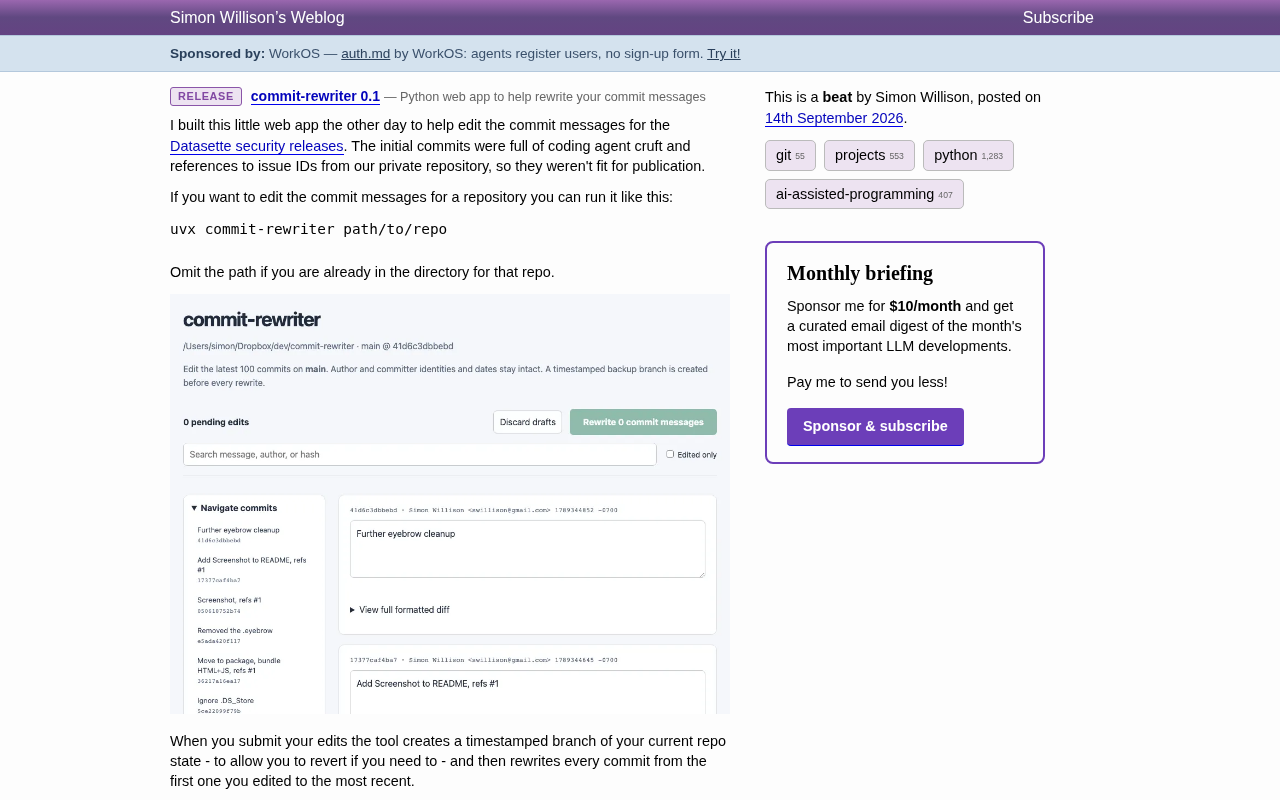
commit-rewriter 0.1: An Open-Source Tool for Batch Rewriting Git Commit Messages
commit-rewriter 0.1 is an open-source Git commit batch-rewriting Web tool by Simon Willison. Run it instantly with uvx to clean AI agent cruft and private refs, with timestamped backup branches for safe rollback.
shot-scraper 1.12 Adds WebP Support: Dramatically Smaller Screenshot File Sizes
shot-scraper 1.12 adds WebP screenshot support with --quality control, delivering significantly smaller file sizes than JPEG and PNG for automated screenshot workflows.