The Latest ESP32 Can Now Run Linux: Is It Closing In on the Raspberry Pi?

The latest ESP32 gains MMU support and Linux capability, stepping beyond MCU into mini computing platform territory.
The ESP32, long used as an IoT co-processor, can now run Linux thanks to MMU integration in its latest generation — a fundamental architectural upgrade that has sparked excitement across the embedded and maker communities. While it still trails the Raspberry Pi in compute power, GPU capability, and ecosystem maturity, it stands to fill the gap between pure MCU and full single-board computer. For developers, Linux brings unified toolchains and package ecosystems; for makers, the low cost plus Linux capability unlocks new possibilities in edge computing and lightweight servers.
ESP32's Leap Forward: From Microcontroller to a Tiny Linux Machine
For most developers, the ESP32 has always been that cheap, wireless-capable microcontroller (MCU) — the go-to chip for smart home gadgets, sensor nodes, and IoT side projects. It's long played the role of a "peripheral co-processor": handling network connectivity, collecting data, and toggling pins, rather than running a full operating system on its own.
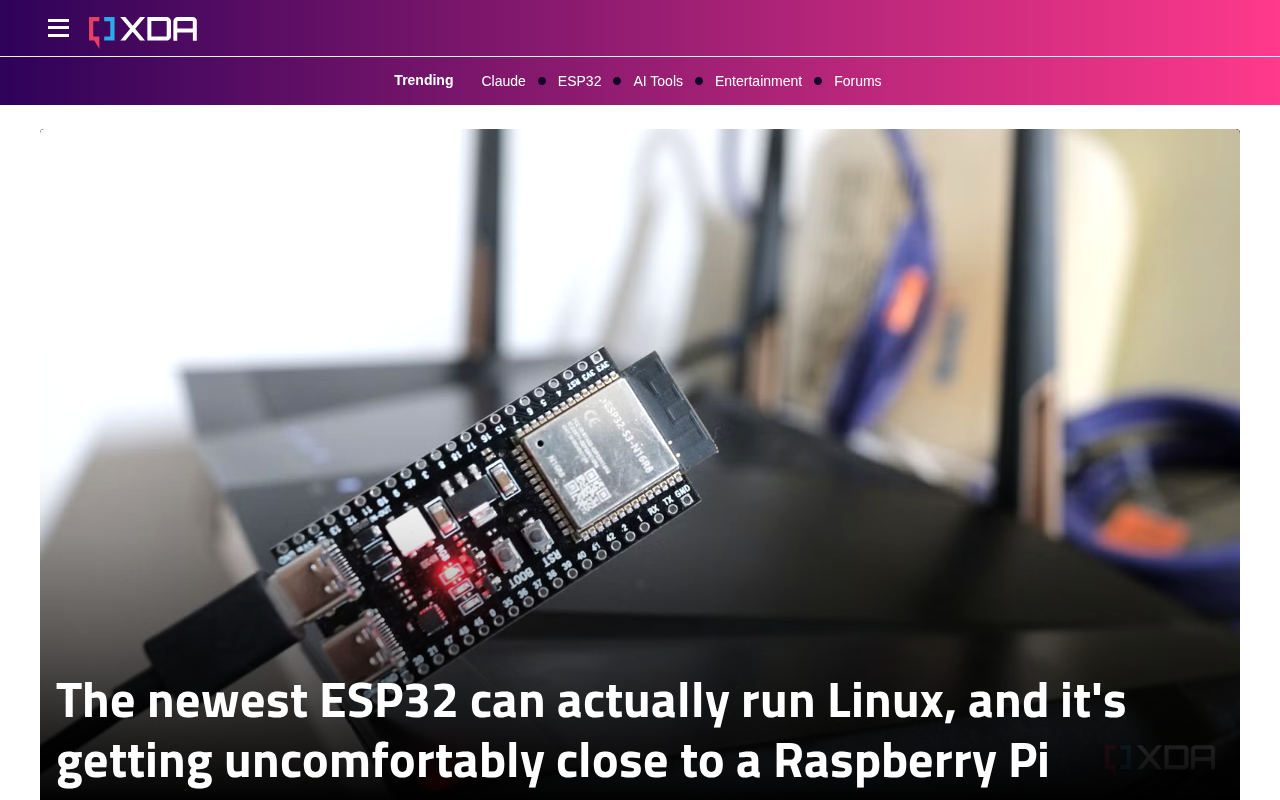
But according to a report from XDA Developers, the latest generation of ESP32 chips can now run Linux — and is gradually closing the gap with entry-level Raspberry Pi boards. The story landed on Hacker News with 230 upvotes and hundreds of comments, clearly striking a nerve in the embedded and maker communities.
Why "ESP32 Running Linux" Is a Big Deal
To appreciate what this means, you need to understand the fundamental gap between a traditional MCU and a Linux-capable SoC (System on Chip). Classic ESP32 chips run on real-time operating systems like FreeRTOS, or bare-metal firmware. Their memory is measured in kilobytes, and crucially, they lack a Memory Management Unit (MMU) — making it impossible to host the Linux kernel, which depends on virtual memory and process scheduling.
The Raspberry Pi can function as a "mini computer" precisely because it uses an application-class processor with an MMU, paired with external RAM and storage, capable of running a full Linux distribution. The fact that ESP32 can now cross this threshold means the chip has seen substantial upgrades in architecture, memory configuration, and peripheral support. It's no longer just a "wireless helper" — it's beginning to have the potential to serve as an independent computing platform.
How the Two Actually Differ in Purpose
It's worth staying grounded here: "closing in on the Raspberry Pi" is not the same as "replacing the Raspberry Pi." Even with Linux support, the ESP32 platform still lags significantly behind mainstream Raspberry Pi boards in raw compute power, GPU graphics capability, memory bandwidth, and ecosystem maturity. What it's more likely to occupy is the middle ground between "pure MCU" and "full single-board computer" — retaining the advantages of low power consumption, low cost, and rich wireless connectivity, while gaining the software flexibility that comes with the Linux ecosystem.
A quick primer on MMU: The Memory Management Unit is the hardware module in a processor responsible for translating the "virtual addresses" a program uses into actual physical memory addresses. The Linux kernel relies on the MMU for process isolation, memory protection, and virtual memory paging — each process believes it has exclusive access to the full memory space, while the MMU handles the mapping behind the scenes. Traditional ESP32 chips (like the ESP32-S3) lack an MMU, which is why they're limited to RTOSes like FreeRTOS: all tasks share the same physical memory with no isolation, and a single out-of-bounds write can crash the entire system. The ability to run Linux means the new ESP32 integrates an MMU — a fundamental architectural upgrade, not merely a performance bump.
This "middle ground" is well-precedented in the industry. Allwinner's F1C100s, certain WCH RISC-V chips, and the once-popular OpenWrt router chipsets have all filled a similar niche: far cheaper than a Raspberry Pi, yet capable of running a trimmed-down Linux, enough to run Python scripts, an MQTT broker, or a lightweight web server. ESP32 enters this space armed with its already mature Wi-Fi/Bluetooth ecosystem and a massive developer base. The real variable is whether Espressif can provide sustained mainline Linux kernel support for the new chip — the lack of upstream-maintained BSPs (Board Support Packages) is typically what causes these platforms to be abandoned in the long run.
What This Means for Developers and Makers
For embedded developers, the most immediate value of running Linux on the same low-cost chip is a unified development paradigm. Developing on MCUs has traditionally meant wrestling with constrained toolchains and bare-metal debugging. A Linux environment means access to familiar command-line tools, scripting languages, mature network stacks, and package managers — dramatically lowering the barrier from prototype to product.
For the maker community, chips like this could spark a new wave of "extreme value" projects: use cases that need a bit of OS capability but don't want to pay the power and cost premium of a Raspberry Pi — think edge computing nodes, portable network tools, or lightweight home servers. ESP32's track record of being dirt-cheap, combined with Linux capability, opens up some genuinely exciting possibilities.
A Realistic Take: This Is a Trend, Not a Disruption
Much of the excitement on Hacker News stems from the community's natural enthusiasm for capability leaps in low-cost hardware — but a degree of technical sobriety is warranted. Running Linux and usably running Linux are two different things. Performance, driver completeness, community support, and long-term maintenance are all critical factors in determining whether a platform can actually gain traction.
The more measured interpretation: ESP32 running Linux represents the ongoing trend of low-end embedded chips pushing their capabilities upward. As process nodes improve and integration density increases, the line between MCU and application processor is blurring. For anyone working in embedded systems, IoT, or edge computing, this is a signal worth tracking — it may not immediately change who's reaching for a Raspberry Pi, but it's actively redefining what a few-dollar chip can do.
Wrapping Up
The latest ESP32 running Linux is a landmark moment in the evolution of embedded hardware. It marks a meaningful step for a chip long celebrated for low-cost wireless connectivity, now moving toward becoming a genuine mini computing platform. While it still trails the Raspberry Pi in overall performance, this downward migration of capability is opening up new project possibilities for makers and developers alike. For more technical details, check out the original XDA Developers article and the Hacker News discussion thread.
Related articles

Gaussian Process Bandit Optimization: Exploration Strategies and Inference Regret Guarantees
Cumulative regret guarantees in Bayesian optimization fail to reflect final recommendation quality. This article examines a new study that provides inference regret guarantees for Gaussian process bandit optimization through exploration query strategies and fill distance analysis, validated on hyperparameter optimization and control tasks.

The Most Detailed Codex Guide on Bilibili: From Installation to Real-World Practice
The most detailed Codex guide on Bilibili: from app store installation to daily work mode configuration, with a real coffee shop project demonstrating file organization, data extraction, dashboard creation, and other practical tasks. Learn to use Plan Mode and desktop pets to leverage Codex efficiently.

Appearance Compensation in Volume Rendering: Why RGB Accuracy Cannot Guarantee Density Correctness
Volume rendering research reveals that volumetric data perfectly reproducing external RGB views may still contain density errors: appearance compensation can double central density and keep external rays unchanged even when L2 error exceeds 14.52%. Density recovery depends on appearance capacity, spatial resolution, and measurement design.