The LLM Verbosity Problem: Beyond Truncation, Where Are the Limits of Semantic Preservation?
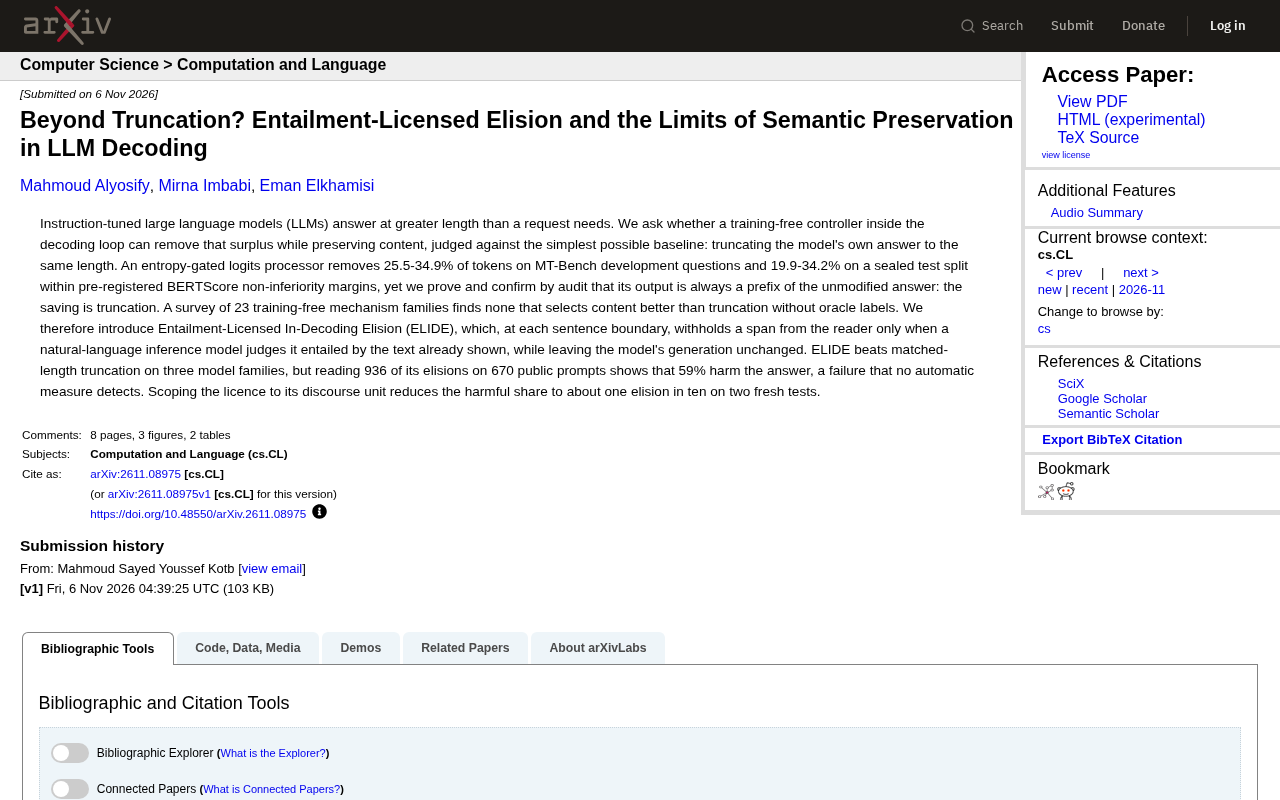
Research proves training-free LLM output streamlining is actually truncation; proposes ELIDE but human auditing finds 59% of deletions harmful.
This paper systematically examines LLM output streamlining. It proves an entropy-gating logits processor merely truncates, and surveys 23 training-free mechanism families—none beat truncation without oracle labels. The proposed ELIDE hides spans only when entailed by context, outperforming length-matched truncation across three model families. Yet human auditing of 936 deletions finds 59% harmful, undetectable by BERTScore. Narrowing licensing to discourse units cuts harm to ~10%, still unreliable. Logical entailment ≠ communicative sufficiency; training-free semantic-preserving deletion remains open, and truncation remains a safe baseline.
Introduction: LLM's "Chattiness" Problem and the Truth About Truncation
Instruction-tuned large language models (LLMs) often respond verbosely when they shouldn't—you ask a simple question and get back a whole essay. This "output excess" not only wastes compute but also hurts user experience. Researchers have tried implanting training-free controllers into the decoding loop to streamline output, but a core question has remained unresolved: are these methods really "intelligently deleting" redundant content, or just truncating in disguise?
A recent paper gives a sharp answer to this question. The authors first examined an entropy-gating-based logits processor, which removed 25.5%–34.9% of tokens on the MT-Bench development set and 19.9%–34.2% on a sealed test set, while satisfying a pre-registered BERTScore non-inferiority margin. However, the authors proved and confirmed through auditing that this processor's output is always a prefix of the original answer—the so-called "savings" are just truncation. This finding directly undermines the foundation of existing training-free streamlining methods.
Entropy gating is a dynamic control strategy based on the model's output uncertainty. During decoding, the model computes a probability distribution over candidate tokens at each step, and the entropy of this distribution reflects the confidence of that prediction: low entropy means the model is certain, high entropy means it is hesitant. Entropy gating typically sets a threshold—when entropy is below the threshold, generation continues; when above, some intervention is triggered (e.g., early stopping, switching strategies, or discarding low-confidence tokens). In the context of this paper, the entropy-gating-based logits processor uses this signal to decide whether to "remove" certain tokens, attempting to streamline output where the model is uncertain. However, because entropy signals are not equivalent to semantic redundancy, this strategy easily degenerates into simple length truncation rather than true semantic deletion.
A Systematic Review of Training-Free Mechanisms: None Can Beat Truncation
To comprehensively assess the state of the art, the authors surveyed 23 families of training-free mechanisms. The conclusion is sobering: without oracle labels, no mechanism outperforms simple truncation in content selection. This means that many previously claimed methods for "intelligent compression" of output may in practice be variants of truncation, without truly understanding which content can be safely omitted.
This finding has methodological significance. It reminds researchers that when developing output streamlining techniques, they must compare against the strongest baseline—length-matched truncation—otherwise improvements may be illusory. Truncation, though crude, is a hard-to-beat baseline—because it at least guarantees that the output is semantically identical to the original answer (just incomplete), whereas any "intelligent" deletion may introduce semantic deviation.
Oracle labels in machine learning refer to "ground truth" or "true labels"—benchmark information provided by human experts or reliable sources for evaluating the correctness of model output. In output streamlining tasks, oracle labels mean knowing which parts of the original answer are truly necessary for the final response and which are redundant. With such labels, one could precisely measure whether a deletion mechanism preserves key information. However, oracle labels are almost never available in practice, so training-free methods can only rely on heuristic signals (such as entropy, attention weights, or natural language inference) to approximate the judgment. This paper points out that without oracle labels, the content selection ability of any mechanism cannot be reliably verified, highlighting a fundamental difficulty in evaluating streamlining methods.
ELIDE: An Entailment-Licensed Deletion Mechanism
Since existing methods cannot beat truncation, the authors propose a new idea: Entailment-Licensed In-Decoding Elision (ELIDE). Its core mechanism is that at each sentence boundary, only when a natural language inference model judges that a span is already entailed by the preceding context, is that span hidden from the reader—while the model's own generation process remains unchanged. In other words, ELIDE does not modify the model's output distribution; it merely performs "licensed deletion" at the presentation level.
This design attempts to reduce the redundant information the reader sees while preserving the integrity of the generated content. Theoretically, if the inference model is reliable enough and the deleted span is indeed derivable from the preceding context, then deletion would not harm answer completeness. ELIDE outperforms length-matched truncation across three model families, showing potential.
Natural language inference (NLI) is a core task in natural language processing, aiming to determine the logical relationship between two sentences: entailment, contradiction, or neutral. Given a premise and a hypothesis, an NLI model outputs whether the hypothesis can be logically inferred from the premise. In ELIDE, the NLI model is used to judge whether a span is already "entailed" by the preceding context—that is, whether the reader can logically derive the content of that span from the preceding text. If entailment holds, the span is considered redundant and can be hidden. However, NLI models have limited accuracy on real text, especially at the pragmatic and discourse levels, which is one of the root causes of ELIDE's high harmful deletion rate.
The Harsh Reality Revealed by Human Auditing: 59% of Deletions Are Harmful
However, the halo of automatic metrics was quickly broken by human auditing. The authors read 936 deletions by ELIDE on 670 public prompts and found that 59% of deletions actually harmed answer quality—and this failure was undetectable by any automatic metric. This is a striking number: more than half of the "intelligent deletions" are wrong, yet metrics like BERTScore are completely oblivious.
The root cause is that the ability of natural language inference models to judge "entailment" is unreliable in real scenarios. A span may be logically entailed by the preceding context but cannot be omitted at the pragmatic or information-structure level. For example, the preceding text may imply a certain conclusion, but explicitly stating that conclusion is crucial for the reader's understanding. ELIDE's failure reveals the deep difficulty of semantic preservation: logical entailment is not equivalent to communicative sufficiency.
BERTScore is an automatic text generation evaluation metric based on pre-trained language models (such as BERT). It computes cosine similarity between token-level embeddings of the candidate text and the reference text, performs greedy matching, and obtains precision, recall, and F1 scores. BERTScore can capture semantic similarity and outperforms traditional n-gram overlap metrics (such as BLEU, ROUGE). However, it measures overall semantic similarity and is insensitive to local information loss: even if a key phrase is deleted, BERTScore may still give a high score as long as the overall embedding distribution does not change much. In this paper, BERTScore is used as the metric for non-inferiority testing, but human auditing found that it cannot detect 59% of harmful deletions, exposing the blind spot of such automatic metrics in fine-grained semantic preservation evaluation.
Narrowing the Licensing Scope: From Sentences to Discourse Units
Faced with the high harm rate, the authors tried narrowing the licensing scope from the sentence level to its discourse unit. In two new tests, this adjustment reduced the proportion of harmful deletions to about one-tenth. This shows that finer-grained contextual constraints can significantly improve deletion safety—when the inference model judges entailment only within a more local discourse unit, the likelihood of misjudgment decreases.
However, this improvement is still not perfect. A one-tenth harm rate is still unacceptable in high-quality question-answering scenarios. ELIDE's exploration shows that training-free semantic-preserving deletion remains an open problem, with its boundary determined by the reliability of the inference model.
Implications: The Limits of Semantic Preservation and Future Directions
This study brings several key insights to the field of LLM output streamlining. First, truncation is an underestimated strong baseline, and any new method must demonstrate value beyond truncation. Second, automatic metrics have blind spots in detecting semantic harm, and human auditing is irreplaceable. Finally, although entailment-based deletion is elegant in concept, it is limited by the accuracy of natural language inference models and cannot yet be reliably used in production environments.
In the future, stronger inference models may be needed, or interactive feedback may be introduced to calibrate deletion decisions. Until then, for applications seeking concise output, simple truncation may still be the safer choice—at least it won't quietly drop key information.
One-line Summary
Research proves that training-free LLM output streamlining methods are actually truncation; proposes ELIDE but human auditing finds 59% of deletions harmful.
Paragraph Summary
This paper systematically examines the field of large language model output streamlining. The authors first prove that the tokens removed by an entropy-gating logits processor are always a prefix of the original answer—essentially truncation. They then survey 23 families of training-free mechanisms and find that without oracle labels, none outperforms simple truncation in content selection. To address this, they propose ELIDE, which hides content at sentence boundaries only when a natural language inference model judges the span to be entailed by the preceding context, outperforming length-matched truncation across three model families. However, human auditing of 936 deletions finds 59% harmful, and automatic metrics like BERTScore cannot detect this. Narrowing the licensing scope to discourse units reduces the harm rate to about one-tenth, but it remains unreliable. The study reveals that logical entailment is not equivalent to communicative sufficiency, training-free semantic-preserving deletion remains an open problem, and truncation remains a safe baseline.
Related articles

Seven Years of Evolution: How Far Has the Foldable Come From the First Generation?
From the first foldable to today's latest models, what has seven years changed? Shallower creases, higher brightness, thinner bodies, and smoother software migration—has the foldable crossed the chasm from enthusiasts to ordinary users? This article discusses the question based on a video comparison.

When Did Humans Start Eating Salt? A 10,000-Year History of Salt
When did humans start eating salt? From salt use at the dawn of agriculture 11,000 years ago to ancient seawater evaporation and rock salt mining, and on to the salt trade, salt taxes, and Gandhi's Salt March, this article traces salt's key role in human civilization.
Microsoft Paza Research: How African Language Speech Recognition Breaks Through Architecture and Data Bottlenecks
Microsoft's Paza research evaluates 53 speech models across 39 African languages, revealing architecture choice matters more than pre-training coverage, 200-300 hours is the practical data threshold, and language typology deeply influences recognition performance.