The Mathematical Foundations of Generative AI: An Intuitive Little Book

The Little Book of Generative AI Foundations sparked discussion on Hacker News as an intuitive math primer for generative AI.
This article introduces The Little Book of Generative AI Foundations: An Intuitive Mathematical Primer, which sparked discussion on Hacker News. The book aims to bridge the gap between thick theory textbooks and purely practical guides, explaining generative AI math intuitively for technical practitioners with limited math background. It likely covers probability distributions, gradient descent, and core generative model ideas, and discusses the trade-off between intuition and rigor.
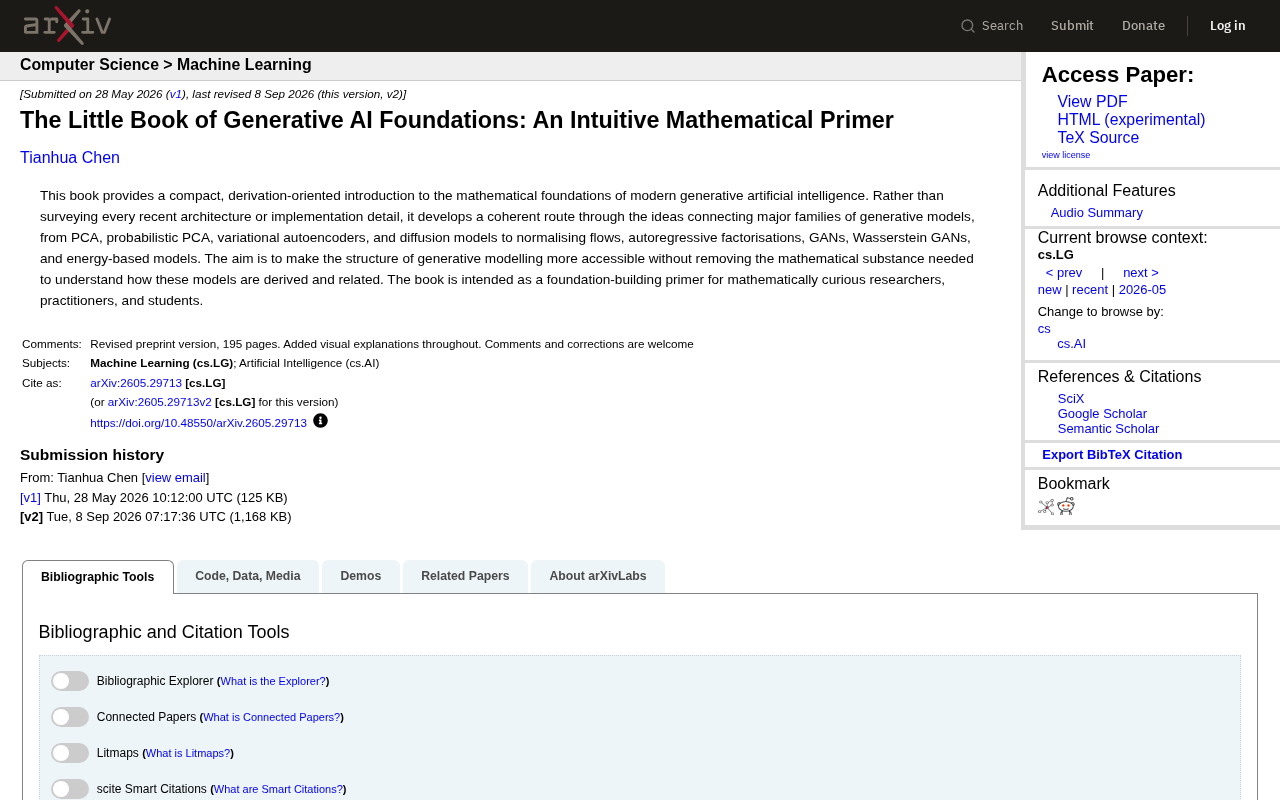
The explosion of generative AI has made many people want to understand the principles behind it, but complex mathematical formulas often become a stumbling block. Recently, The Little Book of Generative AI Foundations: An Intuitive Mathematical Primer, which sparked discussion on Hacker News, attempts to resolve this contradiction—explaining the mathematical foundations of generative AI in an intuitive way.
Why an "Intuitive Math Primer" Is Needed
AI textbooks on the market today roughly fall into two categories: one is thick theory books aimed at researchers, filled with matrix calculus and probabilistic graphical models; the other is practical guides aimed at application developers, focusing on parameter tuning and API calls while avoiding principles altogether. What is missing between the two is a bridge that allows readers with basic programming ability but limited mathematical background to understand the core mechanisms of generative models.
The positioning of this little book is precisely to fill that gap. From "Intuitive Mathematical Primer" in the title, it is clear that it does not pursue mathematical completeness but emphasizes building intuition—first letting readers understand "why it is designed this way," then supplementing with the necessary formula derivations. This approach gained attention on Hacker News, indicating that many technical practitioners have a real need for mathematical explanations that are "sufficient and easy to understand."
Core Content an Intuitive Explanation Might Cover
Although the original material does not disclose the table of contents, inferring from the foundational knowledge system of generative AI, a qualified intuitive math primer usually needs to cover several key modules:
Basic Intuition for Probability and Distributions
The essence of generative models is learning data distributions, so probability theory is an unavoidable starting point. The focus of intuitive explanation is not measure theory, but helping readers understand conditional probability, Bayesian updating, and sampling processes—concepts that directly correspond to how generative models "draw samples from a distribution."
KL divergence (Kullback-Leibler Divergence) is one of the most commonly used measures of distribution difference in generative models, but it is not a "distance" in the strict sense: it does not satisfy symmetry, that is, the KL divergence from distribution P to Q is usually not equal to the KL divergence from Q to P. Intuitively, KL(P||Q) measures "how many extra bits of information are needed on average when using Q to encode samples from P." In variational autoencoders, KL divergence is used to constrain the latent variable distribution to be close to the prior; in generative adversarial networks, it is closely related to JS divergence. Understanding the asymmetry of KL divergence helps readers understand why different generative models exhibit different tendencies such as "mode collapse" or "insufficient coverage" during training.
Neural Networks and Gradient Descent
From linear algebra to backpropagation, this part is easily written as a pile of formulas. The value of an intuitive primer lies in explaining gradient descent from a geometric perspective: imagine the loss function as terrain, and the training process as finding the lowest point in a valley. Although this metaphor is not rigorous, it helps readers build physical intuition about the optimization process.
The essence of backpropagation is an efficient implementation of the chain rule on a computational graph. Intuitive understanding can be divided into two steps: during forward propagation, the network computes outputs layer by layer and records intermediate results; during backpropagation, starting from the loss function, it computes the partial derivative of each parameter with respect to the loss by going backward through the computational graph layer by layer. The key intuition lies in "multiplying local gradients"—each layer only needs to know its own local derivative, then multiply it by the gradient passed back from upstream to obtain the final gradient. This design makes the gradient computation complexity of deep networks the same order as forward propagation, avoiding the high cost of numerical differentiation. If readers can imagine backpropagation as "error signals flowing backward through the network, with each layer sharing responsibility according to local rules," they have grasped its core.
Core Ideas of Generative Models
Whether variational autoencoders, generative adversarial networks, or diffusion models, their mathematical frameworks all involve concepts such as latent variables, KL divergence, and score matching. A little book cannot go into every detail, but it can connect these models through a unified perspective—such as "how to measure the difference between two distributions"—so that readers form an overall understanding rather than isolated memorization.
The core intuition of diffusion models can be summarized as "adding noise and denoising": the forward process gradually adds Gaussian noise to the data until the data becomes pure noise; the reverse process trains a neural network to gradually denoise starting from pure noise, ultimately generating samples. Mathematically, this is equivalent to learning the score function (i.e., the gradient of the log probability density) of the data distribution at each noise level, so diffusion models are closely related to score matching. Compared with GANs, diffusion models are more stable to train, but sampling requires multiple iterative steps and is slower. Understanding the intuition of "gradually recovering structure from noise" is the key to grasping why diffusion models can generate high-quality images.
The Trade-off Between Intuition and Rigor
This type of primer faces an inherent contradiction: oversimplification misleads readers, while excessive rigor loses readability. The name "Intuitive Mathematical Primer" hints at the author's choice—prioritizing correct intuition, and marking key points with "simplified here, see references for details."
This trade-off is usually accepted in the discussion atmosphere of Hacker News. The evaluation standard of the technical community for introductory materials is often "can it help me quickly build a mental model" rather than "is it mathematically impeccable." However, readers also need to remain vigilant: after building preliminary understanding through intuitive explanations, more rigorous textbooks are still needed to correct misunderstandings.
Who Is Suited to Read This Kind of Book
Judging from the heated discussion, the target readers roughly include several groups: developers with an engineering background but rusty math, product managers who want to understand the internal mechanisms of models, and students preparing to enter the AI field. For practitioners already familiar with the details of the Transformer architecture, the value of this book may be limited; but for those practitioners who "can use it but cannot explain why," an intuitive math primer is exactly the step to fill in the gaps.
The mathematical threshold of generative AI objectively exists, but it is not insurmountable. Attempts like The Little Book of Generative AI Foundations are meaningful in lowering the psychological barrier to entry, allowing more people to understand what models are doing before they start tuning them.
One-line Summary
The Little Book of Generative AI Foundations sparked discussion on Hacker News and is positioned as an intuitive primer on the mathematical foundations of generative AI.
Paragraph Summary
This article introduces The Little Book of Generative AI Foundations: An Intuitive Mathematical Primer, which sparked discussion on Hacker News. The book aims to fill the gap between thick theoretical textbooks and purely practical guides, explaining the mathematical foundations of generative AI in an intuitive way for technical practitioners with limited mathematical background. The article infers that its content may cover modules such as probability distributions, gradient descent, and core ideas of generative models, and discusses the trade-off between intuition and rigor: primers prioritize building mental models, and readers still need rigorous textbooks afterward to correct their understanding. Target readers include developers with an engineering background but rusty math, product managers, and introductory AI students.
Related articles

Deleted Reddit Post Sparks Debate Over AI Content Moderation
A Reddit post removed with only a 'Removed by Reddit' notice highlights AI content moderation's transparency gaps, misjudgment risks, and appeal challenges for platforms and creators.

DSH + Ollama Local LLM Deployment in Practice: Free Chat with Da Fei Yu
Bilibili creator tests DSH + Ollama local LLM deployment end to end: Ollama install, Xunlei-accelerated downloads, ModelScope GGUF model import, DSH custom API address setup, and a comparison of Qwen 3.5 4B, 8B, Gemma, and other models on 8GB VRAM, with advice on choosing local deployment vs. API calls.

Tested: A $899 Mac Mini vs. a $200/Month AI Subscription
Real-world test of whether an M4 Mac mini can replace a $200 AI subscription: 16GB can't fit large models, and both speed and quality fall short—but privacy, no caps, and near-zero running costs make it an ideal host for an always-on agent. Includes buying advice per configuration and money-saving strategies.