The Model Hosting Dilemma: Navigating Compliance, Community, and Funding
Open-source model hosting platforms face a structural dilemma between censorship resistance and professional compliance.
A Reddit discussion about alternative AI model hosting platforms exposed deep tensions in open-source weight distribution. Platforms styled after piracy culture may host entirely legal content, yet their image costs them dearly: AI labs won't publish there, and mainstream sponsors and payment processors stay away. Civitai's repeated clashes with payment processors over NSFW content illustrate the direct link between compliance and funding access. Meanwhile, professionally compliant platforms tend to get acquired or lose community energy. The emerging consensus: multi-platform redundancy and decentralized risk distribution are more realistic than expecting any single platform to serve all needs.
The distribution of open-source model weights has long been a critical topic in the AI community. A recent Reddit discussion about alternative model hosting platforms revealed a tension that has persisted in this space for years — how to strike a balance between compliance, community culture, and sustainable operations. Though it unfolded in an informal online community, the conversation touched on some genuinely sharp and real issues within the open-source model ecosystem.
It Started with "The Hugging Bay"
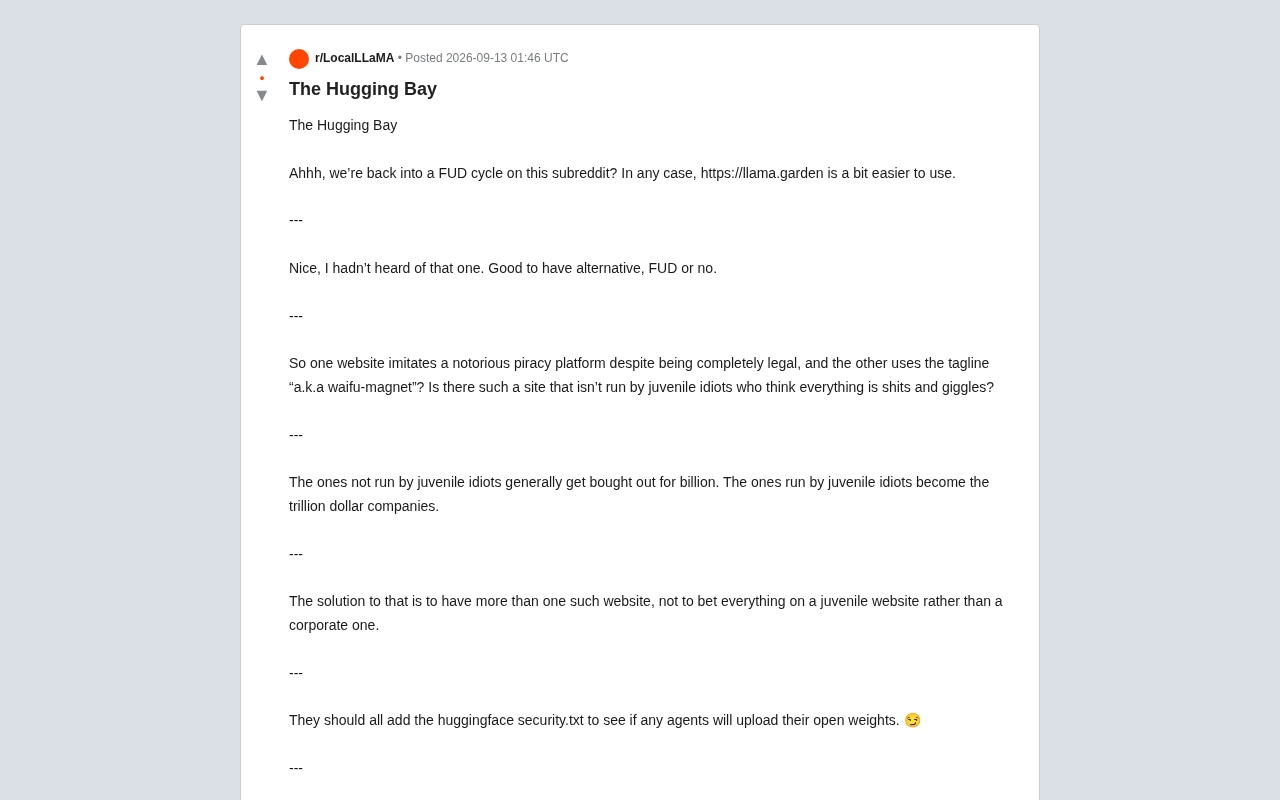
The spark for the discussion was a platform nicknamed "The Hugging Bay" — an obvious nod (or parody) to the infamous piracy site The Pirate Bay. One user promptly recommended another alternative, llama.garden, which they described as "easier to use," arguing that regardless of whether the community had fallen into yet another cycle of FUD (Fear, Uncertainty, Doubt), having more options is always a good thing.
What's interesting is that these platforms are deliberately styled after piracy culture — even though they host entirely legal open-source weights. One user was blunt in their criticism: one site imitates a notorious piracy platform, another sports a "waifu-magnet" tagline, prompting the question: "Is there not a single site that isn't run by a bunch of immature people who treat everything as a joke?"
Emotional as it was, that comment pointed to a widespread lack of professional image among open-source model distribution platforms.
The Pirate Bay was founded in 2003 and is one of the world's most well-known BitTorrent index sites. It has faced numerous lawsuits from copyright holders and blocks in various countries, yet has earned iconic status in hacker culture for its decentralized spirit and resilience against censorship. Naming or parodying a platform after it signals, within geek communities, "we're not afraid of being shut down" and "we stand for free information flow" — but to mainstream observers or institutional partners, that signal reads almost as "we deliberately flirt with the edges of legality." FUD (Fear, Uncertainty, Doubt) is a common tech community term, originally used to describe the negative messaging large companies spread to undercut competitors, later generalized to describe any perceived irrational panic — it appears frequently in open-source AI discussions, often used to question whether concerns about a platform's safety or reliability are overblown.
Immature vs. Mature: A Counterintuitive Pattern
In response to that criticism, another user offered a remarkably insightful comeback: "The platforms not run by immature people usually get acquired for billions of dollars. The ones run by immature people end up becoming trillion-dollar companies."
Half-joking as it was, the comment captures something real about the tech industry's dynamics — early-stage, unconventional, even anarchic products often have stronger community energy and viral growth potential. Serious, compliance-focused platforms are actually more likely to be acquired or marginalized in competition.
The counterargument, however, was that the real solution isn't about "betting on an immature site over a corporate one" — it's about building multiple such platforms and using redundancy to distribute risk. This is essentially a decentralization mindset: don't rely on the reliability of any single entity.
Harmless Branding, or Burning Bridges?
On whether a platform's "alternative" vibe causes real harm, the community was clearly divided.
One camp argued that as long as the branding is harmless and the user experience is solid (the discussion repeatedly affirmed these platforms' usability), tone doesn't matter.
The other camp raised more practical concerns: this kind of presentation effectively ensures that labs will never proactively publish models there — even though they might have under a more neutral image. It also makes it much harder to find sponsors to sustain operations. In other words, the cost of "playing it for laughs" may be the loss of institutional trust and funding.
Would Labs Actually Show Up?
At its core, the debate came down to one key question: would AI labs actually release weights on platforms like these?
One user offered a clear "no," backed by a well-reasoned argument:
- Labs would never publish there in the first place;
- There are already plenty of compliant, open platforms willing to host weights (such as Hugging Face and other mainstream platforms);
- These "maverick" sites exist precisely to resist censorship from corporate or legal authorities — that's their reason for being;
- And the people willing to fund these platforms are typically those who genuinely care about these issues, with heavy overlap with piracy culture or anime/2D communities.
The discussion also referenced a real-world case: Civitai (referred to as "the civit way") was forced to change its infrastructure after being unable to secure funding for NSFW content. This confirmed the direct link between compliance and capital — once content touches gray areas, mainstream payment and financing channels close up.
One user half-jokingly suggested that all these platforms should add Hugging Face's security.txt file to "see if some AI agent would automatically upload their open-source weights" — a joke that nonetheless hinted at a technical vision of automated crawling and weight propagation.
Civitai is a community platform focused on distributing Stable Diffusion and other image generation model weights, including LoRAs and fine-tuned variants. It has been highly influential in the AI creative community due to its allowance for NSFW (Not Safe For Work, i.e., adult-oriented) content uploads. Between 2023 and 2024, Civitai repeatedly had payment processors (such as Stripe) terminate their relationships with it for violating terms of service, forcing the platform to seek alternative payment channels and adjust its content policies. This case directly illustrates the strong link between "content latitude" and "infrastructure accessibility": even if a platform hosts no pirated content whatsoever, involvement in adult or fringe content is enough to be marginalized by mainstream financial and cloud service ecosystems. This risk of "de-platforming" is a hard constraint that all non-mainstream model hosting platforms must confront in their planning.
The Structural Contradiction Is Unavoidable
Peel back the community venting, and this discussion touches on a structural contradiction in open-source model distribution:
Platforms that pursue censorship resistance and free distribution will naturally attract fringe content and niche cultures, thereby losing favor with mainstream institutions and funders. Platforms that pursue professional compliance, meanwhile, struggle to win on vitality and differentiation. Each path involves trade-offs; having it both ways is difficult.
For developers and researchers who follow the open-source ecosystem, this means the model distribution landscape will likely remain in a state of "multi-platform coexistence" for the foreseeable future — mainstream platforms handle institutional releases, while alternative platforms serve specific community needs. Expecting any single platform to serve all needs is neither realistic nor necessarily aligned with the spirit of decentralization.
This contradiction is known in academia as the "compliance dilemma" or the "double-edged sword" of content moderation, and has been well documented in platform economics research. Decentralized protocols (such as IPFS and BitTorrent) were once seen as a way to technically sidestep this contradiction — data stored in a distributed fashion with no single node that can be taken down — but in practice they face challenges including low retrieval efficiency, poor user experience, and cold-start difficulties, and have never achieved meaningful scale in the AI weights distribution space. Hugging Face is currently the de facto mainstream weight hosting hub; its business model relies on enterprise subscriptions and private model hosting, which means it must answer to capital markets on content policy — a fundamental departure from the positioning of "censorship-resistant" platforms. The two types of platforms serve different needs and are not simply in competition; rather, they represent functionally complementary tiers of an ecosystem.
Related articles

Spotit: Turn Every Mac App into a Real-Time Interactive Tutorial
Spotit is an AI-powered interactive tutorial tool for Mac. Press a shortcut, ask in plain language, and it highlights exactly where to click next — guiding you through any Mac app as you learn by doing.
OpenCode: The Open-Source Coding Agent That Hit 150K GitHub Stars
OpenCode is an open-source TypeScript coding agent with 150K+ GitHub stars. Learn about its features, advantages, and use cases for AI-powered development.

Learning AI Agent Development from Scratch: An Open-Source Tutorial Worth Bookmarking
Haozhe-Xing/agent_learning is a systematic, hands-on open-source tutorial for learning AI Agent development from scratch, with daily arXiv paper tracking built in.