The Most Complete Agent Development Course on Bilibili: From Zero to Hands-On in Seven Days

A 748-episode Agent course in three chapters—Cognition, Advanced, Hands-On—solving the pain points of concept-only or code-only tutorials.
The article introduces a 748-episode Agent systematic course that addresses the problem of over 90% of tutorials only stacking concepts or throwing code, proposing a 'cognition first, then hands-on' learning path. It covers ReAct, LangChain, AutoGen, Function Calling, and three enterprise projects. Suitable for beginners and developers who haven't completed projects, but the volume requires significant time.
Why Do Most Agent Tutorials Teach You Nothing?
After scouring Agent-related content across Bilibili and YouTube, the author of this course discovered an awkward reality: over 90% of tutorials either pile up big words like "autonomous planning" and "tool calling," or they just throw code at you and tell you to call an API. As for what problems Agents actually solve and how they think—nobody explains that clearly.

This disconnect is exactly why so many beginners get stuck at the door—they've heard a pile of concepts, but when asked to design a usable agent, they have no idea where to start. This systematic course, totaling 748 episodes, tries to break through with a different approach: first understand how Agents think, then build one from scratch by hand. The author claims to have spent four months deconstructing core knowledge points, referencing technical blogs and GitHub open-source projects, and ultimately reorganizing the content into three chapters: Cognition, Advanced, and Hands-On.
Cognition Chapter: Build Foundational Understanding First, Then Touch Code
The first part of the course deliberately slows the pace to answer a basic but critical question: what exactly is the difference between an Agent and a large model conversation?
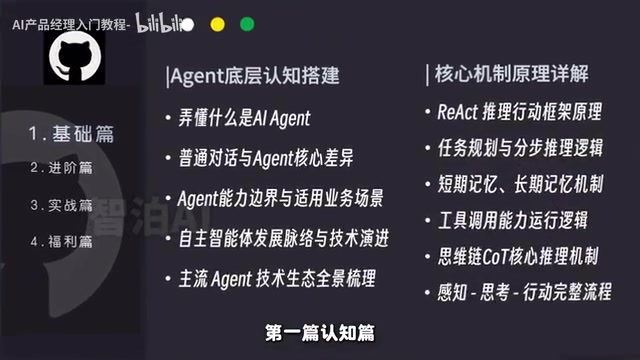
Around this question, the course breaks down concepts like the ReAct framework, planning and reasoning, and memory mechanisms, using everyday analogies instead of bombarding you with jargon. For zero-foundation learners, the value of this approach is—first understand "why agents can get work done," then write your first line of code. The Cognition chapter's endpoint is getting an Agent demo running, giving learners an intuitive feel before they start hands-on work, rather than imagining things from documentation alone.
The ReAct framework is one of the most fundamental reasoning paradigms in the Agent field, short for Reasoning and Acting. Its core idea is to have the large model alternate between "thinking" and "acting": first output a reasoning step (Thought) to decide what to do next; then execute an action (Action), such as calling a search tool or querying a database; then observe the result returned by the action (Observation), and continue reasoning based on the new information. This "Thought-Action-Observation" loop lets the model dynamically adjust its strategy rather than giving an answer all at once. ReAct's value lies in combining the large model's reasoning ability with the execution capability of external tools, enabling Agents to handle complex tasks that require multi-step information retrieval and decision-making. It is also the design foundation for many subsequent Agent frameworks.
Advanced Chapter: Framework Practice and Multi-Agent Collaboration
Entering the second chapter, the course intensity rises noticeably, covering the current mainstream tech stack for Agent development:
- LangChain and AutoGen framework practice: the transition from single Agent to multi-Agent collaboration
- Function Calling tool invocation: enabling models to truly interact with external systems
- ReAct and Agent hybrid architecture: understanding the applicable scenarios of different architectural patterns
- Evaluation, debugging, and security boundaries: easily overlooked in tutorials but unavoidable in engineering
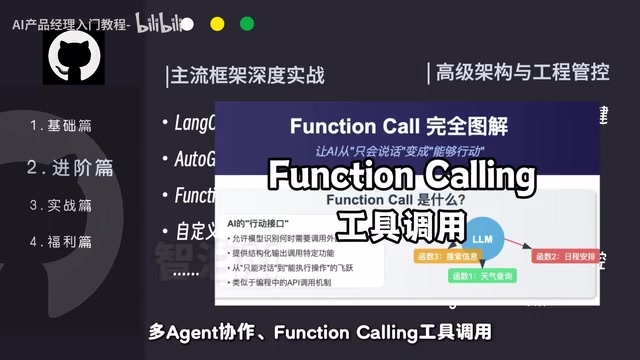
A feature of this chapter is that each section comes with code and courseware, and the author explicitly states "everything is packaged for you, don't worry about falling behind." From a teaching design perspective, this is equivalent to binding "reading concepts" and "running code" together, preventing the intuition built in the Cognition chapter from quickly eroding in the face of complex frameworks. Multi-Agent collaboration is the highlight of the Advanced chapter, and also the threshold that must be crossed when current Agent applications move from demo to production environments.
Function Calling is the key mechanism for large models to interact with external systems. Simply put, developers can predefine a set of functions (such as querying weather, sending emails, operating databases) and describe the names, parameters, and purposes of these functions to the model. When a user makes a request, the model determines whether a function needs to be called and generates a call request that conforms to the parameter format, which is actually executed by external code and the result returned to the model. Function Calling frees Agents from being limited to text generation, enabling them to truly "take action" and operate external services. It is the foundational capability for implementing tool invocation, API integration, and automated workflows. Understanding how it works is an important step from "chatbot" to "agent."
Hands-On Chapter: Three Enterprise-Level Projects Implemented
The third chapter directly targets business scenarios, arranging projects in three directions:
- Intelligent customer service Agent system: from intent recognition to automatic ticket routing
- Automated data analysis Agent: automatically generate reports and charts after uploading Excel
- Multi-Agent collaborative production line: let multiple agents divide work and collaborate like a team
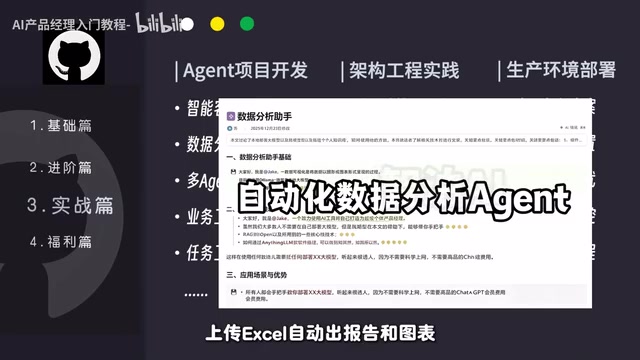
The choice of these three projects is quite deliberate—intelligent customer service corresponds to high-frequency interaction scenarios, data analysis corresponds to office automation needs, and multi-Agent collaboration points to more complex process orchestration. After completing this content, the goal is not just to "understand Agent principles," but to be able to independently design agent applications that solve real business problems. For learners looking to transition into Agent development, this project-driven conclusion is more convincing than simply grinding through framework documentation.
Multi-Agent collaboration refers to multiple agents, each with specific roles and capabilities, working together to complete complex tasks through message passing, task allocation, and result aggregation. Common collaboration patterns include: a coordinator Agent responsible for decomposing tasks and distributing them to multiple executor Agents, or multiple Agents engaging in equal dialogue and voting on decisions. The advantage of this architecture is clear division of labor and strong scalability, suitable for handling long processes or multi-domain problems that a single Agent struggles to cover. But it also brings new challenges, such as communication overhead, task conflicts, and global state management. In enterprise applications, multi-Agent collaboration is commonly used in scenarios like customer service ticket routing and cross-department process automation, and is a design pattern that must be mastered when moving from demo to production.
Who This Course Is For, and Who It Isn't
Judging from the course structure, it is best suited for two types of people: first, beginners who have never been exposed to Agent development and need a clear path; second, developers who have watched scattered tutorials but never completed a full project. The everyday analogies in the Cognition chapter lower the entry barrier, while the code support in the Advanced chapter and the project loop in the Hands-On chapter provide verifiable learning outcomes.
It should be noted that the 748-episode volume means this is a systematic course that requires time investment. "From novice to master in seven days" is more of a promotional pitch. The real value lies in its attempt to solve a common pain point: pulling Agent development back from concept stacking to hands-on, implementable engineering practice. If you are looking for a complete learning path from cognition to project, this course's structure is worth referencing; if you only want quick-fix tips, you may be disappointed.
One-line Summary
A 748-episode Agent systematic course, structured into Cognition, Advanced, and Hands-On chapters to address the pain points of tutorials that only discuss concepts or throw code at you.
Paragraph Summary
The article introduces a 748-episode Agent systematic course that addresses the problem of over 90% of current tutorials only stacking concepts or directly throwing code, proposing a learning path of "build cognition first, then get hands-on." The course is divided into three chapters: the Cognition chapter uses everyday analogies to explain fundamentals like ReAct, planning and reasoning, and memory mechanisms, and gets a demo running; the Advanced chapter covers LangChain, AutoGen multi-Agent collaboration, Function Calling, and ReAct hybrid architecture, with code and courseware for each section; the Hands-On chapter forms a loop through three enterprise-level projects: intelligent customer service, automated data analysis, and a multi-Agent collaborative production line. The article believes the course is suitable for zero-foundation beginners and developers who have watched scattered tutorials but haven't completed projects, but the 748-episode volume requires significant time investment, and "from novice to master in seven days" is just a promotional pitch.
Related articles

RePlan-VLA: Progress-Aware Replanning Breakthrough for Long-Horizon Robotic Manipulation
The RePlan-VLA framework converts VLA models' short-horizon capabilities into reliable long-horizon execution through progress-aware adaptive replanning, improving success rates by 21.9% and 10.4% on RoboCasa365 and CALVIN, and validating real-world deployment on a Franka Research 3 robot.

Geometric Bridge Flow Matching: A New Breakthrough in Blind Rigid Motion Correction
Geometric bridge flow matching enables blind rigid motion correction in head CBCT, achieving 37.1 dB PSNR and 0.27 mm RPE on simulated data in ~9.1 minutes, outperforming existing methods.

Google Releases Gemini 4 Hydrogen: 2.5x Faster Without Sacrificing Intelligence
Google releases the lightweight Gemini 4 Hydrogen: 2.5x faster task completion, AA Intelligence Index of 54 beating its flagship sibling, 7.3s single-step on Agent Arena faster than Claude and GPT rivals, four thinking levels with pay-as-you-need pricing, now available across AI Studio and more.