The Mystery of Scattered Human Bones at Göbekli Tepe: A New Theory on 12,000-Year-Old Burial Rituals
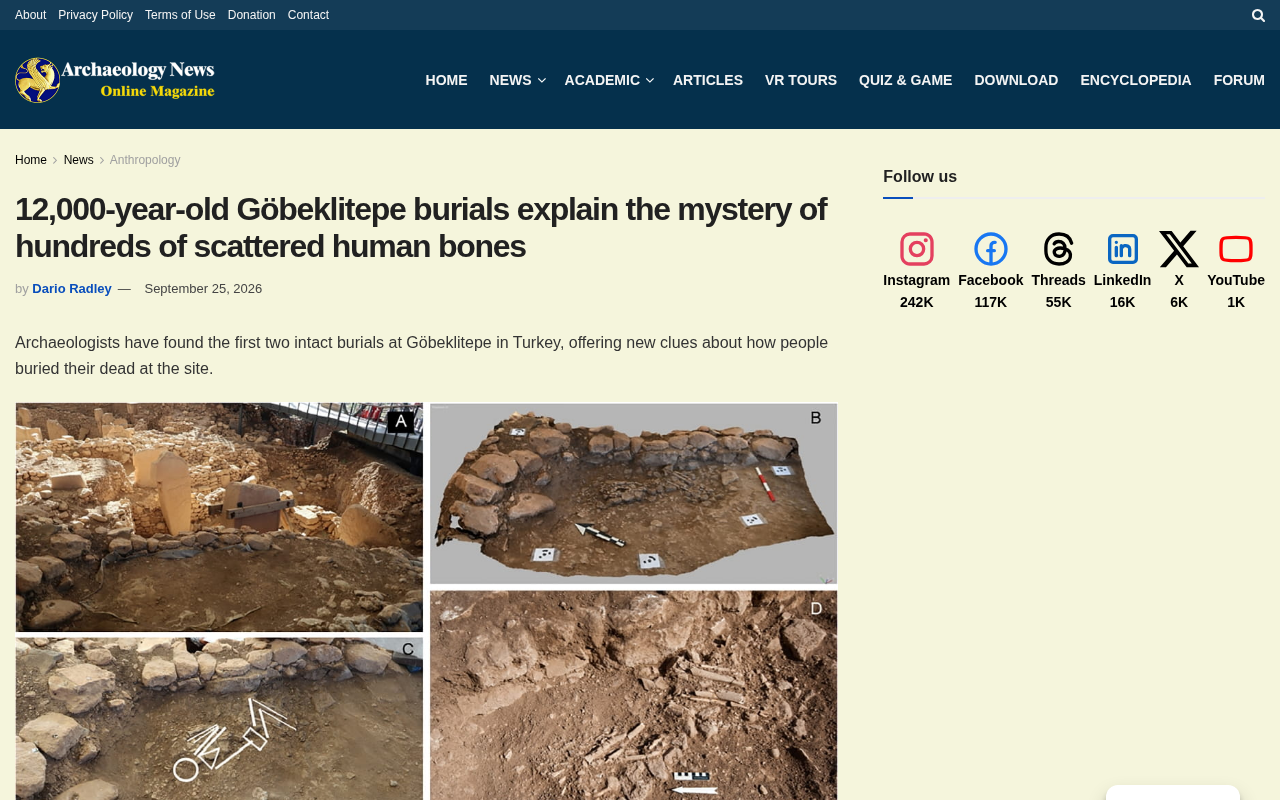
Scattered bones at Göbekli Tepe may stem from systematic secondary burial rituals predating agriculture.
Göbekli Tepe, a roughly 12,000-year-old ceremonial complex in Turkey, predates agriculture and challenges conventional ideas about civilization's origins. Its scattered human bones have long puzzled researchers, but new burial studies suggest they may reflect secondary burial practices — a staged ritual process of collecting and repositioning bones after soft tissue decomposition. This reframes a seemingly disordered find within a structured social behavior, shedding light on early human funerary beliefs and supporting the idea that spiritual ritual drove early organized human activity.
The archaeological debate surrounding Göbekli Tepe in Turkey shows no signs of slowing down. This massive stone monument, believed to be approximately 12,000 years old, has long sparked speculation due to human bones scattered throughout the site. A recent study attempts to explain these scattered remains, pointing toward complex funerary practices among early humans.
It's worth noting that the original source for this article comes from a Hacker News link submission with limited information (just a headline and minimal community discussion). The following content faithfully represents that lead while drawing on publicly available archaeological context, offering readers a sense of the topic's significance and the directions the discussion might take.
Why Göbekli Tepe Matters
Located in southeastern Turkey, Göbekli Tepe is widely regarded as one of the oldest known large-scale religious or ceremonial complexes in human history. Its construction predates the widespread adoption of agriculture and the establishment of settled villages — a fact that has long challenged the conventional view that large-scale cooperative building required an agricultural, sedentary society to come first.
The T-shaped stone pillars, animal reliefs, and scattered human bones found at the site have become key materials for studying the early human spiritual world. The scattered — rather than formally interred — human bones have drawn sustained scholarly attention: are these the result of natural disturbance, or evidence of some intentional ritual practice?
The T-shaped pillars at Göbekli Tepe are the site's most recognizable feature, ranging from 3 to 6 meters in height and weighing up to several dozen tons. These pillars are far from plain — they are carved with reliefs of foxes, snakes, vultures, scorpions, and other animals, and some bear humanoid arms and belts, suggesting they may represent anthropomorphized deities or ancestral figures. Transporting and erecting these pillars required large-scale coordination, and with no domesticated draft animals available at the time, the builders must have relied on a highly organized social structure and division of labor. German archaeologist Klaus Schmidt, who led excavations from 1994 until his death in 2014, classified the site as "the world's first temple" — though this interpretation remains contested. Some scholars argue the site's function may have been more multifaceted, serving as a combined venue for feasting, gathering, and ritual.
A New Explanation for the Scattered Bones
Based on the direction indicated by the report's headline, the latest burial research offers an interpretive framework for the scattered bones. In such archaeological findings, incomplete and dispersed skeletal remains do not necessarily mean the bodies were discarded carelessly — they may instead reflect a tradition of "secondary burial" or staged body processing.
Secondary burial refers to a practice in which, after an individual's death, the body undergoes initial processing, and once the soft tissue has decomposed, the bones are collected, treated, and reinterred or repositioned. This type of custom was not uncommon in prehistoric societies, and it often accompanied commemoration of ancestors, veneration of specific individuals, or ritual activities tied to group identity.
If the scattered human bones at Göbekli Tepe do indeed stem from this kind of systematic funerary behavior, it further reinforces the view that the site was not merely an architectural wonder, but a place where complex social and spiritual practices were carried out.
Secondary burial as a mortuary institution has been widely documented in prehistoric cultures around the world. Its core logic divides death into two phases: the first deals with the "wet" body (containing soft tissue), and the second with the "dry" skeleton. Early 20th-century French anthropologist Robert Hertz, in his study of the Dayak people of Borneo, interpreted this process as a symbolic journey in which the soul transitions from a "dangerous state" to a "safe state." Evidence of secondary burial in the Neolithic Near East is not uncommon — at Çatalhöyük, for instance, traces have been found of bones being repeatedly moved beneath building foundations. During secondary processing, bones may have been coated in ochre, engraved, or placed alongside specific objects — practices that themselves constitute material evidence of ritual behavior, providing archaeologists with crucial clues for reconstructing the spiritual world of early humans.
Why This Finding Deserves Attention
Providing a coherent explanation for scattered human bones matters because it brings an apparently "disordered" archaeological phenomenon back into an "ordered" framework of social behavior. This helps researchers reconstruct early human funerary concepts, social structures, and belief systems.
From a broader perspective, the evidence that Göbekli Tepe continues to yield is rewriting our understanding of the sequence in which civilization emerged. Ritual spaces and collective activities may have preceded agriculture and cities, suggesting that human spiritual needs played an earlier and more active role in the civilizational process than previously thought.
A Note on Sources
This article was prompted by a post shared on the Hacker News community (15 upvotes, 1 comment) — a tech and science enthusiast community passing along coverage of cutting-edge archaeological research. Since the original source does not provide details about the research institution, publishing journal, or specific data, readers who wish to explore further are encouraged to consult the original academic papers and reports from authoritative archaeological organizations for rigorous, first-hand information.
For readers interested in the intersection of technology and human civilization, Göbekli Tepe remains an invaluable window — a reminder that understanding "where we came from" is itself an ever-evolving inquiry.
Related articles

Perplexity Hybrid Compute Tested: Privacy Data Never Leaves the Mac
Perplexity Hybrid Compute tested: how PrivacyGate intercepts sensitive data, how local and cloud models divide work, model differences on 16GB vs 32GB Macs, and privacy protection in real scenarios like bank statements and medical records.

Big Fat Fish Roasts Mainstream LLMs at Home and Abroad: Doubao Takes the Crown, DeepSeek Tied for First
Bilibili creator Big Fat Fish roasts mainstream LLMs: Doubao tops for emotional value, DeepSeek ties first for open-source value, with ERNIE, Hailuo, Yuanbao, Kimi, Qwen, Kling, Claude, Gemini, and Grok each branded with a distinct persona.

How to Truly Test AI Agents Before Production? A Practical Testing and Monitoring Framework
BotGage founder Pramin Pradeep shares a three-step framework for testing AI Agents before production: Agent registration visibility, red teaming, and production observability — plus a real case cutting QA costs from $180K to $80K and an analysis of IT roles shifting to Agent supervisors.