The New Bar for AI/LLM Roles: A Practical Guide to Agent Observability and Evaluation
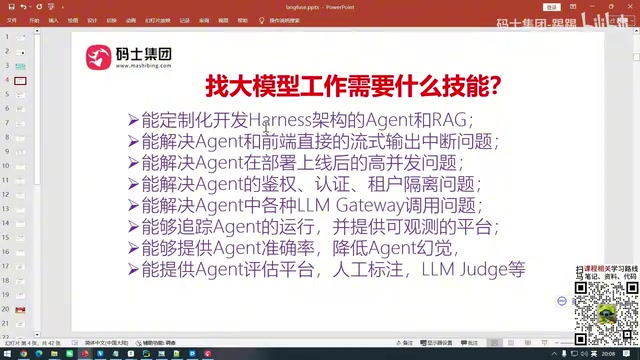
Master 8 engineering competencies — from LLM gateways to Langfuse observability — to land enterprise AI Agent roles.
Landing an enterprise AI/LLM role today requires far more than knowing how to use tools. Companies now test for a full engineering stack: streaming output recovery, high-concurrency design, multi-tenant isolation, LLM gateway configuration, and — most critically — Agent observability with Langfuse and systematic evaluation using LLM-as-a-Judge. This guide breaks down all eight must-have competencies.
The Capability Bar for AI/LLM Roles Is Rising
If you're looking for a job in AI and large language models, you might still hold a common misconception: that knowing how to use LLM tools is enough. But based on recent interview feedback from top-tier companies (like Alibaba and other major tech firms), the technical bar has clearly risen significantly.
According to analysis from Mashibing AI's public LLM course on Bilibili, landing an LLM-focused role today requires more than just "using" tools — you need to be able to custom-develop Agents or RAG systems tailored to real business needs. Beyond that, a set of engineering and productionization skills are becoming high-frequency interview topics.

Eight Core Competencies for Agent Roles
Around the Agent direction, companies broadly assess the following engineering and delivery capabilities. Together, these form the dividing line between "being able to call a model" and "being able to ship an enterprise-grade product."
1. Interruption Recovery for Streaming Output
Today, virtually all LLMs and Agents use streaming output. Streaming is implemented via Server-Sent Events (SSE) or WebSocket protocols, allowing the model to generate content token by token and push it to the client in real time, rather than waiting for a complete response before returning — this dramatically improves perceived latency, but also introduces complexity around session state management.
The "interruption problem" refers to this scenario: if a user closes the page or loses their network connection mid-conversation, the streaming output stops — but the entire conversation session must be fully preserved. Session persistence typically relies on in-memory databases like Redis to store intermediate state, paired with a persistent layer (e.g., PostgreSQL) to save the full history, ensuring the ability to resume from a breakpoint after a network interruption.
For example, if you ask DeepSeekAd "What is machine learning?" and close the browser mid-stream, your complete conversation history should still be there when you reopen it. The session content must never disappear just because the stream was interrupted — this is a fundamental requirement for continuity of user experience.

2. High-Concurrency Throughput
Once an Agent is deployed, whether it can handle high concurrency is one of the top concerns for enterprises. Interviewers often ask: how do you achieve 500 to 1,000 concurrent users? How do you break through 5,000+?
Achieving thousands of concurrent users typically requires combining async I/O frameworks (e.g., Python's asyncio/FastAPI), message queues (Kafka, RabbitMQ), and connection pooling. Tens of thousands of concurrent users often involve horizontal scaling, load balancing (Nginx/Envoy), and Kubernetes-based autoscaling. Since LLM inference is itself a compute-intensive operation, concurrency design also needs to account for efficient GPU resource scheduling and queuing strategies — all of which tests your depth in system architecture, async processing, and resource orchestration.
3. Multi-Tenancy and Data Isolation
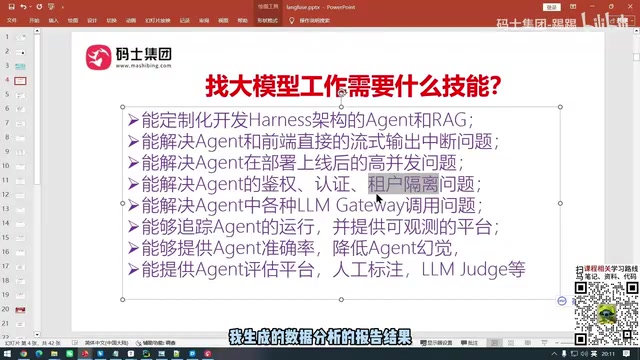
"Multi-tenant isolation" is critical for enterprise deployments. When two users are using the same Agent simultaneously, the data environment must be strictly isolated — especially data isolation and file isolation.
There are three main approaches to multi-tenant architecture: separate databases (strong isolation), shared database with separate schemas, and shared schema with row-level isolation (using a tenant_id field). In AI Agent scenarios, beyond database isolation, you also need to isolate the file system (via object storage bucket prefixes or separate buckets), in-memory state, and tool-call context.
For instance, if a user generates a data analysis report or temporary file through an Agent, another user must absolutely not be able to access that data. Each user's runtime environment must be completely independent and mutually isolated. This is something many developers have overlooked in past practice, yet it's now an important new exam topic in interviews.
The LLM Gateway: Key to Stable Model Invocations
A deployed Agent simply cannot afford frequent downtime. And one major source of instability is the model invocation itself.
Take online models like DeepSeek or Moonshot's Kimi (K2) as examples — these services often have constrained compute resources and are prone to rate limiting. This means your Agent may encounter response timeouts when calling these models — sometimes waiting one, two, or even three minutes without getting a result back.
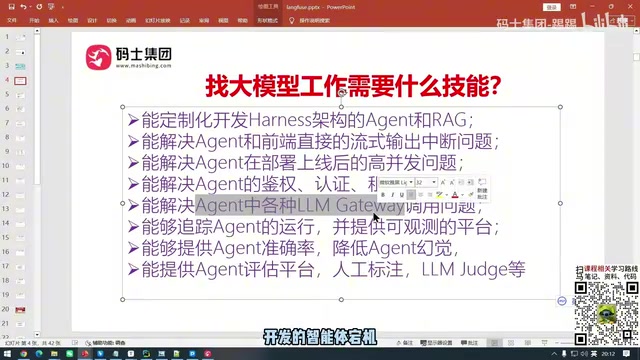
You can't let the Agent sit there waiting indefinitely, and you definitely can't let it crash as a result. This is where a dedicated LLM Gateway is needed to coordinate model calls. An LLM Gateway is similar to an API gateway in microservice architectures, but designed specifically for LLM invocation scenarios. Popular open-source solutions include LiteLLM and PortKey, with core features covering: multi-model routing and failover, rate limiting and circuit breaking, request retries, cost tracking, and load balancing. Through a unified abstraction layer, developers can call models from OpenAI, Anthropic, DeepSeek, and other vendors using the same interface, achieving vendor agnosticism — when a model times out or becomes unavailable, the gateway automatically switches to a fallback model, ensuring high service availability while reducing dependence on any single vendor's compute.
Tracing, Observability, and Evaluation: The "Last Mile" of Engineering Delivery
Building on the capabilities above, three additional skills are becoming the most heavily weighted in interviews — and are indispensable components of a quality assurance system for enterprise-grade Agent deployments.
Tracing and Observability
An Agent's execution process is often a "black box": multi-turn conversations, multiple tool calls, and multiple model requests are all interleaved. Being able to trace the complete execution chain of an Agent and provide an observability platform is essential for quickly identifying the root cause when problems arise.
Observability originates from distributed systems engineering and encompasses three pillars: Logs, Metrics, and Traces. In LLM applications, the OpenTelemetry standard is being progressively adopted. Langfuse, as an open-source observability platform purpose-built for LLMs, can automatically capture the Agent's complete call chain (Spans/Traces), recording the inputs, outputs, latency, token consumption, and cost of every step. It fully visualizes the Agent's execution trajectory and supports online evaluation scoring — making it one of the mainstream tool choices for enterprise-grade Agent monitoring, and a core instrument for engineering teams to diagnose issues and drive continuous optimization.
Improving Accuracy and Reducing Hallucinations
Enterprise applications demand extremely high reliability. How to improve an Agent's accuracy and reduce hallucinations is a core metric that determines whether a product can truly be deployed in production. This requires a combination of prompt engineering, retrieval-augmented generation (RAG), output validation, and other multi-faceted optimization strategies.
Evaluation Platforms: Human Annotation + LLM-as-a-Judge
Finally, you need to be able to build an evaluation platform for Agents, combining human annotation and LLM-as-a-Judge to systematically assess output quality.
LLM-as-a-Judge is a paradigm where a powerful language model (such as GPT-4 or Claude) is used to automatically evaluate the outputs of another system. Research from institutions like Stanford has validated its strong correlation with human evaluation. Common evaluation dimensions include: accuracy, relevance, faithfulness (in RAG scenarios), and safety. In practice, LLM-based automated evaluation is typically combined with small-scale human annotation to build a continuous evaluation pipeline, providing quantitative evidence for model version iteration and prompt optimization. Only by establishing a measurable evaluation framework can a team continuously iterate and quantify improvements.
Summary: From "Knowing the Tools" to "Delivering the Product"
Taken together, the capability requirements for LLM roles have evolved from simply "knowing how to use tools" into a comprehensive set of engineering and delivery skills:
- Frontend interaction layer: Interruption recovery for streaming output
- Performance and architecture layer: High-concurrency throughput, multi-tenant data isolation
- Stability layer: Fault-tolerant failover via LLM gateway
- Quality assurance layer: Tracing and observability, accuracy improvement, evaluation platform development
Among these, tracing, observability, and evaluation are currently the hottest topics interviewers are probing. For job seekers, hands-on experience with tools like Langfuse, familiarity with gateway solutions like LiteLLM and their configuration, and a solid understanding of the complete technical stack for enterprise-grade Agent deployment will be the keys to standing out.
Competition for AI/LLM roles is rapidly shifting from "Prompt players" to "engineering delivery experts" — are you ready?
Key Takeaways
Related articles

Is the AI Black Box Actually Transparent? Interpretability Research Upends Conventional Wisdom
Goodfire's research "Neural Networks Are Already Clean" challenges the AI black box myth: polysemanticity may be an illusion from visualization tools and the SwiGLU double-negative flaw. Neural networks self-organize via recursive generalization and are inherently readable. This deep dive explores implications for AI interpretability and alignment.

Automate Job Search with AI Agents and Residential Proxies for Precise Matching
Build an AI Agent with MCP and residential proxies to bypass recruitment site anti-scraping and geo-restrictions, scrape thousands of DevOps jobs, then have Claude score and rank each against your resume. Includes proxy comparison experiments, project structure, and cost analysis—filtering only, no auto-submission.

The AI Task Assistant That Knows When to Back Off: A Cure for Activation Struggles
One Small Step is an AI assistant for task initiation struggles, using agentic decisions for guilt-free reminders, timely retreat, and cross-platform task management. The developer shares real test results on 13 tasks and architectural trade-offs.