The New Frontline of AI Competition: Output per Dollar Becomes the Decisive Factor
AI competition is shifting from parameter scale to effective output per dollar, with efficiency optimization becoming a source of differentiation.
The article notes that as the marginal returns of the large-model parameter race diminish, the industry is focusing on "how much effective output can be obtained per dollar." An AI company argues economics is the true frontier and advances on three layers: FLOPs-efficient pretraining to lower capability acquisition costs, long-horizon RL (Rocket) to raise the reasoning ceiling within controllable costs, and seven token-efficient MAI models released within a week to cut inference overhead. Building models and products together creates a closed loop, while remaining open to frontier models keeps the economic advantage from being tied to a single technical route. Cost structure and engineering efficiency will become sources of differentiation, but the "output per dollar" standard remains ununified.
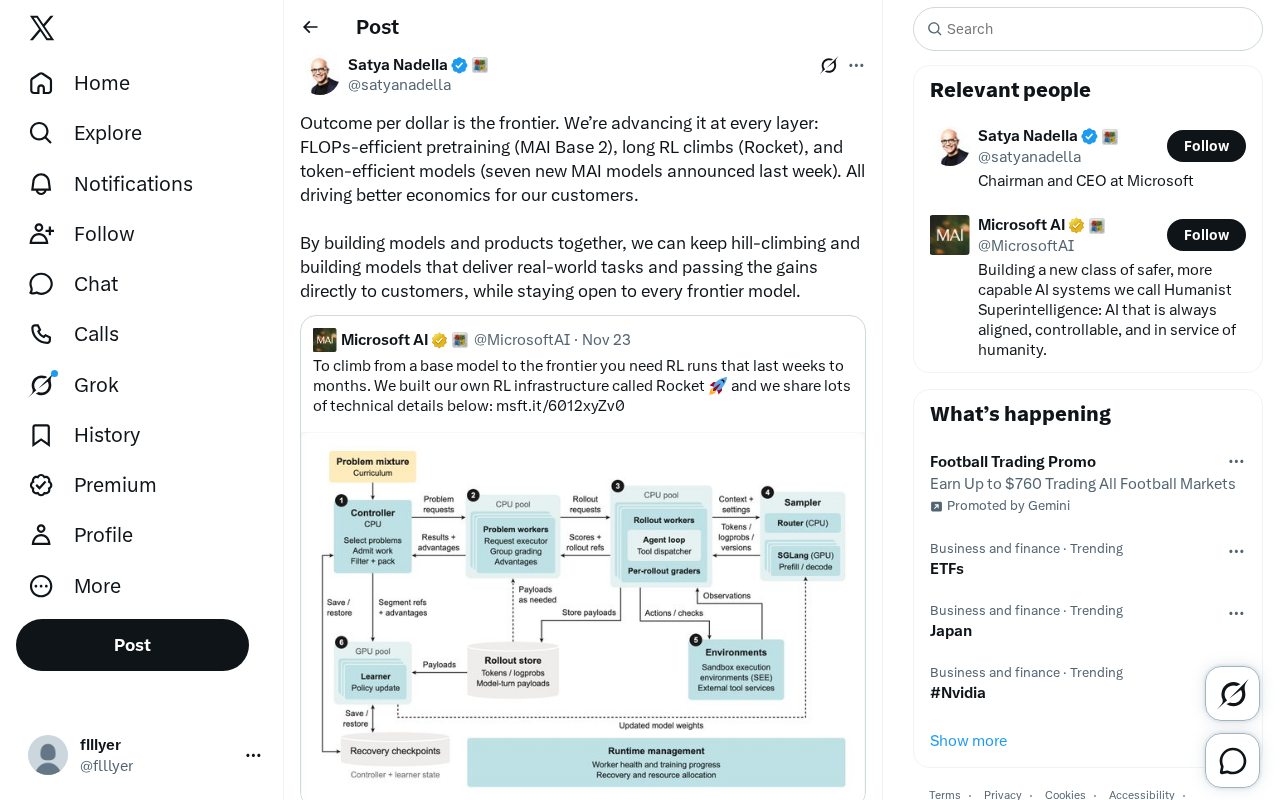
When the parameter race in large models gradually hits the ceiling of diminishing marginal returns, the industry is turning its attention to a more pragmatic metric: outcome per dollar. Recently, an AI company explicitly stated on its official account that this economic metric is the true frontier, and demonstrated its approach of advancing simultaneously across three layers: pretraining, reinforcement learning, and model efficiency.
From Compute Worship to Economic Priority
Over the past two years, improvements in model capabilities have largely relied on stacking FLOPs, but the high costs of training and inference have led enterprise customers to re-examine their return on investment. The team's core judgment is that true competitiveness lies not in single-evaluation scores, but in how many real task outcomes can be delivered per unit of cost. This perspective pulls AI development away from the pure "bigger and stronger" track back toward "cheaper and more practical."
One detail worth noting: they emphasize that this economic optimization is not a compromise that sacrifices capability, but rather an improvement in architecture and training methods that makes every unit of compute generate higher returns.
FLOPs (floating-point operations) is a common unit for measuring the computational volume of neural network training and inference, often used to approximate model scale and compute consumption. What the industry calls "stacking FLOPs" refers to improving capabilities by increasing parameter count, data volume, and training steps, underpinned by the empirical Scaling Law: loss decreases as a power law with compute. But the marginal returns of scaling laws diminish, and the absolute costs of training and inference rise with scale, making the cost-effectiveness of simply adding FLOPs decline. Therefore, "FLOPs efficiency" focuses not on how much compute is used, but on how much capability improvement is gained per unit of compute, typically measured by loss or evaluation performance under the same compute budget.
Efficiency Advancement Across Three Layers
FLOPs-Efficient Pretraining
According to their disclosure, the new-generation foundation model MAI Base 2 significantly improved FLOPs efficiency during pretraining. This means that under the same compute budget, the model can achieve a stronger capability foundation; conversely, the computational resources needed to reach equivalent capability are substantially reduced. For enterprises that need to iterate models frequently, this directly translates into a lower R&D barrier.
Long-Horizon Reinforcement Learning Climb
In the reinforcement learning direction, they advanced a long-horizon RL training effort codenamed Rocket. Long RL climbs are generally believed to bring sustained improvements in reasoning capability, but training costs are extremely high. Making this process more economical means that model performance on complex reasoning tasks can be continuously optimized within controllable costs, rather than becoming unsustainable after a one-time investment.
Long-horizon reinforcement learning refers to training models with reinforcement learning on tasks that require multi-step reasoning, tool use, or long-chain decision-making, where credit assignment spans a longer time horizon. Compared with short-horizon RL, it can train models to maintain coherent intermediate steps in complex reasoning, and is therefore considered helpful for raising the ceiling of reasoning capability. The cost is training instability, low sample efficiency, the need for large amounts of rollouts and verification signals, and compute overhead far higher than supervised fine-tuning. The industry often uses "hill-climbing" to describe this process of continuous iteration and gradual approach to better policies. Making long RL economical hinges on increasing the information content of each rollout, reducing verification costs, and designing more efficient sampling and rewards.
Token-Efficient Model Matrix
Just a week earlier, the team released seven new MAI models at once, focused on token efficiency. Token efficiency directly affects inference costs—given comparable output quality, consuming fewer tokens means lower cost per call. For high-frequency product scenarios, these savings amplify into a considerable cost advantage at scale.
The three layers work together: pretraining lowers the cost of acquiring capability, long RL raises the reasoning ceiling, and token efficiency reduces everyday usage overhead.
Token efficiency measures the ratio of tokens consumed to output quality when a model completes the same task. Since mainstream APIs bill by input and output tokens, token efficiency directly determines per-call cost; in high-frequency, long-context, or multi-turn agent interaction scenarios, redundant tokens are amplified into significant overhead. Common ways to improve token efficiency include more compact output formats, better instruction following to reduce repeated clarification, and adaptive compute allocation during inference. It is worth noting that token efficiency and "output per dollar" are not fully equivalent: fewer tokens but lower quality can actually push up the cost per unit of effective output.
The Closed-Loop Logic of Building Models and Products Together
The team specifically mentioned that building models and products together is the key to their ability to continuously "hill-climb." Building only models easily becomes disconnected from real tasks, while building only products is constrained by underlying capabilities. When the two are combined, real feedback from the product side can guide the direction of model iteration, and improvements in model capability can be immediately realized in the product, with the benefits passed directly to customers.
This closed loop also brings an open posture: while developing in-house, they remain open to various frontier models. In other words, the economic advantage need not be tied to a single technical route, but rather serves customers by combining the best capabilities.
Implications for the Industry
This statement reflects a shift in the focus of AI industry competition. As the capability gap between models gradually narrows, cost structure and engineering efficiency will become sources of differentiation. For enterprise users, the era of looking only at benchmark scores when choosing a model vendor is passing; economic metrics such as cost per task, inference latency, and iteration speed will carry increasing weight.
However, it should also be noted that the measurement of "output per dollar" itself is not standardized, and the definition of output varies greatly across tasks and scenarios. How to standardize this metric remains a question the industry must answer together.
(This article is organized and analyzed based on information publicly released by the team)
The measurement challenge of "effective output per dollar" lies in the lack of a unified definition of "output": correctness, latency requirements, and manual review costs vary greatly across tasks, and benchmark scores cannot be directly converted into business value. Commonly used proxy metrics in practice include cost per task, end-to-end latency, first-pass rate, and rework rate, but these have limited cross-scenario comparability. For economics to become a comparable industry standard, consensus is needed on task classification, cost accounting conventions (including training amortization and inference), and quality thresholds; otherwise "output per dollar" can easily become marketing rhetoric rather than a verifiable engineering metric.
One-line Summary
AI competition is shifting from parameter scale to effective output per dollar, with efficiency optimization becoming a source of differentiation.
Paragraph Summary
The article points out that as the marginal returns of the large-model parameter race diminish, the industry's focus is shifting to "how much effective output can be obtained per dollar." An AI company argues that economics is the true frontier and is advancing on three layers simultaneously: FLOPs-efficient pretraining to lower the cost of acquiring capability, long-horizon reinforcement learning (Rocket) to continuously raise the reasoning ceiling within controllable costs, and seven MAI models focused on token efficiency released within a week to reduce inference overhead. The team emphasizes that building models and products together forms a closed loop, with real task feedback guiding iteration and passing benefits to customers, while remaining open to frontier models so that the economic advantage is not tied to a single technical route. The article argues that cost structure and engineering efficiency will become sources of differentiation, but the measurement standard for "output per dollar" is not yet unified and still needs to be addressed by the industry together.
Related articles

Google Stitch Skills: Connecting Coding Agents to the Design Workflow
Google Stitch Skills is an Agent Skills library following the open standard, adding a design-to-code workflow to the Stitch MCP Server. This article breaks down its three skill groups, SKILL.md directory structure, installation paths, and dependency pitfalls.

40.5-Inch Color E-Paper Art Frame: An Art Display You Charge Once a Year
The Ink Poster Tella 40.5-inch color e-paper art frame uses the E Ink Spectra 6 full-color solution: A1 format, no backlight, no noise, about one charge a year, 2,000+ licensed artworks built in, and automatic adaptation of phone photos.

Jingle Jam Memories: RT's Awkward First Encounter with Lewis
RT shares his awkward first Jingle Jam experience: unexpectedly pushed into the studio, meeting Lewis and Yogg's cast, and Toddy appearing in armor.